AI Overviews now cover 63 of 100 big-brand searches, up from 5 in July

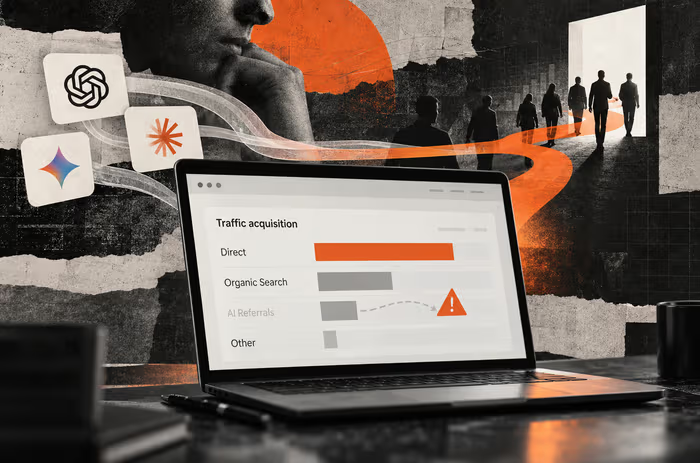
A search for a company’s own name used to be the most predictable page in Google. Over the third quarter of 2026 it stopped being one. Ahrefs checked Google’s US results for the exact names of 100 of the world’s largest brands every week from July to September. On 1 July, five of 98 usable results carried an AI Overview. By 30 September, 63 of 100 did.
Branded search is where buyers go once they already know a supplier’s name: to check pricing, find a login or read up before a sales call. B2B marketing teams have long treated it as the safe end of search, with high intent and a results page the brand largely controls. The Ahrefs data, published on 2 October and backed by two other trackers, suggests Google now places its own summary on that page for most large brands, built partly from pages the brand does not run.
How far have AI Overviews spread on brand-name searches?
Ahrefs’ panel of 100 exact brand names, drawn from Interbrand’s Best Global Brands 2025 list, grew slowly through the summer and then jumped in September. The count stood at 13 at the end of July and again at the end of August, reached 16 shortly before 9 September, rose to 42 on that date and finished the quarter at 63, according to checkpoint figures reported by Search Engine Journal.
Ahrefs puts 48 of the 63 September Overviews in position one, with an average position of 1.49. It does not define what that position measures, Search Engine Journal noted, so the figure cannot confirm whether brands’ own listings moved down the page. Barry Schwartz of Search Engine Roundtable, checking results by hand on 30 September, found most brand Overviews sitting mid-page or lower, with Adobe a rare example at the top.
The company’s larger dataset points the same way. Across 232.8 million US desktop crawls between July and September, 92.5 million of them on branded keywords, the share of branded results showing an AI Overview rose from 61.3% in July to 73.3% in September. On 29 September it reached 82.91%, the single-day figure behind the 83% in Ahrefs’ headline. Non-branded keywords averaged 78.3% in September, so the gap between the two narrowed from 12.2 points in July to five.
Two independent counts land in similar territory. DemandSphere, which tracks branded keywords daily across markets and devices, recorded AI Overviews on 26.12% of them on 1 September and 90.48% on 27 September. Chris Long of the agency Nectiv reported on 30 September that 93 of roughly 100 enterprise brands he tested showed one, though he did not publish the list. Google had made no public statement about the change when DemandSphere published its figures on 1 October.
Which sources does Google use to describe a brand?
Wikipedia is the outside source Google cites most often in brand Overviews. Of the 57 panel Overviews whose source lists Ahrefs could inspect between 16 and 29 September, 41 cited Wikipedia (71.9%), 22 cited YouTube (38.6%) and 13 cited LinkedIn (22.8%). Yahoo Finance appeared in nine, Facebook in six and Walmart in four.
Competitors were largely absent. Only two of 58 full-text Overviews (3.4%) discussed rival companies, and a single verified competitor-owned site appeared across all 57 source lists. For the global brands in this sample, a rival’s comparison page sitting inside the answer to a brand’s own name was rare.
Ahrefs did not report how often brands’ own websites were cited, which is the figure most marketing teams would want first. A domain count also says nothing about who owns the page. A YouTube channel or LinkedIn company page may be run by the brand itself, Search Engine Journal pointed out, in which case those citations are the brand’s own material rather than a third party’s.
The sample also leans towards consumer giants. Interbrand’s list is not a list of B2B software companies, and a mid-market SaaS firm with a thin Wikipedia entry, or none, may see a different source mix. The Ahrefs data cannot say which sources Google would use instead.
What can brand teams measure, and what can’t they?
Google Search Console can track branded traffic but cannot isolate the effect of an AI Overview on it. Its branded queries filter reports clicks, impressions, position and click-through rate for branded searches, using Google’s own definition of “branded”, which site owners cannot customise. Its generative AI performance report, part of the AI visibility reporting Google added to Search Console, shows how often a site’s links appear in AI Overviews and AI Mode but has no query dimension, so brand-name searches cannot be separated from the rest. GA4 files the resulting visits under Organic Search rather than its AI Assistant channel, according to Search Engine Journal.
No click data exists for the Ahrefs panel. The study recorded whether an Overview appeared and what it cited, not what searchers did next. An earlier Ahrefs study, referenced in the new report, found a 58% lower click-through rate for the top-ranking page when an Overview was present, but it measured a different set of queries. A separate study covered by The Helm in July put the loss at 39.8% and found it fell on engaged visitors. Google maintains that clicks from AI Overview results are of higher quality, a position it set out in August 2025.
The checks Search Engine Journal recommends need no new tools. Brand teams can search their exact company name, read the Overview and the pages it references, repeat the search on different days and keep dated screenshots. Communications teams can then review the external pages cited for the brand’s name, starting with the YouTube and LinkedIn pages they already manage. Accuracy already carries legal weight in at least one market, where a German court has held Google liable for false statements in its AI Overviews.
Ahrefs cautions that the current level is not guaranteed to persist, and DemandSphere’s count fell from 90.48% to 80.23% in the 24 hours after its 27 September peak.