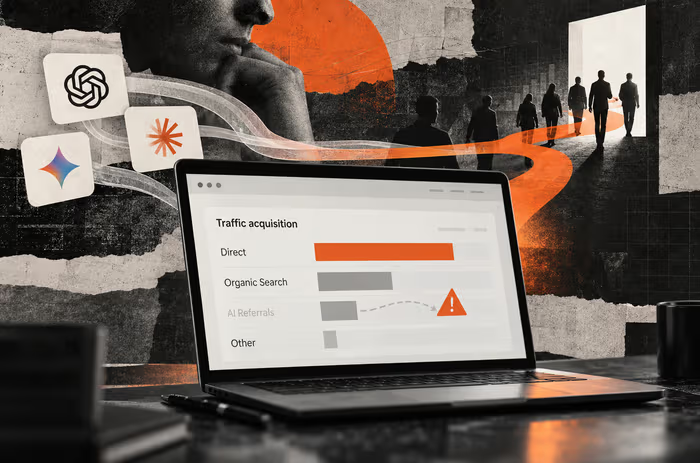
OpenAI tests picture ads in ChatGPT with the measurement advertisers wanted

OpenAI’s ad business is adding pictures. The company said on 5 October that it will start testing visual ads in ChatGPT later this month, shown in the US to users on the Free and Go plans while they generate images, with an initial group of advertisers.
Until now, advertisers in ChatGPT have worked with one format: advertiser name, logo, headline, description, landing page and an image, according to Digiday. The new unit is built around product photography: a product in use, or the experience it promises. OpenAI says the ads will be clearly labelled and kept separate from the image a user is creating, and that, as with its other formats, “advertising does not influence the answers ChatGPT provides”.
The measurement changes in the same announcement are likely to matter more to B2B budgets than the format. OpenAI expanded its conversion-data integrations and attribution partners and opened brand-suitability pilots with DoubleVerify and Integral Ad Science. Advertisers have been asking for those since OpenAI began selling ads in February, as AI assistants started turning into an ad channel. Digiday reported in September that without a way to tie ChatGPT campaigns to outcomes, most advertisers were keeping spend to contained tests.
What exactly is OpenAI testing in ChatGPT?
OpenAI is testing an image-led ad unit that appears during image generation, when a ChatGPT user asks the model to create a picture. The ad sits beside the generated image, not inside it. The test is narrow on three counts: US users only, the Free and Go plans only, and an unnamed initial group of advertisers. Plus and Pro subscribers are not part of it.
OpenAI has given no start date beyond “later this month”, and had not announced by 13 October that the test was live. It has not published how test advertisers are chosen, minimum spend, pricing or creative specifications for the format. Businesses can register through ads.openai.com, the general sign-up route for ChatGPT Ads, though OpenAI has not said whether that leads to a place in the visual test.
OpenAI puts ChatGPT’s reach at 1.2 billion people a week. That is weekly reach across every market and plan. The audience for this test is a slice of it, defined by country, by plan and by the act of making an image.
On placement, OpenAI says its guardrails assess whether a conversation suits advertising, to keep ads out of emotionally vulnerable or sensitive contexts. For brand-specific rules, a Negative Phrases control is now available to “qualifying advertisers”, with the qualifying criteria unpublished. The announcement does not set out which signals decide the ad a given user sees.
How does ChatGPT’s measurement change for advertisers?
OpenAI’s measurement update connects ChatGPT Ads to systems marketing teams already run. Integrations with Hightouch, Tealium and LiveRamp let advertisers send conversion data from existing tools into ChatGPT Ads. Ten attribution partners, including AppsFlyer, Adjust, Northbeam, Kochava, Branch and DV Rockerbox, now support conversions API, reporting and click attribution. Fospha, Measured and INCRMNTAL cover full-funnel measurement. Geo-based incrementality experiments with Haus, Measured and WorkMagic are, by OpenAI’s own account, at an early stage.
OpenAI also published early results from those partners. According to DV Rockerbox, WeightWatchers’ attributed cost per acquisition on ChatGPT Ads was 15.3% below its blended paid-search benchmark. WorkMagic reported statistically significant lift for wellness brand Dose, with 67% of incremental purchases coming from net-new customers. Triple Whale said 93% of Portland Leather’s visitors from ChatGPT Ads were new. The figures come from OpenAI’s partners via OpenAI, with no sample sizes or test periods given, and all three advertisers sell to consumers.
For B2B teams the integrations are the more useful part. A team that already pipes CRM conversions to ad platforms through a tool such as Hightouch or LiveRamp can now send the same events to ChatGPT Ads. That is the step needed before ChatGPT can be judged on cost per opportunity alongside search and LinkedIn, rather than on clicks alone.
Is ChatGPT a serious B2B paid channel yet?
ChatGPT is not yet a proven B2B paid channel, and the visual test does little to change that on its own. The format suits things that photograph well, such as a meal kit, a jacket or a holiday. Software is harder to sell in a single picture; a SaaS product tends to show best as an interface, a workflow or an outcome. The first placement also sits inside a creative task, making an image, which is not obviously a moment when buyers research software.
Supply is the other limit. Shamsul Chowdhury, executive vice-president of paid social at Zeno Group, told Digiday that ChatGPT handles about 2.5 billion prompts a day against roughly 15 billion Google searches, with one ad placement where Google has several. In his words, “it all leads to a disconnect between supply and demand”. A second placement eases that mainly for advertisers whose products suit an image.
For B2B marketing teams, the practical reading is that the format is one to brief creative teams on, since product-in-use imagery is a different job from a logo-and-headline unit. The conversion plumbing is the part to act on, for any team already running text ads in ChatGPT, because it will decide whether the channel earns more than a test budget. OpenAI says further formats and capabilities will follow, but it has named none.
OpenAI timed the announcement for the start of Advertising Week New York, where its executives were gathering marketers’ feedback on the product, and it has not said whether the visual format will extend beyond image generation or outside the US.