AI Overviews cut clicks 39.8% — and take engaged visitors, not idle ones
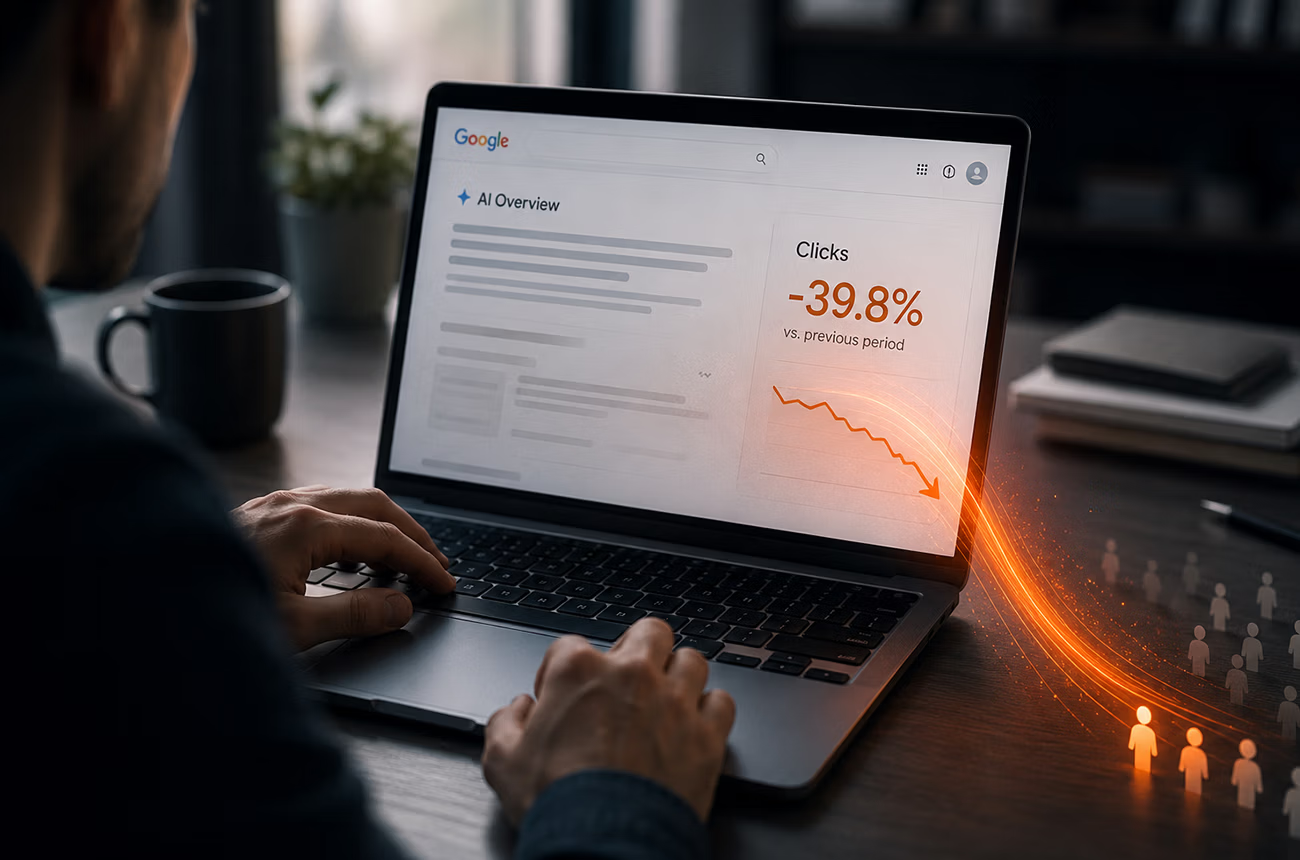
For two years the argument over what Google’s AI Overviews do to web traffic ran on correlation. A randomised field experiment has now put a causal number on it: when an AI Overview appears, organic clicks to websites fall by 39.8%, and the share of searches that end without any click rises from 54% to 72%.
The finding matters because Google has consistently argued that the clicks its summaries absorb are low-value ones, visitors who would have bounced anyway. The same experiment tested that defence directly and found the visits lost when Overviews appear are no less engaged than the ones that survive. For marketing teams watching organic traffic slide, it reframes the decline as real, engaged demand rather than noise — and moves the question from whether the loss is happening to where the demand goes instead.
What the experiment found
Saharsh Agarwal of the Indian School of Business and Ananya Sen of Carnegie Mellon’s Heinz College built a Chrome extension and randomly assigned 1,065 US users either to see AI Overviews as normal or to have them hidden in real time. Because assignment was random, the design isolates the effect of the Overview itself, rather than the correlations earlier work had to rely on. Data collection ran from 7 January to 10 February 2026; the paper went up on SSRN on 3 April and was revised on 17 June, when the headline figure moved from an initial 38% to 39.8%.
Across the study, AI Overviews were triggered on about 41% of queries, and where they appeared, sponsored clicks were untouched while organic clicks fell. That pattern separates this from the correlational measures that came before it, such as Pew Research’s finding that users click 8% of the time with an Overview present against 15% without, or Ahrefs’ report of a 58% drop in click-through rate for top-ranking pages. The paper is a working draft and has not yet completed peer review.
Why the “low-value clicks” defence does not hold
Google’s public answer to falling traffic has leaned on quality, with search VP Liz Reid arguing that Overviews mainly remove “bounce clicks” while offering no data to support it. The revised paper tested that claim on its own terms, comparing three measures for the clicks in question: how often people hit the back button to return to results, how often a visit ended within 10 seconds without interaction, and total time on the destination site. None showed a statistically significant difference. Roughly four in ten same-tab clicks returned to the results page in both conditions, about 18% of visits ended within 10 seconds either way, and time on site was indistinguishable.
The authors write that the result is “at odds with the view that AIOs primarily eliminate low-engagement website visits”. The damage is also uneven: losses concentrate in informational queries, where Overviews were triggered on 53% of searches, against 15% of navigational and 6% of transactional ones. When a top-of-page Overview was removed, the top three organic results gained the most, with the first position nearly doubling its clicks.
What it means for B2B marketing teams
Informational queries are where the effect bites hardest, and that is precisely the top-of-funnel explainer and comparison content B2B teams publish to be discovered. Treating that organic traffic as genuinely at risk, rather than assuming it was weak to begin with, is the honest starting point. The practical response points the same way several of the year’s other developments have: toward acquisition marketers control more directly, including email capture, branded and direct demand, community, and visibility inside AI answers themselves.
That last point carries a sharp distinction. A brand cited as a named source inside an Overview still collects the fraction of users who click through; a brand merely summarised without attribution collects nothing, which makes citation, not ranking alone, the metric that decides how much of an informational query’s traffic survives. The usual caveats apply: this is a single study, run on US desktop Chrome users, and still a working draft.
The authors expect the effect to grow as AI Overviews appear on more queries over time. Their paper is the strongest causal evidence yet on the question, and, for now, the one Google has not answered with data of its own.