LinkedIn says AI cites point of view over format, but its stats don’t add up
LinkedIn’s head of marketing has told B2B marketers that formatting content for AI answers is now the minimum, and that what earns a citation from ChatGPT or Perplexity is a perspective no one else could have written. Davang Shah, the platform’s vice president of marketing, made the case on 29 September in a LinkedIn Marketing Blog post titled “Why Your Brand Needs a Point of View AI Can’t Replicate”, according to a 10 October report by the trade site PPC.land.
The argument arrives as B2B research moves into AI assistants. Forrester’s Buyers’ Journey Survey 2025 found that 94% of buyers use AI somewhere in their buying process, up from 89% a year earlier, and content teams are under pressure to appear in those answers. It also comes from a company that sells advertising and benefits when brands publish more on its platform, at a time when organic reach on LinkedIn is already falling. Traced back to their sources, the numbers Shah uses to make the case are uneven.
What did LinkedIn’s Davang Shah claim about AI citations?
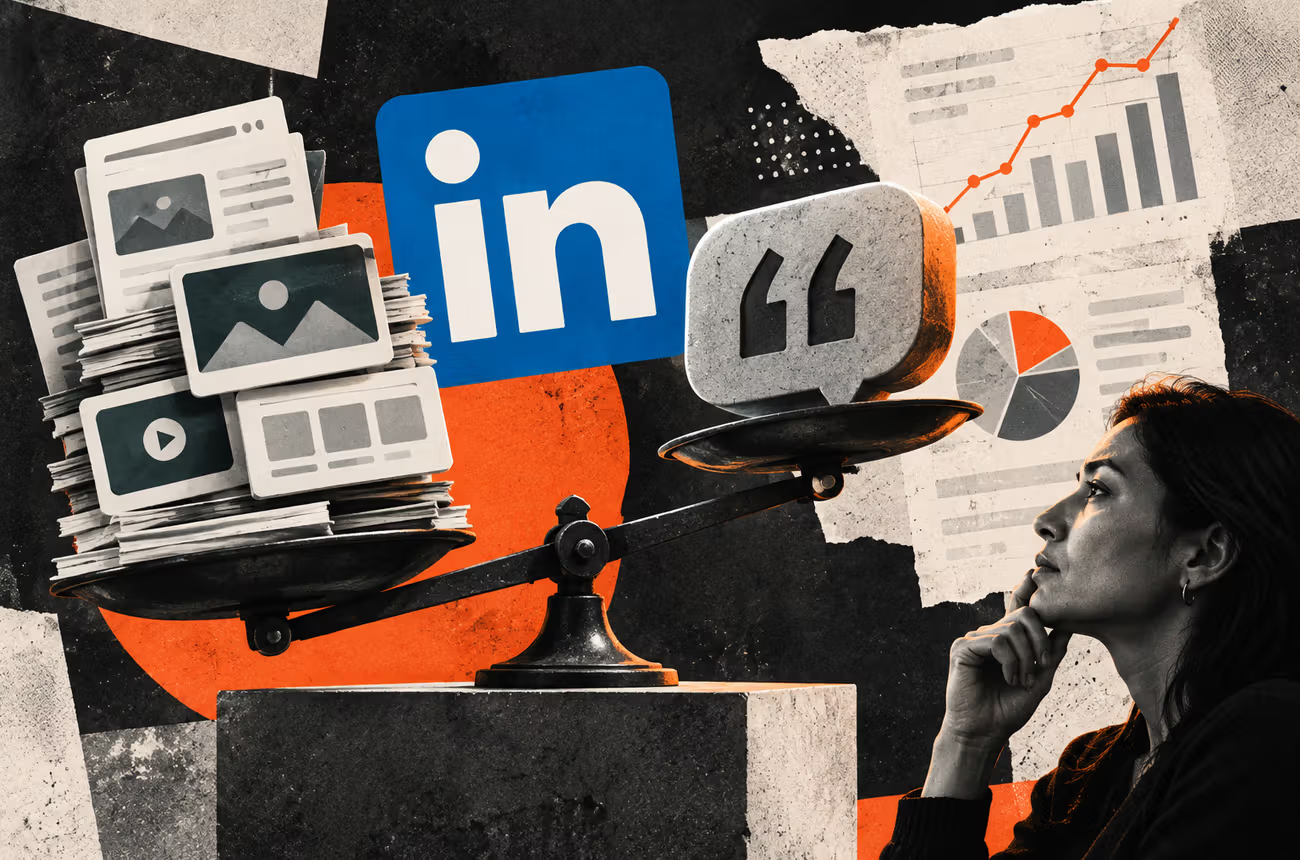
Davang Shah argues that structure has become “table stakes” for AI visibility. His reasoning is that once every brand in a category uses the same headings, lists and answer blocks, structure stops telling a model anything new, so the model reaches for information it cannot assemble from elsewhere. “Formatting your content for extraction is the entry fee,” he wrote, adding that unique information gets cited while common information is skipped.
The post says Shah’s team spent nearly a year researching how AI systems choose sources. PPC.land found no methodology, query counts or published findings behind that work. The piece ends by promoting a download, “Unlocking AI Search Visibility: The B2B Marketer’s Guide to LinkedIn”, which PPC.land describes as gated.
LinkedIn’s own earlier advice leans the other way. When Shah launched the same guide in an 11 August blog post, its checklist led with clear headers, direct-answer blocks and question-style subheadings, alongside a distinctive point of view. It also set targets of 800 to 1,200 words for LinkedIn articles and two to three posts a week. None of those prescriptions came with evidence that they change citation outcomes.
Do the statistics in LinkedIn’s post check out?
Shah’s post draws statistics from five named organisations, and only one carries a visible source line. That one is a 2025 thought-leadership study LinkedIn produced with Edelman, which found 86% of decision-makers are more receptive to outreach from a company that publishes strong thought leadership. LinkedIn co-produced the research it is citing.
Meltwater’s figures are partly verifiable. Its 12 May release, based on 9.5 million AI citations across 16 B2B categories, confirms that LinkedIn was the second most-cited source after YouTube and that 51% of LinkedIn citations came from members with fewer than 10,000 followers. The post also attributes to Meltwater an analysis of the 24 most-cited LinkedIn articles: all used bullets or numbered lists, 93% used H2 or H3 headings, 75% named specific companies or tools and 67% included hard numbers. That breakdown does not appear in Meltwater’s release, and PPC.land points out that 93% cannot come from a sample of 24. Twenty-two articles would be 91.7%; 23 would be 95.8%.
The Semrush figure does not match either. Shah cites 300,000 citations. Semrush’s March 2026 LinkedIn study analysed 325,000 prompts and found 89,000 unique LinkedIn URLs. A separate Semrush content study from January sampled 304,805 AI-cited URLs, which may be the source, but the post does not say. The Forrester figure is genuine, traceable to the 2025 buyer survey, though the post gives no link. The Ipsos reference carries no figure, title or date at all.
Most of the detailed data in the post measures formatting. Lists, headings, named companies and hard numbers are also the traits Meltwater’s own release attributes to frequently cited LinkedIn content.
What does independent research say about formatting versus point of view?
Semrush’s January study is the closest independent test of what separates cited pages from the rest. It compared 304,805 URLs cited by ChatGPT Search, Google AI Mode and Perplexity with 921,614 pages ranking in Google’s top 20 for related keywords, scoring each on 13 text features. Cited pages scored 32.83% higher on clarity and summarisation, 30.64% higher on expertise and trust signals, 25.45% higher on question-and-answer format and 22.91% higher on section structure. Semrush describes these as associations rather than causes, and the study did not measure originality as a feature.
Semrush’s LinkedIn study offers partial support for Shah. It found LinkedIn URLs in an average of 11% of AI responses: 14.3% in ChatGPT Search, 13.5% in Google AI Mode and 5.3% in Perplexity. About 95% of cited LinkedIn posts were original rather than reshares, and long-form articles made up 50% to 66% of cited LinkedIn content against 15% to 28% for feed posts. That points to original, substantial writing doing well, but it compares originals with reshares, not a point of view with good structure.
Neither study shows that a perspective outranks formatting. What the evidence supports is doing both: content that is clearly organised and answers questions early, carrying material a competitor could not reproduce, such as first-party customer data or a named expert’s analysis. PPC.land called Shah’s thesis a plausible hypothesis that his own evidence leaves unproven.
Shah recommends that marketing teams track citations, share of voice and sentiment in AI answers. PPC.land notes that this kind of measurement is still a gap for most B2B teams, and AI visibility data still cannot be tied reliably to sales.
As of 13 October, The Helm could find no Meltwater publication containing the 24-article breakdown, the most detailed formatting data in Shah’s post.