Google’s AI gets Lily Ray’s SEO title right, citing her own site to do it
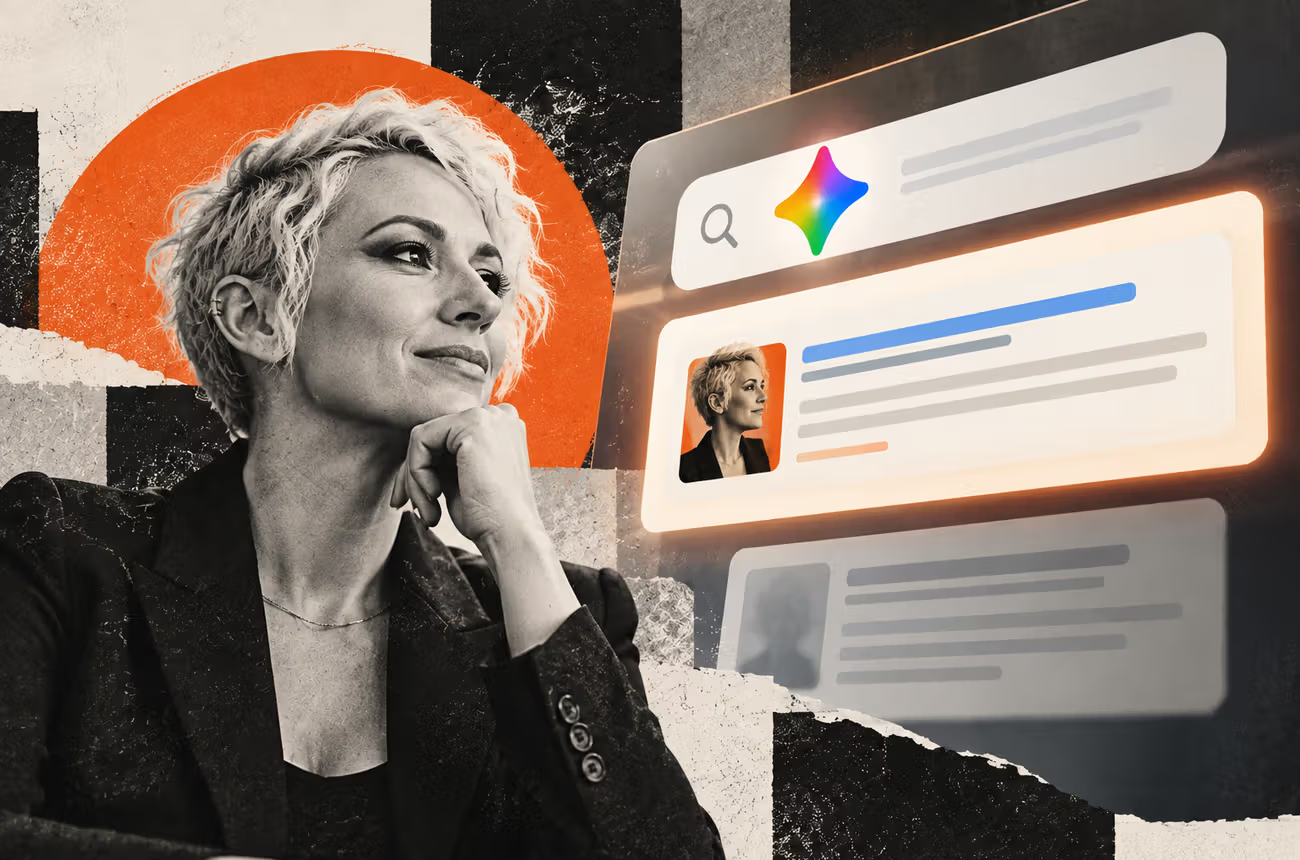
Lily Ray has spent more than a year arguing that Google’s AI answers trust companies too readily when they rank themselves. On 28 September she posted the counter-example on X: screenshots of Google’s AI Overview confirming her own SEO World Champion title, captioned “No listicles required”.
Ray, who launched the search consultancy Algorythmic in March, was voted the best presenter of the year by fellow delegates at SEOktoberfest, an invitation-only summit held at the Stanglwirt resort in Austria from 20 to 25 September. Host Marcus Tandler announced the result on X on 25 September and published the full standings on LinkedIn, according to PPC Land, which reported the episode on 30 September. Ray took the title from Eric Wu, who had held it for two years. Jono Alderson finished second and Jes Scholz third.
Google’s answer was accurate. The sourcing is the story. In the screenshots PPC Land examined, the sentences about the award linked to Algorythmic, Ray’s own site, rather than to Tandler’s announcement or any other independent record. That is the sourcing pattern Ray has criticised in self-promotional “best of” lists, and it lands as B2B marketing teams work out how much of their AI search visibility rests on what they publish about themselves.
What did Google’s AI Overview cite for Lily Ray’s title?
Google’s AI Overview attributed the award claim to Algorythmic, according to PPC Land’s reading of Ray’s screenshots. The answer stated that Ray had won the top SEO World Champion award at SEOktoberfest 2026, then added three supporting points on her presentation, the event and her professional roles. The event description cited LinkedIn plus one collapsed source, and the role details cited the Athens SEO conference site plus another.
Those collapsed “+1” links matter. PPC Land could not identify every source behind them, so Tandler’s LinkedIn standings may have informed the answer without appearing as a visible citation. A screenshot shows what Google displayed at one moment. It cannot show which documents the system actually relied on, and Google has not commented on this answer.
Ray’s own write-up, published on Algorythmic on 28 September, describes the title as one of the hardest awards in SEO to win. Independent confirmation of the result exists on Tandler’s X and LinkedIn accounts. Google’s visible award citations pointed to the winner’s site instead.
Why does a single visible source stand out in AI Overviews?
Google’s AI Overviews usually spread their citations across several sites. Scrunch, which sells AI visibility monitoring, reports from more than 442 million citation events tracked between December 2025 and March 2026 that 88% of AI Overview responses cited at least three sources. An award claim resting visibly on the winner’s own domain is unusual, even when the claim is true.
Google’s public documentation says its systems choose supporting links automatically, and that a page must be indexed and eligible for a search snippet to qualify. It describes no separate test for credentials, awards or self-descriptions, and nothing in it explains why one source rather than another carries a particular sentence.
Earlier tests show where that gap leads when a claim is false. In March, SEO practitioner Jon Goodey published an article about a Google core update that never happened, and Search Engine Journal reported that Google ranked it and its AI answers repeated the invented details as fact. PPC Land also points to a BBC reporter’s fabricated ranking of tech journalists by hot-dog eating, which surfaced in Google’s AI answers within a day. Ray’s title is the harmless version of the same mechanism: a well-placed page from an interested party becomes the citation of record.
What does it mean for B2B brands that publish their own rankings and awards?
Self-ranking still works, in a narrow sense. A separate Scrunch study published on 24 September examined roughly 10,000 URLs cited by seven AI assistants, including ChatGPT, Claude, Perplexity and Google AI Overviews, between 17 May and 30 June 2026. When a company’s list ranking itself first was cited, the assistant recommended that company about 7% of the time, against about 4% without the citation, and mentions rose from about 19% to 39%. Scrunch called the lift modest. Its causal figures rest on a capped sample of about 6% of eligible data, and the mention effect had not yet passed its own falsification test.
The same data carries a warning. In 24.3% of answers that cited a self-ranking list, a competitor was recommended instead of the list’s author, although Scrunch’s testing suggested this mostly reflected existing momentum rather than the list itself. Kevin Indig’s analysis of 5.32 million search results, published on 24 August, found that 62% of vendor-written listicles had gained estimated organic traffic since January, according to PPC Land’s summary of the paywalled study.
Ray’s position, set out in May according to PPC Land, separates declaring a product the best from being named the best by others. The SEOktoberfest episode shows that this distinction does not carry through to an AI answer automatically. A credential with a named organiser, published standings and third-party coverage gives Google more to cite than the winner’s own announcement, but only when the organiser’s record is indexed and easy to find. Ray’s title had an X post and a LinkedIn post from the host behind it. Neither was visible among the award citations in her screenshots.
At the time of writing, SEOktoberfest’s own website listed its 25 experts and 30 attendees, but no 2026 results.