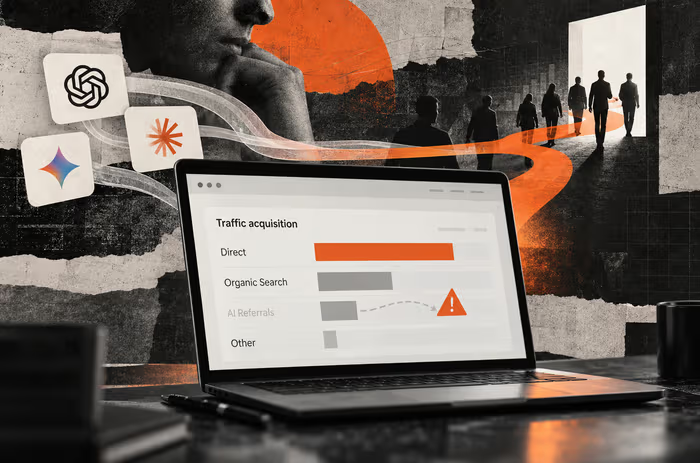
Gemini starts tagging links with UTMs, a second route to AI visits in GA4
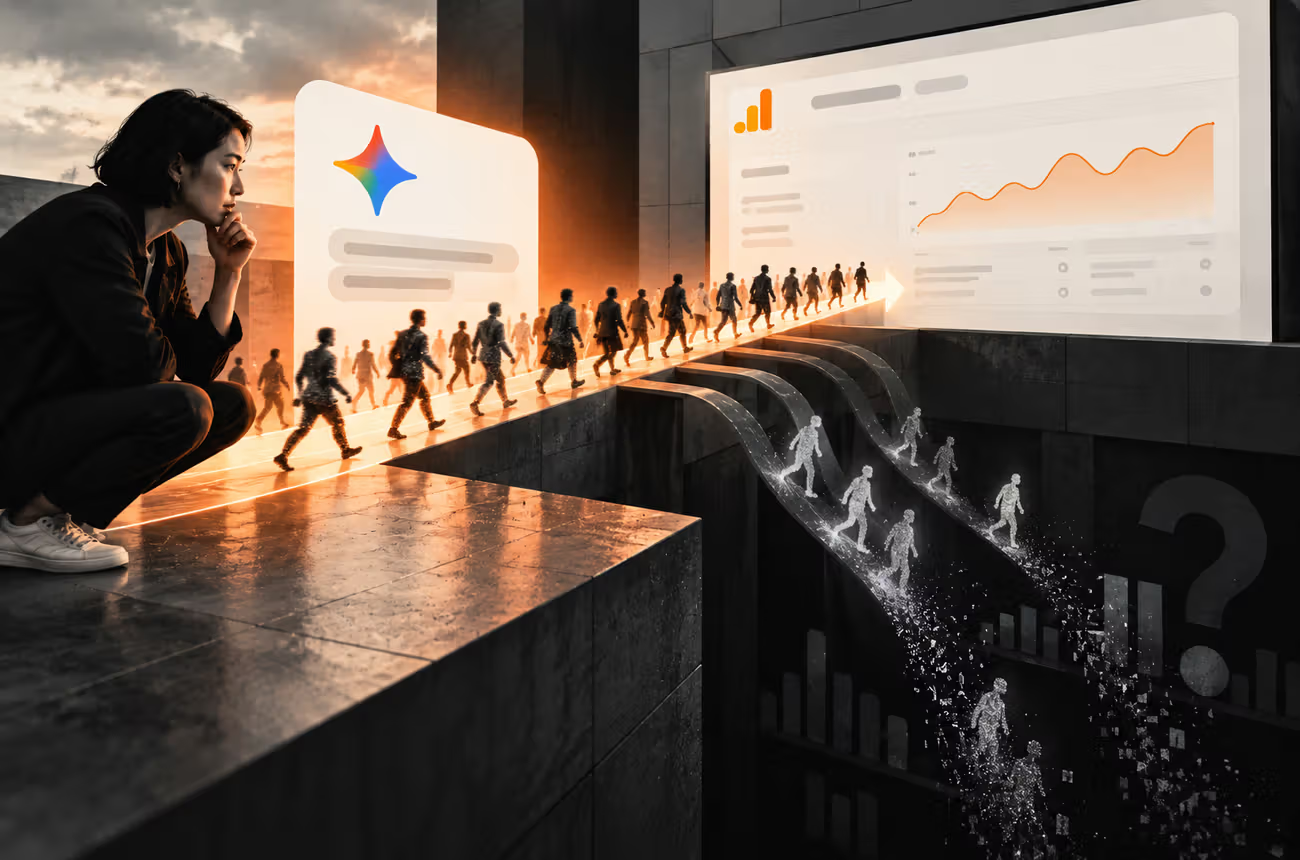
Gemini’s referral traffic has picked up a paper trail. On 1 October, Search Engine Journal reported a Reddit sighting of UTM parameters on links clicked from Google’s AI assistant, and John Mueller, a search advocate at Google, replied in the thread that he could see them too.
The change lands on a measurement problem marketing teams already know well. Google added an AI Assistant channel to GA4’s default channel group on 13 May 2026, but that channel depends on the browser passing a referrer, and a visit with no referrer has nothing to match against. Those sessions fall into Direct. A UTM parameter travels inside the URL itself, so it can survive where a referrer is stripped. If Gemini’s tagging holds, a share of the AI-sourced traffic currently sitting in Direct becomes countable. Google has not said which links are tagged, what values the tags carry, or whether the behaviour is permanent.
What has Gemini changed, and how firm is the evidence?
Gemini appears to be appending UTM parameters to at least some outbound links, based on one community report and one Google employee’s acknowledgement. The original post, in Reddit’s r/SEO community, described the behaviour as about 24 hours old when Search Engine Journal’s Roger Montti covered it on 1 October.
Mueller’s reply is the strongest corroboration available. He wrote that he saw the tags, then asked whether Gemini did not already pass a referrer that sites could track. In a follow-up he offered to forward reproducible examples of referrer problems to the relevant team, adding that it would be good to keep referrers as well as the new tagging. That is an informal confirmation from a Google staff member in a public thread. It is not a product announcement, and it says nothing about scope.
The Marketing Helm found no Google announcement, help article or changelog entry describing the change as of 13 October. Search Engine Journal’s original report did not list the parameter values observed, and later posts from SEO agencies and tool vendors cite differing source and medium values without showing the tests behind them. Until Google publishes a specification, the defensible reading is that Gemini has been observed tagging some links, on some surfaces, with values that teams need to check for themselves.
Why do the tags matter when GA4 already has an AI Assistant channel?
GA4’s AI Assistant channel identifies visits by referrer alone. According to Google’s documentation, GA4 sets the medium to “ai-assistant” and the campaign to “(ai-assistant)” when the referring site matches its list of AI assistants, which includes ChatGPT, Gemini, DeepSeek, Copilot and Grok. The channel then groups any session whose medium exactly matches “ai-assistant”. Visits from Google’s AI Overviews and AI Mode are excluded and counted as Organic Search.
The weak point is mobile. In the same Reddit thread, a commenter posting as CrawlWarden claimed the Gemini referrer mostly survives only on desktop web, that the Gemini mobile app passes it around 9% of the time, and that Android assistant invocations strip it entirely. The same commenter said the UTM parameters survive Gemini’s in-app browser and show up in raw server logs. None of those figures comes with a sample size, test dates or device breakdown, and The Marketing Helm could not verify them. They are worth testing rather than quoting in a board report.
ChatGPT offers the nearest comparison. Search Engine Journal notes that ChatGPT adds UTM parameters only to links in answers grounded in web sources, not to answers drawn from the model’s training data. Practitioners have reported “utm_source=chatgpt.com” on ChatGPT’s cited links since 2024, including one GA4 analysis of 100 ecommerce brands run by the agency StudioHawk, although OpenAI’s own help pages do not document the tag. Gemini’s trigger conditions are unknown.
How the two signals interact inside GA4 is also unresolved. If Gemini’s tagged links set the medium to exactly “ai-assistant”, those visits would meet the channel rule. If they carry a different medium, they would appear as their own source and medium row, possibly outside the AI Assistant channel. Google has not said which applies.
What should marketing teams check in GA4 now?
Marketing teams can find out what Gemini is sending by looking at their own data rather than relying on reported values. The Traffic acquisition report in GA4, filtered by the session source / medium dimension, will show any new Gemini-related rows alongside the existing AI Assistant channel. Searching that dimension for “gemini” catches variants, where hard-coding an assumed value would not.
Landing page URLs and server logs show the full query string, which is the most direct way to see the exact parameters. For B2B sites where AI visits are a small share of sessions, a handful of logged requests may say more than a month of aggregated reports.
A dated baseline taken now gives the change something to be measured against. Recording the AI Assistant channel, any Gemini source and medium rows, and Direct traffic to the pages AI tools cite most often will show whether the tagging moves anything over the coming weeks. Tagged and referrer-only Gemini visits are separate signals, and keeping them apart until the overlap is understood avoids counting one visit twice. A tagged session also proves only a click from Gemini. Any claim that Gemini influenced a deal still needs CRM data behind it.
The same measurement gap has already pushed affiliate networks to build their own tracking: Awin’s partnership with ScalePost was set up to measure the AI-led discovery that last-click attribution misses. For B2B brands still working out how often they appear in AI answers at all, as The Marketing Helm’s reporting on the AI citation gap found, visible Gemini clicks are a narrower but harder number.
Mueller has asked for reproducible referrer examples to pass to Google’s Gemini team. Google has not said whether the tagging is permanent, which links it covers, or whether the Gemini app will start passing referrers as well.