B2B brands rank for thousands of keywords but are cited in 3% of AI answers
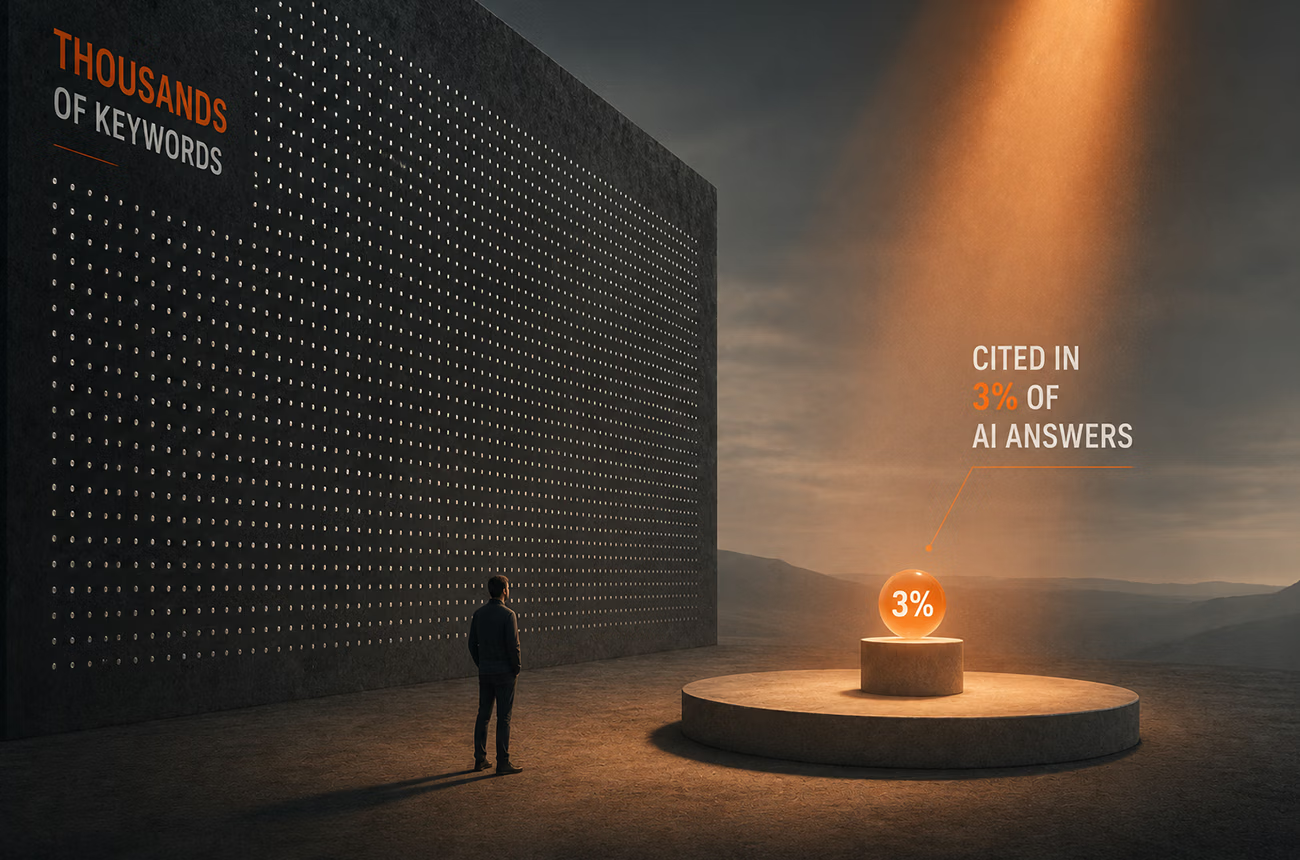
The median enterprise B2B brand ranks for around 9,700 keywords in Google. According to a benchmark of 828 companies published by the B2B agency Walker Sands in April, that same brand is cited in just 3% of the AI-generated answers it is relevant for, a gap between traditional search visibility and AI visibility that is fast becoming the more important of the two.
The timing is what gives the finding weight. In Forrester’s State of Business Buying 2026, drawn from a survey of more than 17,500 global buyers, generative AI and conversational search overtook vendor websites, product experts and sales contact as the most meaningful source buyers use to research purchases; the share of B2B buyers using AI in the process rose to 94%. When the shortlist is increasingly assembled inside an AI answer before a buyer visits any website, a 3% citation rate means most brands are absent from the conversation at the point it is decided.
What the Walker Sands benchmark measured
Walker Sands analysed nearly 45 million relevant keywords across 828 enterprise B2B companies in 14 industries, then tracked how the visibility narrows at each step. The median company ranks for about 9,700 keywords; roughly half of those trigger an AI Overview; and of those, the brand is cited in around 3%, close to 135 citations from a starting position of thousands of rankings. Top-quartile brands rank for more than 37,000 keywords, but breadth of ranking does not predict whether a brand is cited. As John Fairley, the firm’s senior vice-president of marketing operations and SEO, put it, “ranking breadth alone doesn’t predict citation inclusion”.
The gap is not uniform. Cybersecurity brands earn the highest share of citations, helped by a steady supply of third-party coverage; professional services rank lowest, ceding the answer to publishers and analysts. The benchmark is Walker Sands’ own, and the agency sells services to close exactly this gap, so its framing is not disinterested. The underlying pattern, though, that strong organic rankings are not converting into AI citations, recurs across independent datasets. Walker Sands projects that generative AI will influence more than 75% of B2B search queries within one to two years; if even roughly right, the 3% figure is an early-market snapshot rather than a settled state.
Why strong SEO doesn’t translate into AI citations
The signals that win AI citations are mostly ones traditional SEO ignored. In a 2025 study of 75,000 brands, Ahrefs found that unlinked brand web mentions correlated with AI Overview visibility at 0.664, against 0.218 for backlinks, roughly three times stronger. The three highest-correlating signals were all off-site brand signals: web mentions, branded anchor text and brand search volume. Ahrefs is a search-optimisation platform rather than an earned-media agency, which makes the finding harder to dismiss as advocacy. A separate Muck Rack analysis of more than a million AI citations found over four in five came from earned media rather than a brand’s own pages.
Correlation is not causation, and mentions cannot simply be manufactured, as AI systems are increasingly able to tell editorial coverage from placement. But the mechanism is intuitive: an AI engine grounds its answer in the third-party pages it has indexed as credible, so a brand widely discussed in trusted publications is more likely to be named than one that has published more pages on its own domain. The volume of content on a brand’s own site has almost no bearing on whether it is cited. That reorders a decade of off-page strategy built around acquiring links.
What this changes for marketing teams
The practical shift is where the marginal pound goes. A budget built to acquire backlinks and publish more owned pages is optimising for signals that move organic rankings but not AI citation; the same money spent on earned coverage, category presence and third-party credibility maps more closely to what AI engines reward. This does not retire SEO, since rankings still determine whether a brand is eligible to be cited at all, but it adds a second discipline alongside it rather than swapping one tactic for another.
It also does not mean abandoning the human side of the buy. Forrester’s data shows buyers using AI as a starting point and then validating its output against peers and industry experts, with a fifth reporting less confidence when AI returned unreliable information. The brands that benefit are those whose authority is legible to both the machine assembling the answer and the buying group checking it. For a marketing manager, the useful reframing is narrow: the question is no longer only whether a brand ranks, but whether it is in the answer at all.
That window is open but contested. On Walker Sands’ own projection, the share of B2B queries shaped by generative AI will more than double within two years, which is either an opening for brands that build earned authority now or a widening gap for those that wait. Whether a brand can convert years of editorial relationships and category presence into citations before the market settles is the question the benchmark leaves unanswered.