Microsoft Clarity ranks AI citation topics on a share that skips zero days
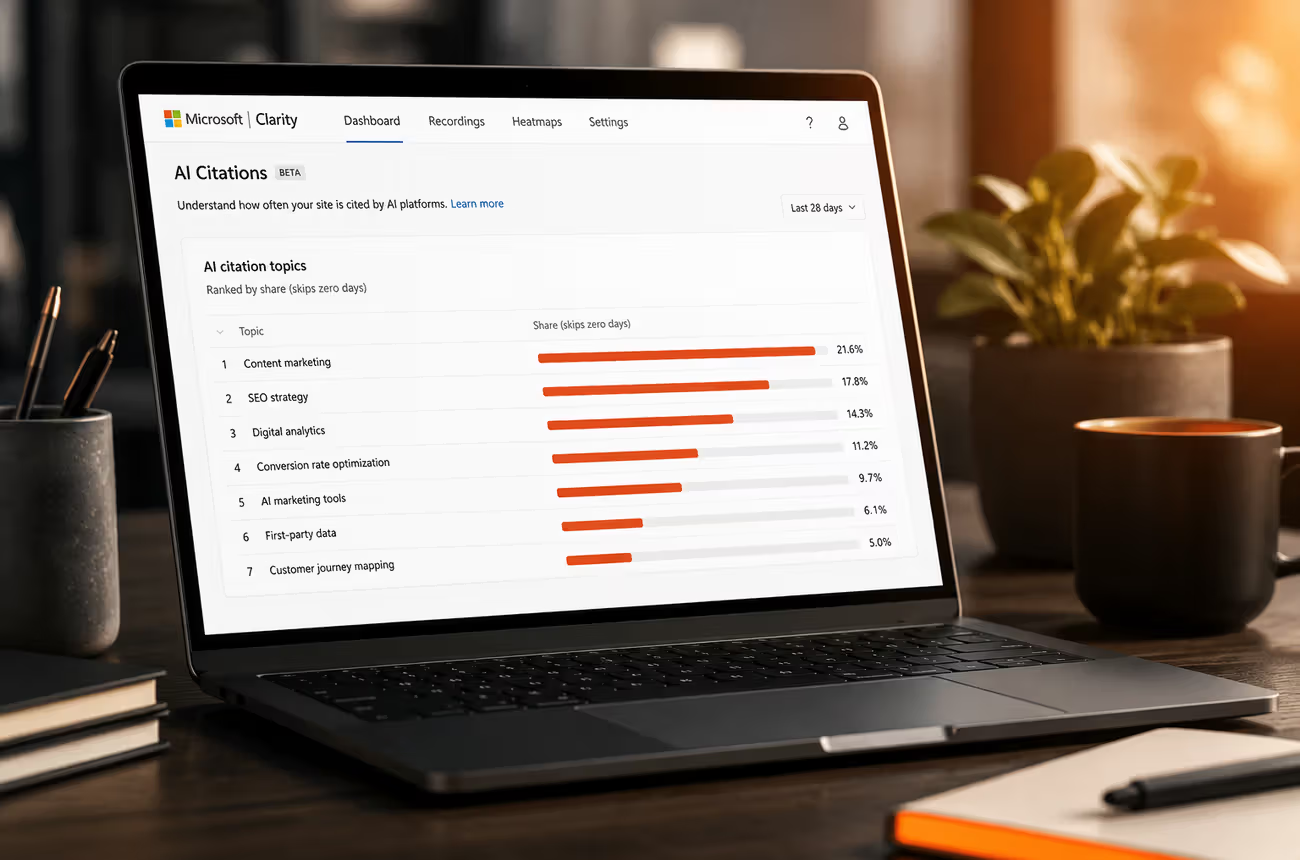
Microsoft’s third attempt in five weeks to make AI citation data readable arrived on 22 July, inside an analytics tool most marketing teams already have installed. Query Topics, now in beta within Microsoft Clarity, groups the grounding queries that pull a site into AI-generated answers into automatically generated themes, then attaches two numbers to each: a citation count and a share of authority.
The ranking is the point, and the reason to read the second number carefully. Marketing teams have spent six months acquiring AI visibility data faster than they have acquired ways to interpret it, and share of authority is the first metric in that stack that looks like a competitive score. Microsoft’s own documentation defines it as a daily, participation-weighted calculation that drops the days a domain earned no citations at all, which means it reads highest in the themes where a site’s presence is most intermittent.
What does Query Topics add to Clarity’s AI Citations dashboard?
Query Topics adds four things to the existing Citations view, according to the Clarity blog post published on 22 July: a topics card inside the dashboard, citation count and share of authority attached at topic level, a filterable topic list showing page-level citation distribution, and export.
The classification runs off the project’s own citation record rather than a fixed taxonomy. Microsoft’s example describes a broad topic such as Sports breaking down into narrower themes like Winter Skiing, generated from patterns in a site’s own citation data rather than assigned from a list.
The illustration Microsoft published with the announcement shows why the two metrics travel together. All-mountain skis carries 10,800 citations at 24.1% share of authority; ski jackets carries 1,200 at 23.6%. Nine times the citation volume, near-identical share. Snowboards sits at 4,300 citations on 14.8%, roughly four times the volume of ski jackets on a materially lower share. Those are illustration figures rather than measured results, but they demonstrate the mechanic: volume and share move independently, and a report carrying only one of them misleads on the other.
Export is the least visible change and the most operationally consequential. It decides whether topic-level citation data enters the monthly reporting pack a marketing team already produces, or stays inside an interface someone has to remember to open.
How does Microsoft calculate share of authority?
Microsoft defines share of authority as a domain’s citations divided by the total citations from all domains, then applies that calculation at a daily level and only on the days the domain actually appeared. The Clarity documentation, last updated on 12 May 2026, sets out the condition: if a domain is cited for a query on a given day, every citation instance for that query that day is counted; if it is not cited, that day is excluded from the calculation entirely.
Microsoft states the consequence itself, in the same paragraph. The approach focuses on active participation, the documentation says, and may produce higher share-of-authority values than a broader calculation would.
The practical effect is that share of authority measures weight when present, rather than presence across a theme. A site cited on three days out of thirty for a given topic is scored on those three days; the twenty-seven days it was absent do not dilute the figure. Two sites can post an identical share while one is cited continuously and the other appears occasionally and well. That difference is invisible in the topic ranking and visible in the citation count beside it, which is the argument against ever reporting either number alone.
Two further limits sit underneath the aggregates. Microsoft acknowledged at the February launch of Bing’s AI Performance dashboard that citation query data represents a sample rather than a complete record, and topic-level totals inherit whatever that sample carries. Microsoft has also not published the method behind the topic classification, so the boundary between one theme and an adjacent one is a modelling decision no one outside the product team can inspect.
How is this different from Topic Insights and Bing’s Topics?
Topic Insights, added to Clarity on 9 July, works from themes a team defines in advance and reports where competitors are winning citations inside them. Query Topics runs the other way, reporting the themes already generating citations, including ones nobody thought to track. Microsoft frames the pair as answering two questions: where a site currently earns visibility in AI experiences, and where the openings to improve are.
Bing Webmaster Tools makes a third. Its Topics view, in global preview since 16 June, sorts AI citation queries into predefined categories, and shipped alongside a metric called Citation Share — the proportion of citations a site earns for a grounding query across all cited sources. That is a different calculation from Clarity’s share of authority, under a different name, in a different product from the same company.
Three topic groupers across two Microsoft products in five weeks leaves marketing teams reporting AI visibility with an attribution problem of their own. A share figure quoted in a board pack now needs the product and the metric named beside it, or it will not be comparable with the same figure a quarter later.
The distribution model is at least consistent. Topic Insights arrived at no cost to every Clarity user, at a point when competing AI visibility vendors reserve comparable competitive analysis for paid tiers, and Query Topics follows it into the same free product.
Query Topics remains in beta. Microsoft has not published a general availability date.