Meta launches Muse Charm hardware and signs Walmart, Sephora as partners
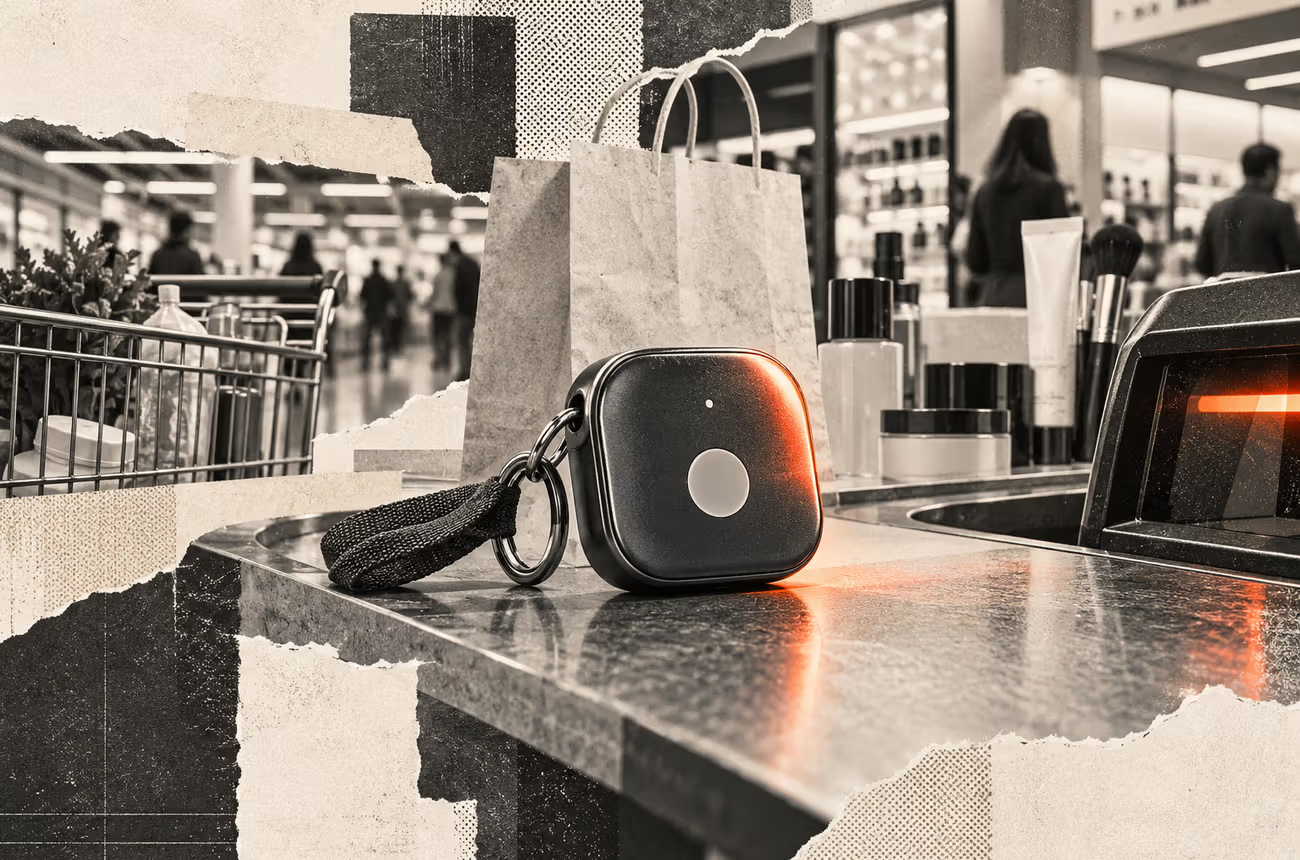
Meta announced Muse Charm at its Connect 2026 event on 23 September, describing it only as “a delightful and fun device built for you to talk and interact with your Muse,” powered by what it calls a state-of-the-art real-time voice model. The company gave no price, no launch date and no specifications, saying only that “we’ll have more to share later this year.” Reuters reported the device is roughly the size of an AirPods case, has a two-inch touchscreen and built-in 5G, and is expected to ship in December, details that come from Reuters’ own reporting rather than Meta’s announcement.
The launch matters because it is Meta’s clearest move yet toward making a personal AI agent a fixture of daily life rather than something opened occasionally in an app. Muse now reaches users through its own app, WhatsApp, the web, a Mac desktop client and, from later this year, a dedicated pocket device, with Meta’s AI glasses joining “in the coming months.” For B2B SaaS marketers, many of whom are also consumers, that expansion is worth watching as an early signal of how AI agents might start mediating discovery and purchasing, even though the evidence for B2B buyers doing the same remains thin.
What Meta confirmed at Connect
Meta confirmed a specific set of new Muse capabilities alongside Charm: Realtime Voice and a Realtime Avatar, the ability for users to customise Muse’s voice by describing traits such as accent or speed, an individual email address for the agent, and a Muse for Mac client that can, with permission, operate apps and continue tasks in the background. Meta’s own materials describe real-time voice and an interactive avatar — not “live video chat,” a phrase used in early coverage of the launch but absent from Meta’s own release language.
On commerce, Meta confirmed new connectors with Walmart, Best Buy, American Eagle Outfitters, Dick’s Sporting Goods, Fanatics, Gap, Michael Kors, Sephora, Ulta and Wayfair, plus Shop Pay and PayPal for payments, with Instacart and Expedia listed as coming soon. Meta also said Muse already has access to Shopify’s catalogue. That confirms Meta wants Muse embedded in shopping across a wide range of retailers; it does not explain how any individual retailer’s checkout, authorisation or data-sharing will work, and Meta has published no commercial terms for the partnerships.
What Meta has not confirmed
Two claims that circulated after the announcement do not hold up against Meta’s own materials. The device is not built on a feature called “Private Processing” — that term does not appear in Meta’s Connect announcement or its published privacy documentation. What Meta has actually built is Muse Secure VM: every user gets an isolated virtual machine, with credentials for connected services stored inside that VM rather than in centralised Meta infrastructure. Meta’s own security post is explicit that this “does not prevent Meta from accessing data when necessary to support, secure or operate the service” — the protection is policy-based, not technical. A stronger version, Muse Confidential VM, is planned for later in 2026 and is meant to make Meta’s access to a user’s data cryptographically impossible rather than merely restricted by policy; it is currently in testing with a small group and has not shipped.
Adoption figures are similarly unconfirmed. Meta has not published a sales forecast for Charm, a Muse user count, or any projection of commerce volume expected to flow through the agent. Broader market estimates exist. Braze has cited research suggesting consumer adoption of agentic shopping could rise from 19% to 46% by the end of 2026, but that figure describes the wider market, not Muse specifically, and should not be read as a Meta projection.
Is B2B buying moving toward agents next?
Forrester’s most recent read on agentic commerce, published in May, is the clearest corrective to any claim that B2B buying has already gone agent-first: B2B use cases, it says, “are gaining traction but are still rare and in early stages.” Meta’s retail partnerships show consumer commerce moving in that direction; they are not evidence that business buyers are transacting through AI agents yet.
Forrester’s recommendations for marketers preparing for that shift, rather than reacting to it as settled fact, are practical rather than speculative: build a content strategy aimed at machines as much as people, with structured schema and comprehensive product information an agent can parse accurately; test assistive AI in owned channels rather than waiting for a dominant external agent to define the experience; and work with technology partners now on the protocols, payments and policy questions that agent-mediated transactions will eventually raise. For a SaaS marketing team, that translates into auditing whether an AI agent asked to evaluate their product would find accurate, complete answers in their own public content, and fixing the gaps before an agent, rather than a person, is doing the evaluating.
Meta has not said when, or whether, Muse-style agents will move from consumer retail into B2B software purchasing. What it has done is build the pocket hardware, the retail connectors and the reasoning for marketers to start testing how their own products read to an agent, before that becomes the default way anyone finds them.