June’s AI shifts for marketers: agents buy, courts rule, trust slips
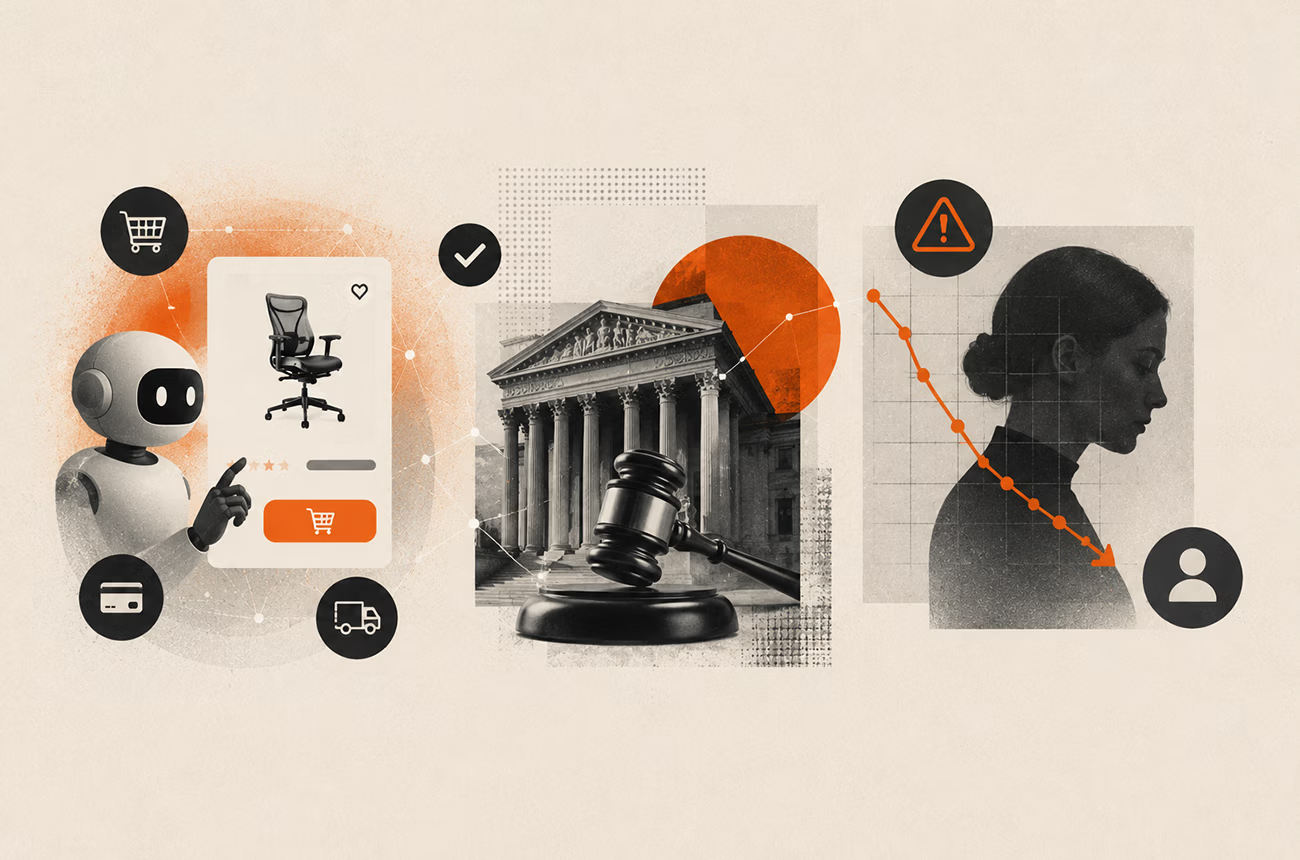
For two years the AI story in marketing was mostly about pace: who could generate more, faster. June 2026 read differently. The month’s significant moves were about where the customer relationship now sits, who is liable when a machine speaks for a brand, and what marketers are rewarded for once everyone has the same tools. Grouped below are the stories worth the read, the calm version of each, and the job it leaves on your desk.
Where brands get found is changing fastest
The discovery layer moved this month, on three fronts at once.
The UK’s competition regulator ordered Google to let publishers opt out of AI search without losing their ranking. It is the first real lever publishers have been handed over AI Overviews — until now, the only way to keep material out of Google’s AI answers was to drop out of Google search altogether. The CMA’s intervention separates the two. If you publish, this is the regulatory backdrop to every decision about what you let Google’s AI ingest. Read the piece.
A German court held Google liable for false AI Overviews, treating the summaries as Google’s own statements. The Regional Court of Munich granted a preliminary injunction after AI Overviews wrongly tied two publishers to scams. The ruling is early and Google is reviewing it, but the principle it tests is the one every brand should watch: when a generative system invents a damaging connection, the platform — not just the source — may have to answer for it. The practical defence is unglamorous: publish clear, structured, first-party information, so there is less room for an AI to fabricate. Read the piece.
ChatGPT stopped forgetting. OpenAI’s rebuilt “Dreaming” memory, rolling out from 4 June and now reaching the free tier, lets the assistant hold a durable, self-updating picture of each user across years of conversations. For marketers that lands as two jobs: earning a place in the answer when an assistant already knows the person asking, and reckoning with the fact that recommendation is becoming personal and persistent rather than fresh each time. Read the piece.
Agentic commerce moved from demo to default
The infrastructure for an AI to buy on a person’s behalf — built across barely a year from Google’s UCP, OpenAI’s ACP and agent-payment rails — stopped being a conference demo in June.
Visa put its rails inside ChatGPT. Announced on 10 June, Visa Intelligent Commerce is designed to let ChatGPT agents pay at Visa-accepting merchants within user-set limits, with Mastercard racing for the same position. The unglamorous takeaway: the brand the assistant recommends, and can transact with cleanly, is the one that wins the sale. Making products selectable and payable by an agent is becoming table stakes. Read the piece.
Shopify switched agentic commerce on by default. Its Spring ’26 Edition made the Catalog and the Universal Commerce Protocol active for eligible stores, auto-syndicating products into ChatGPT, Copilot and Google’s AI surfaces unless a merchant opts out. The default has flipped from “opt in to AI shopping” to “opt out if you must” — which means the question for marketing teams is no longer whether to show up in AI chats, but whether they can see and shape what those channels are doing. Read the piece.
The agent is becoming the customer’s main contact
Salesforce agreed to buy Fin — the company formerly known as Intercom — for about $3.6bn. It is one of 2026’s largest enterprise-AI deals, and the price matters less than the signal: an incumbent chose to acquire agentic customer service rather than build it, and the agent that answers the customer is becoming part of the core platform. For marketers, the contact point with a customer is increasingly software, and the brand experience now includes how that agent behaves. Read the piece.
Anthropic put a shared Claude agent inside Slack channels. Claude Tag lets a team summon an AI agent that lives where the work already happens, rather than in a separate window. It is a small launch with a large direction of travel: agents are moving into the shared spaces teams collaborate in, which is where a good deal of marketing actually gets done. Read the piece.
And the human counterweight got louder
For all the infrastructure, June’s other thread was a correction.
Trust is slipping, and AI is part of why. Research from McCann and Economist Enterprise found a large share of people will walk away from brands they don’t trust, with AI named among the forces eroding confidence. It is the backdrop the whole AI shift sits on: efficiency that costs trust is a bad trade, and the marketers who treat trust as the asset, not the by-product, are the ones with room to manoeuvre. Read the piece.
Cannes Lions raised its AI bar. The festival introduced AI Craft subcategories and a new Creative Brand Lion, with jury leaders signalling that work would be judged on whether AI made it better — not on whether AI was used at all. After two years of using the technology loudly, the reward has moved to the judgement to tell a strong idea from a fast one. That is the most reassuring sentence a marketer read all month. Read the piece.
The connecting thread is straightforward enough to act on. The tools are arriving faster than the rules and faster than the trust that makes them usable. The brands that come out of June ahead are the ones being deliberate about both: building so an agent can find and recommend them, and behaving so a customer still wants them to.