Salesforce buys Fin for $3.6bn as the customer's main contact becomes an agent
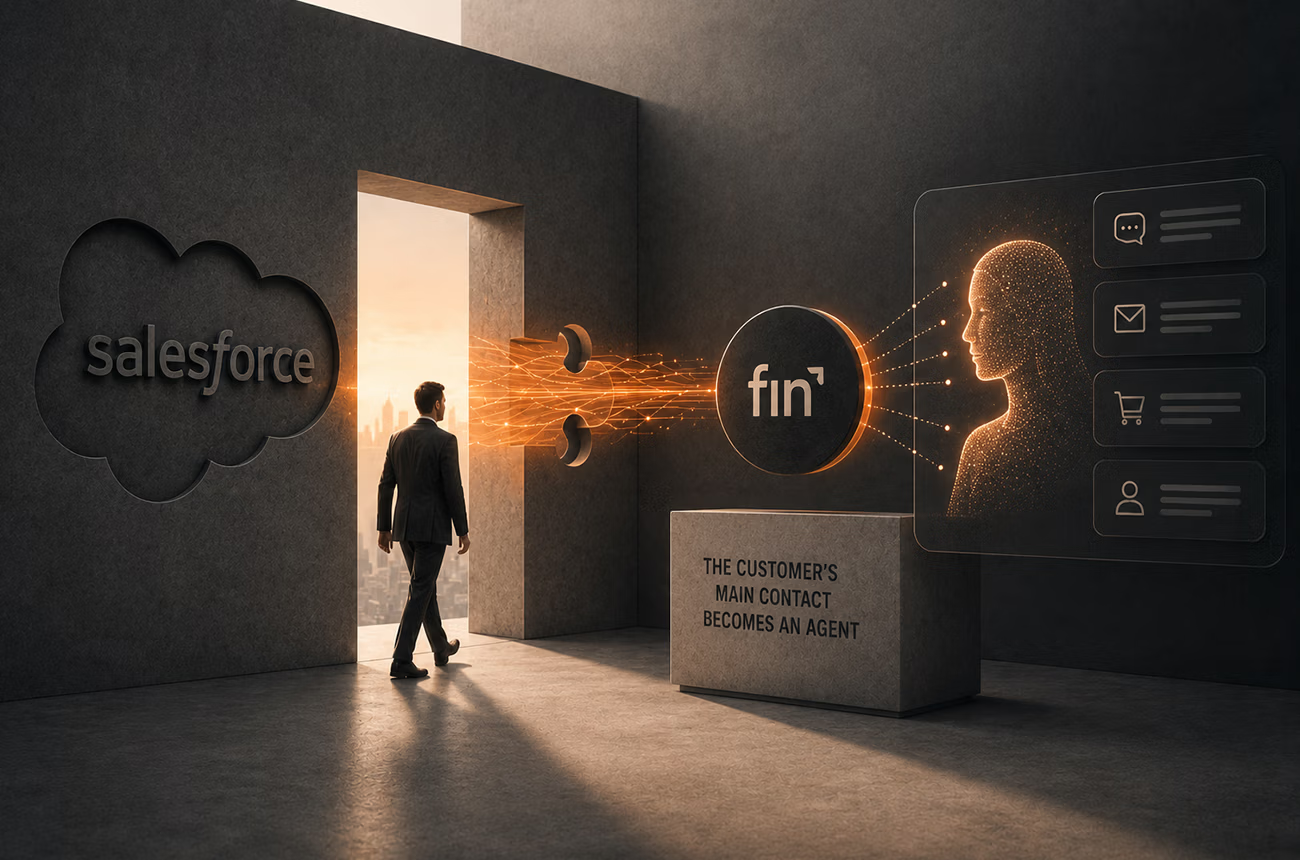
Salesforce announced on 15 June that it had signed a definitive agreement to acquire Fin — the company formerly known as Intercom — for approximately $3.6bn, in one of the year’s largest enterprise-AI deals. The price is less interesting than what it is being paid for: a customer-service agent that, by the companies’ own account, already resolves the majority of support queries without a human.
For B2B marketers the deal lands on two counts. It marks the agentic-AI scramble consolidating into the platforms that already own the customer relationship, and it confirms that the customer-facing agent — increasingly the brand’s main voice — is now a buyable, measurable capability rather than a science project.
What Salesforce is buying
Fin’s core product is an AI agent that resolves customer queries end to end across live chat, email, WhatsApp, SMS, phone and Slack, run on a proprietary model called Apex that the company says is purpose-built for support and outperforms leading general-purpose models on resolution. Salesforce points to the agent resolving, on average, 76% of support volume without human help — a figure that, taken at face value, represents a real cut in the cost of serving customers. It is worth remembering whose figure it is: this is the seller’s and acquirer’s number, quoted in a deal announcement, and the kind of claim a marketing or service leader should ask to see proven on their own traffic.
The acquisition brings Fin’s technical AI team and a base of more than 30,000 customers, including Amazon and Atlassian, into Salesforce, where the technology will fold into Agentforce, the company’s platform for building and deploying AI agents. Salesforce is positioning it for smaller and commercial organisations that want fast time-to-value rather than a long build. “We’re thrilled to welcome Fin to Salesforce as we enable every company to become an agentic enterprise,” said chair and chief executive Marc Benioff. Fin, founded in Dublin in 2011 and later headquartered in San Francisco, is Salesforce’s fifth acquisition announced in 2026 and its third in June, after M3ter and Contentful. The transaction is expected to close in the fourth quarter of Salesforce’s 2027 fiscal year, subject to regulatory clearance.
Why an incumbent is buying, not just building
Salesforce already has an agent platform in Agentforce, so the more telling part is that it chose to pay $3.6bn for capability that is proven rather than wait for its own to mature. The context explains the urgency. Salesforce shares have lost more than a third of their value in 2026, amid a wider anxiety that agentic AI could erode the value of traditional software subscriptions, and the company has framed this deal as its most direct answer yet — adding AI that is already generating enterprise returns while reinforcing Agentforce as the place that capability lives.
For marketers at B2B SaaS companies watching their own sector, that is a live case study in how an incumbent responds to the agentic shift: consolidate best-in-class capability into the platform rather than cede ground to a nimble specialist. It also signals that strong standalone agent companies are now acquisition targets, and that agentic capability is migrating inside a smaller number of large platforms. The practical consequence for buyers is a familiar one — fewer, bigger suppliers, and the build-versus-buy and lock-in questions that come with them.
What it means for B2B marketers
The first implication is the one easiest to miss. When an agent handles most customer conversations, that agent is who the customer experiences as the company — so its tone, accuracy and consistency become a brand responsibility, not just a support metric. The same discipline marketers have started applying to what AI search and assistants say about a brand now applies to the agent answering its customers: it speaks in the brand’s name, and the brand owns what it says. Whoever runs customer service is, increasingly, running part of the brand.
The second is that agentic capability now arrives with a number attached. Autonomous resolution rate and cost-to-serve are concrete measures, which is how marketing and customer-experience leaders should evaluate these tools — and a reason to treat vendor headline figures like 76% with healthy scepticism and ask for evidence on comparable workloads. The third is procurement: as capability consolidates into platforms a company may already use, the decision shifts from chasing the newest standalone tool to weighing integration, measurable outcomes and the cost of dependence.
The deal will not close until late in Salesforce’s next fiscal year, and regulators still have a say, so nothing changes for customers tomorrow. But the direction is unambiguous: agentic customer service has moved from promise to acquisition target in the space of a year, and the agent that answers the customer is becoming part of the brand itself. For marketers, that makes it a question worth owning rather than leaving to the service desk.