Cannes Lions 2026 raises its AI bar: proof of better work, not novelty
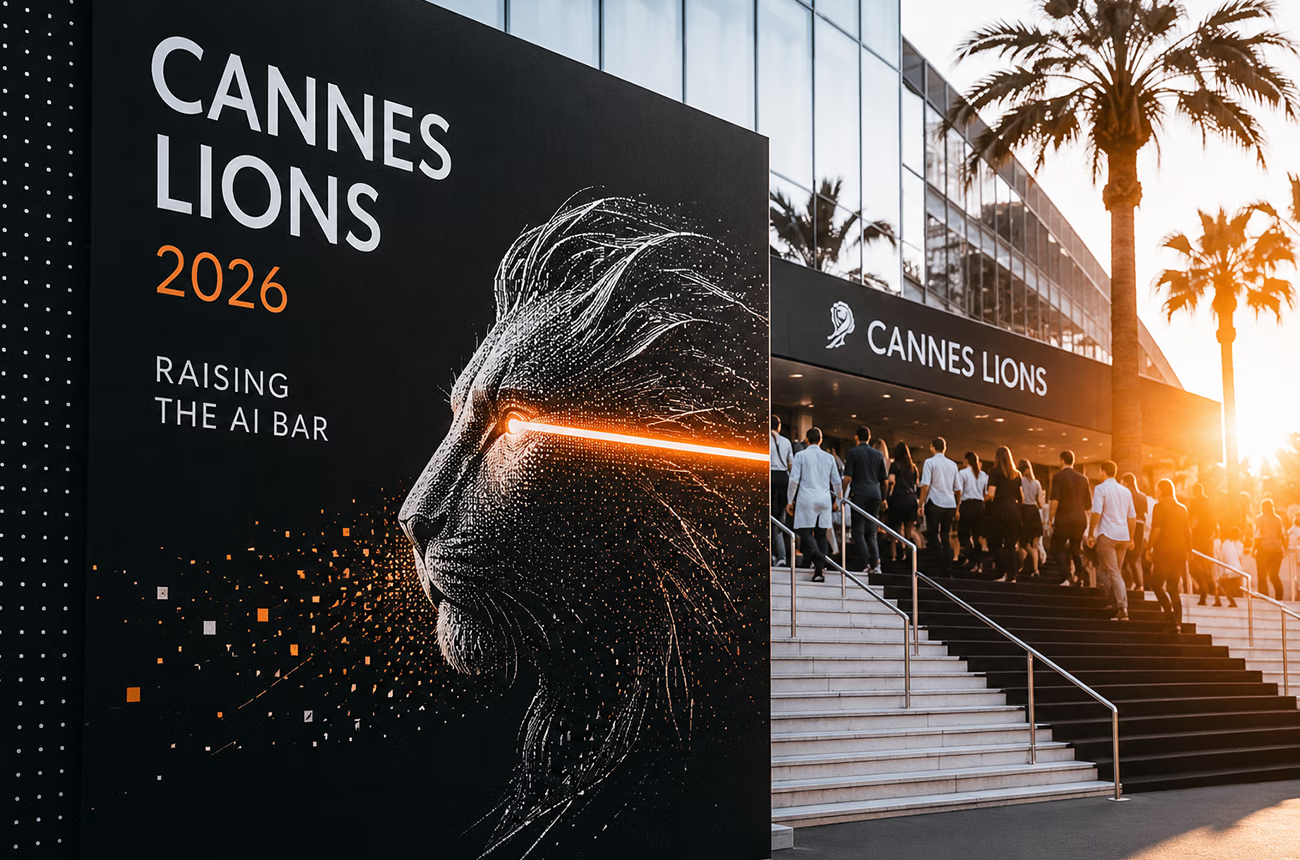
For two years, the surest way to stand out at the Cannes Lions International Festival of Creativity was to use artificial intelligence loudly. That changed before a single 2026 entry was judged. The festival, which runs from 22 to 26 June at the Palais des Festivals, rewrote what it counts as excellent: it added AI Craft subcategories across several award tracks and created an entirely new prize, the Creative Brand Lion, for the systems and culture behind work that stays good over time.
The change matters because Cannes Lions functions as the advertising industry's annual benchmark, and the categories it rewards tend to signal where agencies and brands point their budgets next. After a stretch in which AI-generated ads and synthetic spokespeople filled awards reels, jury leaders have indicated that using a tool is no longer, on its own, an achievement. The bar has moved from whether AI was involved to whether it made the final work better — a distinction that puts craft, taste and measurable results back at the centre of judging.
What has Cannes Lions actually changed?
Cannes Lions has added AI Craft subcategories spanning Film Craft, Design, Digital Craft, Industry Craft and Creative Data, asking entrants to show how the technology made a concrete difference rather than simply that it was present. Alongside them sits the new Creative Brand Lion, which rewards the organisational systems and consistency that produce strong work repeatedly, rather than a single standout campaign. Marian Brannelly, the festival's global director of awards, framed the shift as creativity now being used to solve business problems, with data and technology playing a central part.
The two additions pull in the same direction. The AI Craft categories judge whether AI raised the quality of an individual piece; the Creative Brand Lion judges whether a brand has built the conditions to do that reliably. Both reflect a view that when generating and testing creative options becomes cheap, the scarce resource is no longer execution but the judgement to know which idea deserves to reach a market. Frontrunners for the new brand prize, according to trade coverage, are campaigns built on years of consistent positioning rather than one-off ideas.
Why has the mood around AI shifted this year?
The mood shifted because the industry has had a full year of implementing AI rather than speculating about it, and the early results have been mixed enough to invite scrutiny. Executives heading into the festival described expecting a more pragmatic conversation than the hyperbole of recent editions. Ivan Kayser, chief executive of the Stagwell-owned consultancy Redscout, told Marketing Brew the industry is "a year smarter" and better placed to talk honestly about how AI changes the way agencies operate.
Part of that recalibration traces back to a defensive reflex. After Meta's Mark Zuckerberg suggested in 2025 that the company's tools could fully create and target ads by the end of 2026, agencies treated automation as an existential threat. A year on, the framing among many executives is narrower: AI will reshape marketing operations without ending the discipline. The festival's own programme reflects the change, with a packed schedule of practical sessions — and a fireside appearance by Google DeepMind's Demis Hassabis — replacing the open question of whether AI belongs in creative work at all.
The retreat is physical as well as rhetorical. The holding groups that long dominated the beachfront have pulled back their presence, while independent agencies such as the performance shop PMG have taken prominent space. The result is a festival where the conversation about AI has moved from the main stage spectacle to the working detail of how teams actually use it.
What are brands being rewarded for instead?
Brands are being rewarded for the discipline that survives contact with a market, not the novelty of the tools behind a single execution. The Creative Brand Lion is built to surface organisations with the systems, governance and culture to make consistent creative decisions — the capability that decides which of many cheaply generated options is worth backing. In effect, the festival is measuring whether a team's judgement was strong enough to use AI well, rather than whether it reached for AI at all.
For in-house marketing teams watching from outside the Croisette, that reframing carries a steadying message: the absence of an enterprise AI stack is not the disadvantage it was sold as. The industry's most influential awards body has said, through its own criteria, that the stack was never the point. The work that travels off the Croisette this year is expected to come from teams that built the judgement to tell a strong idea from a fast one — and could prove the technology earned its place in the result.
Cannes Lions winners will be announced across the week, with the AI Craft categories and the Creative Brand Lion judged for the first time. Whether the juries hold the higher bar in practice — rewarding outcomes over spectacle — is the test the new categories were written to set.