Gemini 3.8 Flash reaches AI Mode as Google's model swaps outpace testing
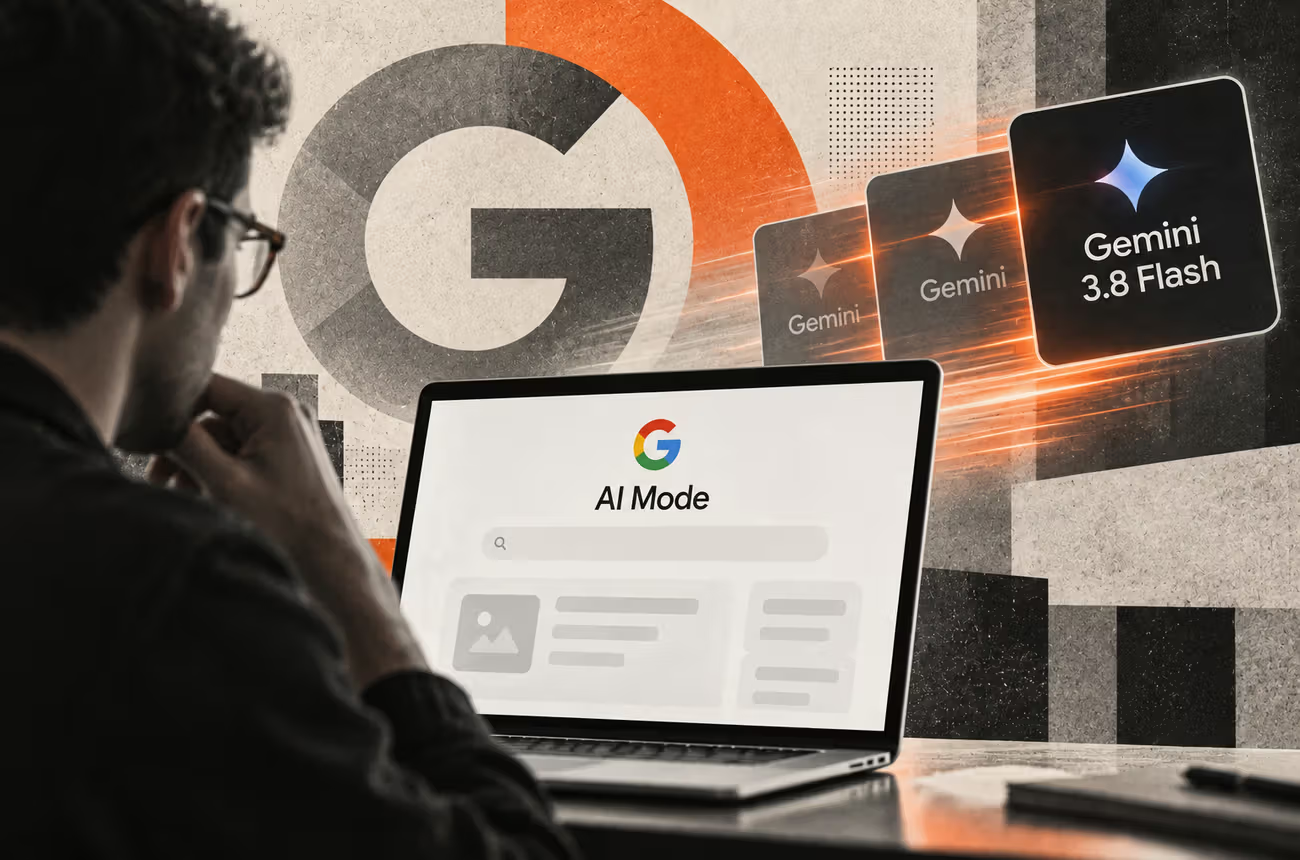
The model answering Google’s AI Mode queries changed again on 2 September, three weeks after the last time. Gemini 3.8 Flash appeared in the AI Mode model menu on the day Google released it, making it the third Flash model to reach Search in six weeks.
Marketing teams have spent the past year rebuilding measurement around AI Mode, tracking which pages Google’s AI surfaces cite and how those citations move. That work assumes the thing being measured holds still for long enough to read. On Google’s current release schedule it does not: the engine behind a paid AI Mode session has been replaced twice since the middle of August.
What did Google change in AI Mode?
Gemini 3.8 Flash is now selectable inside AI Mode for Google AI Pro and Ultra subscribers, from the plus icon in the “Ask anything” bar. Search Engine Journal reports it sits under the “Gemini 3 models” heading between “Auto” and “Pro”, the same slot where Gemini 3.7 Flash appeared on 14 August. Robby Stein, vice-president of product for Google Search, announced the rollout on X, writing that the model is “available today in AI Mode for Google AI Pro & Ultra subs”.
Search moved up the running order this time. Google’s launch post, published on 2 September by Tulsee Doshi, a senior director of product management, and Raluca Ada Popa, Gemini security lead at Google DeepMind, lists AI Mode alongside the Gemini app and Google Sheets among the consumer products where subscribers can use the model. Three weeks earlier, the 3.7 Flash post named only Spark in the Gemini app, and AI Mode followed a day later. Search is now part of the model launch itself, which means the model a subscriber can pick in AI Mode moves on Google’s model schedule rather than a separate Search timetable.
Google describes 3.8 Flash as its “most intelligent workhorse model” and its third Flash release in six weeks. The performance figures behind that are Google’s own: a score of 54.9% on HLE-Verified, and results on the Vals Finance Agent V2 and Harvey’s Legal Agent benchmarks that Google says beat both 3.7 Flash and larger frontier models. No independent testing of how the model behaves inside AI Mode has been published.
One line in the launch post carries a cost signal, and an independent measurement has since put a figure on it. Google says 3.8 Flash works harder on complex tasks, running extra reasoning steps and calling tools repeatedly, and may use more tokens at higher effort levels. Artificial Analysis found that at high reasoning the model cost around 40% more per task than 3.7 Flash despite identical token prices, attributing the gap to 30% more output tokens per task and more turns in agentic evaluations. For teams building on the Gemini API rather than searching in AI Mode, the introductory rate is $0.75 per million input tokens and $3.75 per million output tokens, and Google’s footnote sets that price to expire on 31 December 2026, doubling to $1.50 and $7.50 from 1 January. Google says 3.7 Flash remains fully supported for workloads where efficiency matters more.
Why does a three-week model cadence complicate AI visibility testing?
Google’s AI Mode has cycled through four Flash generations since December, and the pace has tightened. Gemini 3 Pro arrived as a selectable option in November, Gemini 3 Flash became the default in December, Gemini 3.5 Flash replaced it as the global default at I/O in May, 3.7 Flash joined the menu on 14 August, and 3.8 Flash arrived on 2 September.
The measurement problem follows directly. Anyone who spent the past three weeks testing which sources AI Mode cites was testing a model that is no longer the newest option in the menu. As Search Engine Journal put it, a reading taken on 3.7 Flash in mid-August and one taken on 3.8 Flash in September came from different models, so a change between them does not isolate anything the content did. The practical response is unglamorous and cheap: record the model name and the date against every AI Mode reading, and treat comparisons that straddle a model change as unmatched rather than as evidence.
That discipline sits on top of a split marketers already had to manage. The Helm reported in July that AI Mode and AI Overviews cite the same URLs only 13.7% of the time, according to Ahrefs, so visibility in one Google AI surface never guaranteed visibility in the other. The addition is that the surface now has moving parts inside it, and a monthly reporting cycle is longer than the interval between them.
None of this argues for measuring less. It argues for labelling readings properly, running tests inside a single model version where possible, and resisting the pull to explain a fortnight’s movement as the result of a content change when the engine underneath it was swapped.
Which searchers actually see Gemini 3.8 Flash?
Google AI Pro and Ultra subscribers are the only group Google names. Free-tier AI Mode users get no model choice at all, receiving whichever model Google sets as the default, and nothing in the 2 September announcement changes that. The Google support page listing AI Mode’s model menu still shows only “Fast” and “Pro”, unchanged since 3.7 Flash arrived on 14 August.
The language question is unsettled. Stein’s post says the model reached subscribers around the world and does not name a language; the 3.7 Flash rollout before it was English only. Search Engine Land reported the 3.8 rollout as reaching English speakers first, as with 3.7. Google’s own launch post does not specify.
Nor has Google said what the “Auto” option routes to. Between the unnamed default served to free-tier searchers and an Auto setting of undisclosed composition, most of the people using AI Mode are receiving answers from a model Google has not identified. For a marketing team trying to establish whether its content appears in AI Mode answers, that sets a hard limit on what any test can prove, whether the searcher it is modelling pays or not.
The next thing to watch is whether 3.8 Flash moves from an option to the default, the path both earlier Flash tiers took, since a default change would reach the free tier. Neither Stein’s post nor Google’s launch post says whether that is coming.