Google’s Mueller backs ‘be specific’ for AI citations; data ranks it second
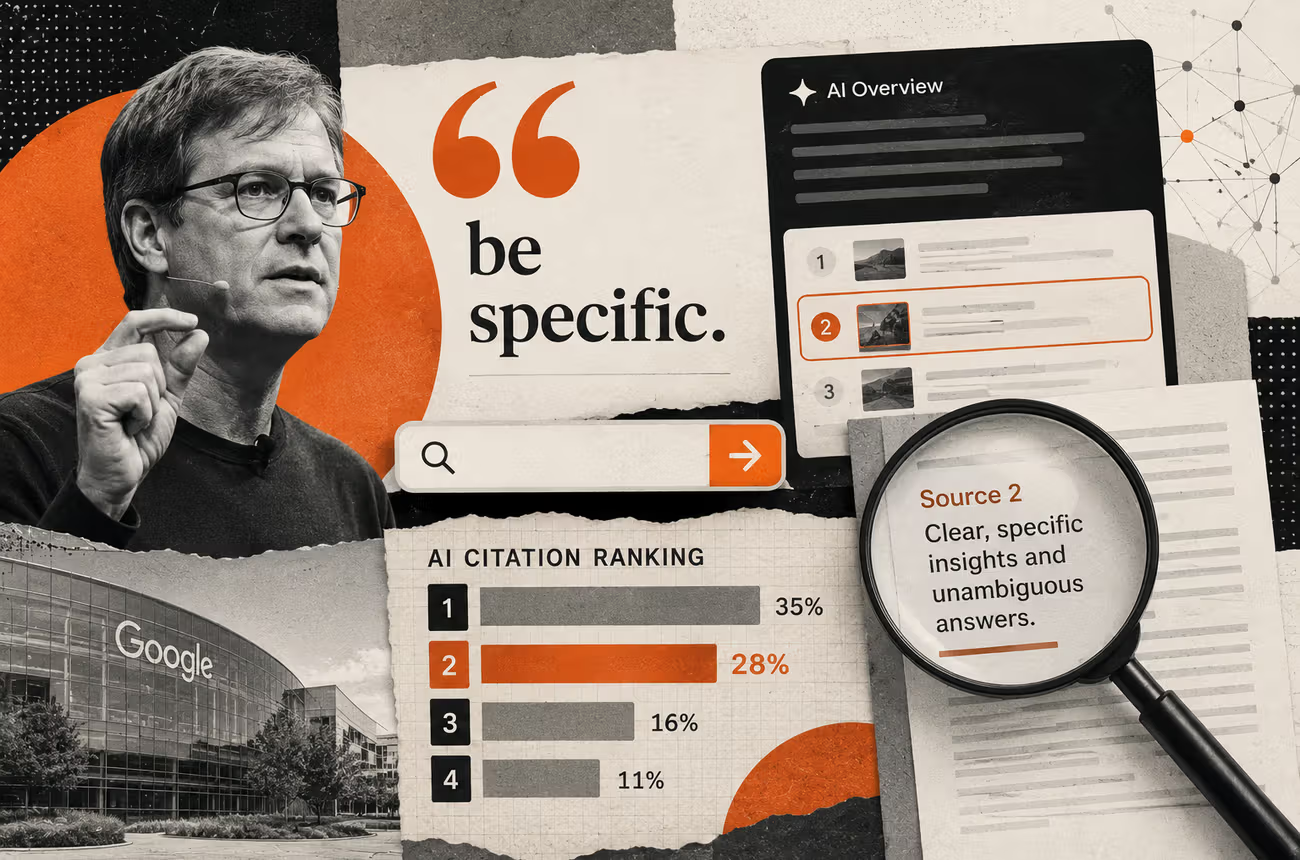
A claim that writing insightfully on a specific enough topic is sufficient to earn citations from AI assistants travelled from a Bluesky thread to Search Engine Journal on 16 July, picking up an endorsement from Google Search Advocate John Mueller along the way. It is now circulating as generative engine optimisation guidance.
Nothing in that chain contains a measurement. The claim arrives in a market where marketing teams are being sold AI visibility tooling and consultancy at pace, and where the published analyses of how ChatGPT selects its sources point at a different first cause: whether a page ranks in conventional search at all.
What did Search Engine Journal actually report?
Search Engine Journal published the piece on 16 July under the byline of Roger Montti, a staff writer who says he has 25 years of hands-on SEO experience, and framed it explicitly as opinion built on a social media discussion. Its own headline is hedged, saying specificity may get content cited more.
The discussion started with Dan Abramov, the software engineer who co-created Redux and worked on React at Meta, and who blogs at overreacted.io. Posting on Bluesky, Abramov said that an insightful blog post on a specific enough topic, combined with people linking to it, gives an author “a real chance at influencing everyone’s LLM output” within about a year. He described seeing Claude condense articles he had assumed nobody would read because of their length, and occasionally cite them directly.
Others reported the same pattern. The developer Tyler Gaw replied that several of his own posts had been pulled into AI answers within roughly six months, and credited specificity rather than insight. Mueller reposted the thread with a five-word endorsement: “Make more insightful & useful stuff.” One respondent pushed back on economic grounds, arguing that creators have no incentive to do the work when the output is reused without credit or payment.
That is testimony, not evidence. There is no sample, no baseline, no control for how well the pages already ranked, and no way to separate specificity from the inbound links Abramov named in the same sentence. Montti’s own contribution is a writer’s argument drawn from four decades of practice: a piece that stays on topic holds attention, and one that wanders loses it.
Does the data support writing more specifically?
AirOps, a company that sells AI content tooling, produced the closest thing to a controlled answer in April, in a study analysed by the growth adviser Kevin Indig. Titled The Fan-Out Effect, it ran 16,851 unique queries through ChatGPT three times each, generating 50,553 responses across 353,799 pages and more than 1.5 million fan-out rows in 10 verticals. AirOps said it scraped the ChatGPT interface rather than the API.
The specificity thesis holds up in that data, but not as the top factor. Retrieval rank was the strongest signal by a wide margin: pages in the top search position were cited 58.4% of the time, against 14.2% for pages in position 10. The strongest on-page factor was heading relevance, with the closest heading-to-query matches cited 41.0% of the time compared with roughly 30% for weaker matches.
Length behaved as the Bluesky thread predicted. Pages between 500 and 2,000 words performed best, and pages over 5,000 words were cited less often than pages under 500. Structure moved the number only slightly: JSON-LD markup lifted the citation rate to 38.5% from 32.0%, and articles with four to 10 subheadings performed best. Freshness had a window rather than a slope, with pages published 30 to 89 days earlier outperforming both newer and much older ones.
Read in order, those findings describe specificity as a selection factor that operates after retrieval has already happened. A page that does not rank is rarely in the pool to be selected from.
Where does the evidence disagree?
Indig’s earlier work points the opposite way on length, which is the clearest sign the field has not settled. Analysing roughly 98,000 citation rows drawn from about 1.2 million ChatGPT responses in Gauge data, published in March, he found that longer pages generally earned more citations, with pages above 20,000 characters averaging 10.18 citations against 2.39 for pages under 500 characters.
The two results are less contradictory than they look, because they count different things. The April study measures the rate at which a retrieved page gets cited; the March one measures how many citations a page accumulates across many prompts. A short, tightly scoped page can win its individual matchup more often while a long reference page turns up in far more answers. That reading is an interpretation, not a finding either study states, and both were produced by commercial vendors with tooling to sell.
What the two agree on is concentration. Indig’s March analysis found 67% of citations within a topic going to just 30 domains, and separate research from SE Ranking in November 2025 found that sites with more than 32,000 referring domains were 3.5 times more likely to be cited by ChatGPT than sites with fewer than 200. Specificity is the variable a content team can change this quarter. Domain authority decides whether their pages are considered at all.
Abramov’s original post carried a qualifier the advice has since shed: he credited inbound links alongside specificity, in the same sentence.