ChatGPT opens ad self-serve to Europe as one in seven ads misses its topic
The self-serve button European marketers had been waiting for appeared on 31 August, seven days after ChatGPT ads started running in their markets. OpenAI opened Ads Manager to advertisers across 31 European countries that day. The same announcement put its advertising business at $1bn in annualised revenue run rate in under 200 days.
That settles the access question The Marketing Helm flagged a fortnight earlier, when ChatGPT ads reached 31 European markets with self-serve buying still shut. It does not settle the measurement question. OpenAI has told advertisers it does not yet hold performance benchmarks across advertisers, industries or campaign types. The independent data that does exist points to a relevance problem and a tracking gap. Both need pricing in before a budget is committed.
What opened for European advertisers on 31 August?
OpenAI opened beta self-serve access to Ads Manager across the same 31 European markets where ads began serving on 24 August, Digiday reported. Those markets cover the 27 EU member states plus Iceland, Liechtenstein, Norway and Switzerland. Until that morning, buying ran through OpenAI’s Ads Solutions team and six agency groups: Publicis, Omnicom, WPP, Havas, Dentsu and MediaPlus. Those routes remain open for advertisers who prefer them.
The United Kingdom sat outside that wave because it had already been through the sequence. ChatGPT advertising activated for UK users on 6 June, and self-serve access followed on 22 June. OpenAI’s own availability page, checked on 7 September, lists the United Kingdom among 52 countries where self-service access is live. The United States, India, Japan and Brazil are on the same list.
The same announcement extended self-serve buying to India, the Middle East and North Africa. Indian advertisers gained access on 4 September with a daily minimum budget of ₹725, roughly £6. That floor is a long way from where Ads Manager started: the tool launched in the United States carrying a $50,000 minimum lifetime spend, since dropped. OpenAI introduced Ads Manager in May, which is when small and medium-sized businesses first got in. It says they now represent a material share of the business. It has not put a number to that.
What does a $1 billion run rate actually measure?
OpenAI’s $1bn figure is an annualised run rate: current monthly revenue multiplied by twelve, not money already booked. At that pace the business is earning roughly $83m a month. Digiday estimated the company had likely booked around $330m in actual advertising revenue across the first eight months of the year. The reported target for 2026 is $2.5bn.
That gap is why the reaction from analysts was mixed rather than celebratory. Nate Elliott, principal analyst at eMarketer, told Reuters the announcement was “incredibly impressive and terribly disappointing”. A run rate reached this late in the year, he argued, leaves the annual target out of reach. OpenAI has not disclosed how much advertising revenue it has actually recognised in 2026.
The scale is real on its own terms. OpenAI says ChatGPT Ads is now used by tens of thousands of advertisers across more than 40 countries. CPC and outcome-optimised bidding account for the majority of campaigns. The company has expanded to more than 50 technology and measurement partners. It also cited two results from unnamed clients. An ecommerce advertiser reached a threefold return on ad spend over 28 days, and a technology partner reported that more than 80% of ad-driven ChatGPT traffic came from new customers. Both are vendor figures, drawn from advertisers OpenAI has not identified, with no baseline given.
What do independent tests show about relevance and tracking?
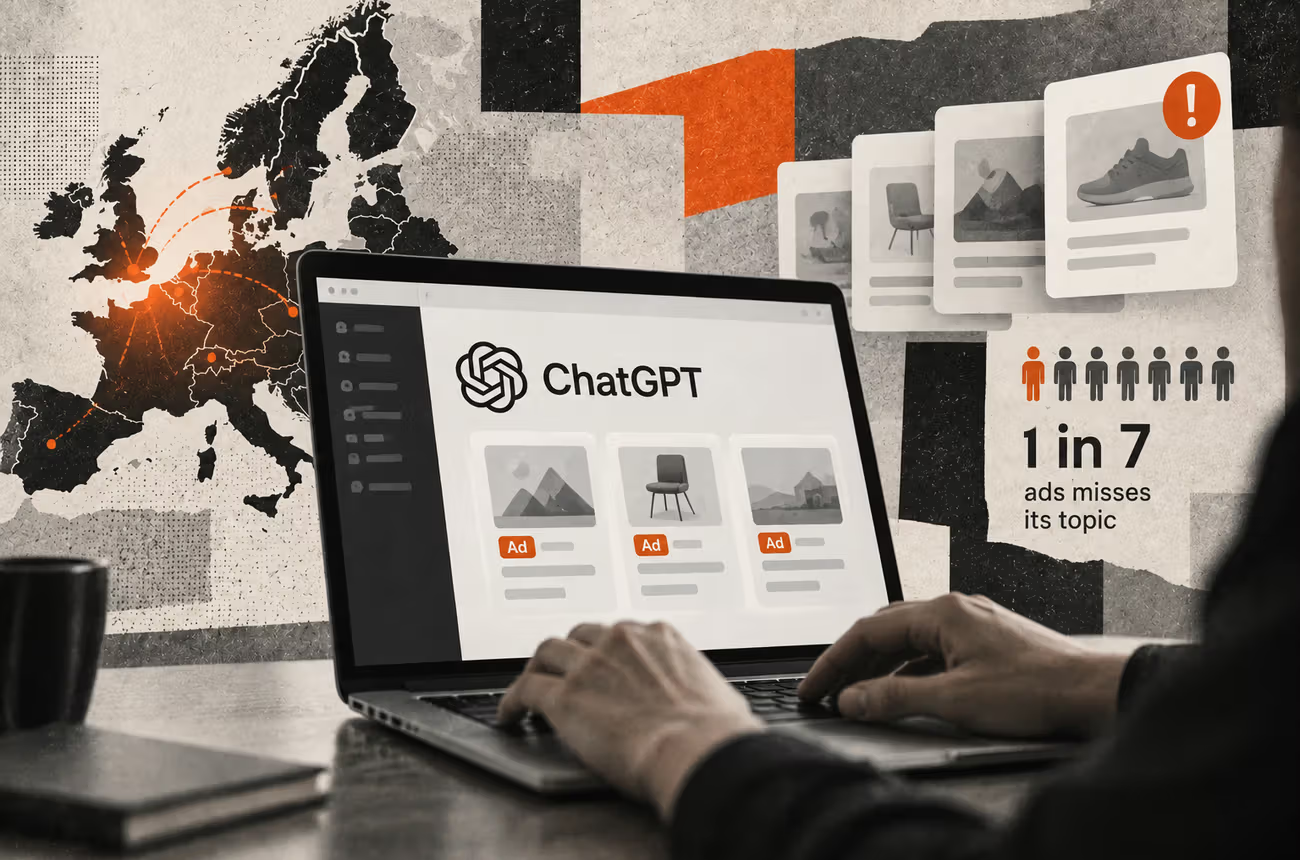
SE Ranking’s prompt study offers the clearest third-party picture so far. The company analysed 50,006 commercial prompts across 20 niches in the United States, with data collected on 23 July, and found ChatGPT served ads on 25.94% of them. Of those placements, 14.35% were semantically unrelated to the prompt that triggered them. The rate varied sharply by category, from 2.6% in pets to more than 50% in relationships and in news and politics.
One finding matters particularly for teams already working on AI visibility. The advertiser appeared as a cited source in the answer above its own ad in just 3.63% of placements. Paid placement and earned citation are separate outcomes, and buying one does not deliver the other.
SE Ranking also ran its own campaigns during the study. They generated more than 97,000 impressions and 1,263 clicks at an average click-through rate of 1.30%, with very few sign-ups. It reported cost per click running at roughly £1.15 to £3 ($1.50 to $4.00). The constraint it flagged is diagnostic rather than financial. ChatGPT Ads has no search terms report and no prompt-level reporting. An advertiser cannot see which conversations triggered an impression, cannot reproduce the mismatch finding inside its own account, and has no way to exclude the placements causing it.
Several agencies have reported a second problem in the days around the announcement. Nicholas Verity, chief executive of B2B lead generation agency Cleverly, wrote that OpenAI’s Ads Manager recorded 57 clicks from one campaign. Google Analytics recorded fewer than 20 visits from the same campaign. “The numbers didn’t match reality”, he wrote, adding that his team could not justify further spend on that basis. OpenAI’s pixel and server-side Conversions API both launched in May, and the platform still lacks view-through attribution, lift measurement and incrementality testing.
The picture is not uniformly negative. OpenAI introduced an automated bid strategy called Max Results in late August. Evan Engler, a senior paid search buyer at Common Thread Collective, reported that one client saw clicks rise more than 50% on the first day it was enabled, with click-through rate up 108% and cost per click down 19%. That is a single advertiser’s self-reported result, not a benchmark, and OpenAI has published none against which to judge it.
Why might ChatGPT’s ad audience miss a B2B buyer?
ChatGPT shows ads only to users on the free tier and the Go plan, which costs roughly £6 a month ($8) in the United States. Plus, Pro, Business, Enterprise and Edu accounts see none. OpenAI reports more than 1 billion weekly active users but has not disclosed how that population splits between ad-supported and ad-free tiers.
For consumer brands that distinction is a detail. For a B2B software team it goes to the heart of targeting. The heaviest and most sophisticated AI users tend to be the ones whose employers pay for the higher tiers. Those are frequently the senior practitioners and technical buyers on a target account list. The ad-eligible pool and the ideal customer profile may overlap far less than the headline user number suggests.
Account-level targeting remains thin as well. When AdRoll piloted ChatGPT ads for B2B, account targeting required an audience of 25,000 users, a threshold most mid-market account lists will not reach. European campaigns carry a further constraint. OpenAI made consent the legal basis for personalised advertising in the EU, so users who decline are targeted on the live conversation and an approximate location alone. Third-party tools have started to fill some of the gap, including a Similarweb product for tracking ads in ChatGPT and Google AI answers launched on 27 August.
OpenAI said its next phase will bring more markets, additional formats, objectives, buying options and measurement capabilities. It has not said when advertisers will get prompt-level reporting, or a published benchmark to measure a campaign against.