GreenBanana founder folds SEO, AEO and GEO into a single £1.50 playbook
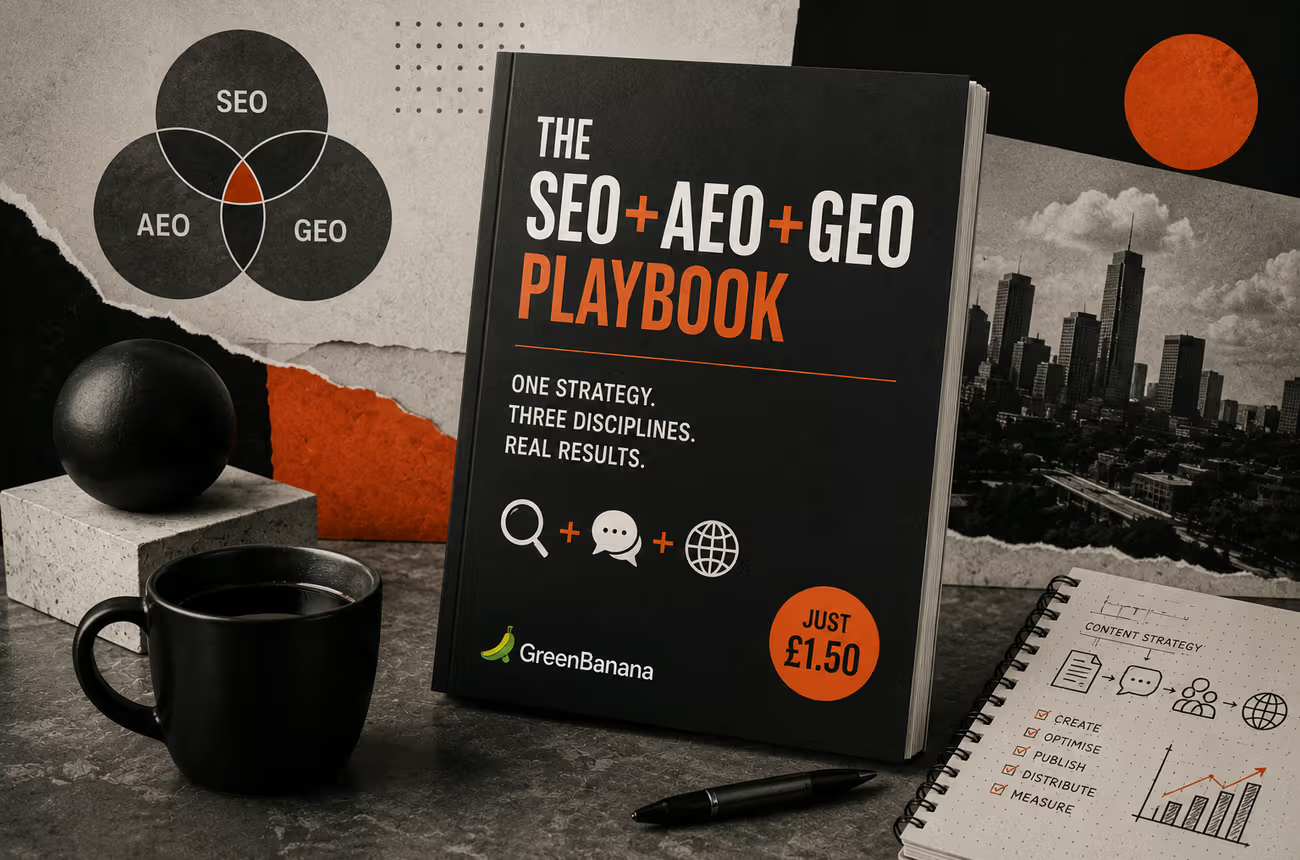
The going rate for a complete AI search framework has fallen to £1.50. Kevin C. Roy, founder and chief executive of GreenBanana SEO, announced The Coherent Mountain over GLOBE NEWSWIRE at 08:37 Eastern Time on 5 August: a 238-page playbook that treats search engine optimisation, answer engine optimisation and generative engine optimisation as one system rather than three separate disciplines. The Kindle edition carries a $1.99 promotional price, about £1.50, and the paperback is listed at $19.99, about £15.
Marketing teams are being told from several directions to fund AI search visibility, and the market selling it now runs from a £1.50 e-book through subscription software to agency retainers. What none of those suppliers has produced is evidence that a particular structural intervention moves citation share in a repeatable way across engines.
What is GreenBanana selling for £1.50?
GreenBanana SEO’s framework runs to six named components, held together by a ski mountain analogy in which pages are trails, internal links are lifts, technical fixes are grooming and authority building is snowmaking. The trail map covers site architecture, with the stated aim of giving search engines and AI systems one clear primary page per topic instead of several competing ones. Lifts covers internal linking built to move topical authority towards commercially important pages. Pruning is a repeatable process for finding and removing cannibalised, orphaned and outdated content. Snowmaking and authority stacking covers citations, mentions and proof signals.
The two remaining components are the ones Roy presents as his own. The Three-Block Blueprint specifies what a page needs beyond conventional optimisation: a clear statement of subject, proof supporting it, and a defined next step. Schema Mountain covers structured data and entity work intended to help AI systems establish who a brand is and what it does. The Amazon listing adds detail the release leaves out, including author entities, trust signals and measuring Share of Answer alongside AI citations, plus worksheets, standard operating procedures, checklists, decision trees, audit frameworks, 90-day plans and 12-month roadmaps.
The announcement describes a release, but the book has been on sale since June. Amazon records a publication date of 26 June 2026, and PPC Land, which examined the listing on 5 August, found the earliest verified-purchase review dated 6 July, with further reviews through the month. A post on the GreenBanana SEO website dated 21 July reads as a price action rather than a first release: Roy writes there that he has dropped the Kindle price to $1.99 and that Kindle Unlimited subscribers can read it for nothing. Ten global ratings had produced an average of 5.0 when the listing was captured, every one of them at five stars.
Does any evidence show a framework lifts AI citations?
No published research establishes that a specific structural intervention reliably increases citation share across AI engines. A critical survey of 45 studies published in July, covering work from November 2023 onwards, argued that generative engine optimisation behaves as a stochastic, partially observable pipeline rather than a single ranking task, and found that the foundational paper’s widely quoted visibility gains hold only where a source is already present in a fixed context, establishing neither organic discoverability nor durable traffic effects. Its conclusion, that no GEO technique reliably lifts AI visibility across engines, covers the interventions any framework of this kind assembles.
Google’s position is narrower than it first appears. Its Search Central guide of 15 May 2026 states that optimising for AI Overviews and AI Mode is still SEO, names AEO and GEO as part of that discipline rather than separate ones, and lists tactics site owners can skip for its own AI features, including llms.txt files, content chunking, AI-specific rewrites and special schema. Brendon Kraham, Google’s vice-president of search and commerce for global ads solutions, repeated the point to marketing leaders in a Think with Google piece in June. That guidance governs Google’s own surfaces, and the company has since made itself the referee for judging optimisation vendors. ChatGPT, Perplexity and Claude retrieve on their own terms.
Measurement is the third gap, and it narrowed only slightly last week. The IAB published Measuring Visibility in the AI Era on 3 August, a 36-page framework sorting metrics into presence, prominence, portrayal and persuasion, and separating directional data from what it calls decision-grade data. It exists because more than 20 companies sell AI visibility tools whose methodologies produce different answers for the same brand. The framework puts the share of brands systematically tracking AI visibility at 16%, a figure it attributes to McKinsey CMO surveys.
What is the going rate for AI search advice?
HubSpot sells the nearest commercial equivalent at about £37 a month. It launched HubSpot AEO on 14 April 2026, built on its acquisition of XFunnel, tracking brand visibility across ChatGPT, Gemini and Perplexity at $50 a month standalone or bundled into Marketing Hub Pro and Enterprise. The company disclosed at launch that organic traffic across its customer base had fallen 27% year on year. Above that sit agency retainers, and above those the analyst layer: Forrester’s 2027 Budget Planning Guides, published on 15 July, named answer engine optimisation as an area to increase spending while telling marketers to cut AI pilots that lack governance or a path to scale.
The vocabulary those suppliers use has run ahead of the people buying. Research from Fractl released on 21 July, based on a survey of 343 United States marketing decision-makers responsible for AI visibility, found 81% still say “SEO” when discussing AI search strategy internally and 19% have adopted “GEO”. Fractl also reported that heavy buzzword use was the single biggest reason buyers write a vendor off. The Coherent Mountain names all three acronyms in its subtitle.
What survives scrutiny in the framework is the part that predates answer engines. Removing pages that compete with each other for the same query, connecting related content so authority reaches the pages that earn revenue, and publishing proof a reader can check were defensible before AI Overviews existed. Google’s guide, Forrester’s advice and Roy’s trail map converge on that work independently, which makes the playbook a reasonable articulation of established practice rather than the new discipline the market keeps trying to name.
Neither the release nor the GreenBanana website states when the promotional price ends, and PPC Land reported that the Kindle listing showed the title as unavailable for purchase when viewed from outside the United States.