Google declares AEO and GEO are still SEO — and makes itself the referee
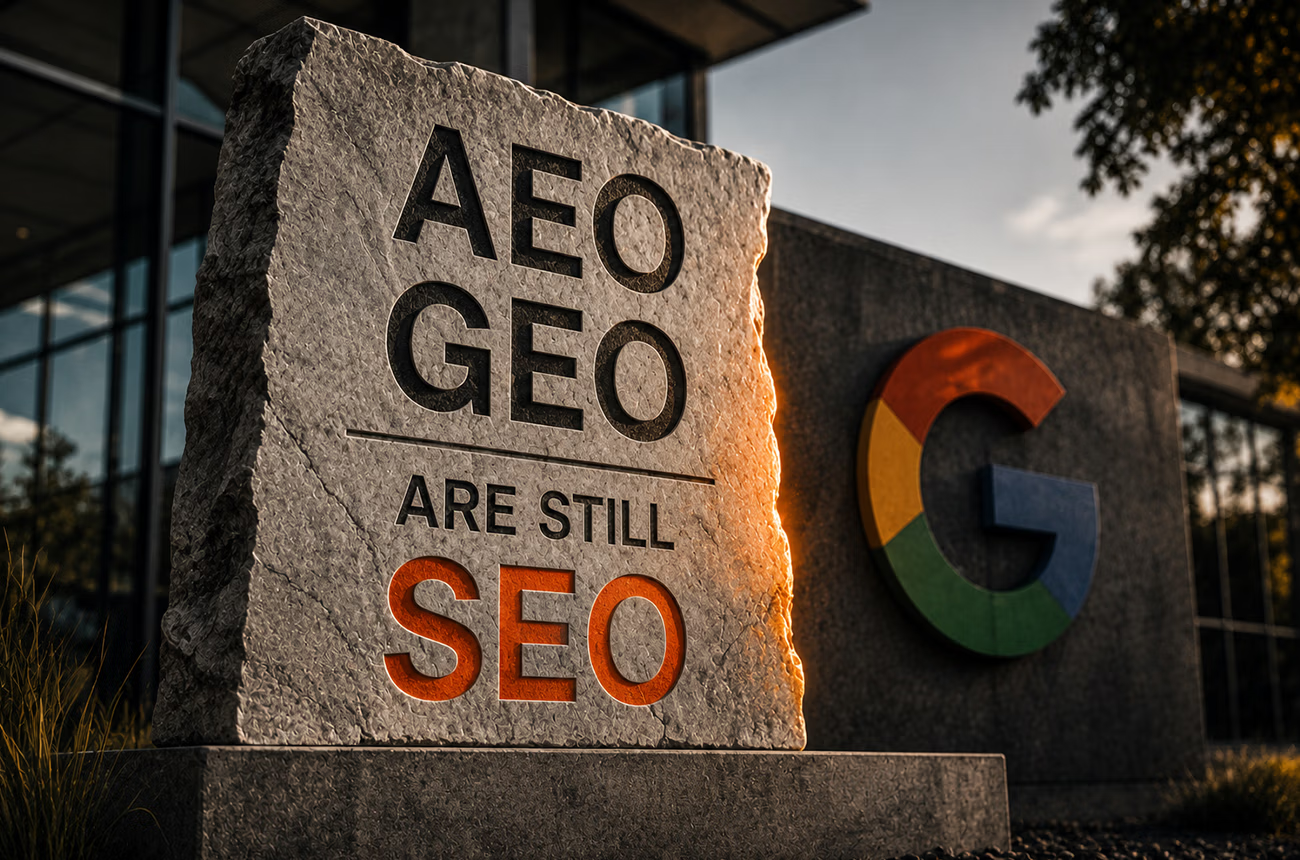
Google has settled a two-year argument on its own terms. In its first official advice on optimising for AI search, published on 15 May 2026, the company said that being cited in AI Overviews and AI Mode is still SEO — and that the wave of answer-engine and generative-engine “hacks” sold to marketers since 2023 is largely unnecessary.
For B2B teams that have been pitched special text files, content “chunking” and AI-specific rewrites, the message is useful and money-saving: the fundamentals still win. But Google did something else at the same time. It made itself the reference point against which every optimisation tactic and vendor is now judged — on the very surfaces whose AI answers are eroding the search traffic that SEO used to deliver.
What Google actually said
The 15 May guide is blunt where the industry had been busy. Because AI Overviews and AI Mode are built on Google’s core Search ranking systems and draw on the same index, the company’s position is that optimising for them “is still SEO”, and that answer engine optimisation and generative engine optimisation are part of that discipline rather than separate ones. The same quality and authority signals that decide organic rankings decide what gets surfaced in an AI answer.
More striking is the list of things Google says site owners do not need. It explicitly waves off llms.txt files, breaking content into machine-friendly “chunks”, AI-specific schema, rewriting copy to sound machine-readable, and chasing inauthentic brand mentions — several of which had become standard line items inside AEO and GEO retainers. What matters, the guide says, is unchanged: original, non-commodity content with a first-hand point of view, crawlable and indexable pages, strong images and video, and a clear, trustworthy page experience. Its closing note is almost deflationary, observing that plenty of content thrives in Search, AI features included, without any overt SEO at all. A short final section on “agentic experiences” — browser agents and emerging protocols — is framed as forward-looking and optional, something to explore only if relevant.
Then Google moved on the vendors
Three weeks later, on 5 June, Google extended the point from tactics to suppliers. It published new guidance on using third-party SEO tools, services and advice, and updated its long-standing “Do you need an SEO?” hiring guide to add a section on evaluating those recommendations — naming AEO and GEO explicitly as a service category for the first time.
The language is pointed. Third-party tools, Google noted, have no access to its internal ranking data and cannot guarantee performance, so any predictions they make are their own. The test it offers marketers is simple: does a vendor’s AI-optimisation advice align with Google’s official guidance, and can each recommendation be traced back to a page on its own developer documentation? Read one way, that is a genuine service to buyers who have been sold guaranteed AI citations by people with no way to measure them. Read another, it is a company instructing the market to check every claim against the rulebook that company writes.
What it means for B2B marketers
Two things can be true at once, and holding both is the useful posture here. The first is to act on the fundamentals without apology. Original content with a real point of view, sound technical hygiene, quality multimodal assets and credible authority signals are what earn visibility in AI answers, and Google’s documentation is now solid cover for declining the hacks — the llms.txt files, the chunking, the AI-only schema — and for pushing back on any pitch that promises a guaranteed lift in AI citations.
The second is to keep a measure of independence about who is talking. Google’s guidance governs Google’s surfaces, and AI Overviews now appear on more than half of all searches; the same feature has been associated with steep falls in referral traffic, with one analysis shared with Axios putting the drop at around 60% for small publishers and 47% for mid-sized ones. The company telling marketers how to stay visible is also the one absorbing the clicks that visibility used to convert into. And its advice does not necessarily describe how rival systems behave: ChatGPT, Perplexity, Claude and other assistants run on their own retrieval and their own training data, and “you only need our documentation” is a convenient position for the firm that owns it. Treating Google as an authoritative source on its own platform, rather than the only authority on AI search, is the more durable stance.
The two-year AEO and GEO gold rush has not so much ended as been folded back into SEO — by the company with the most to gain from owning the definition. For marketers, the practical win is permission to stop chasing hacks. The discipline is remembering whose interests the simplification serves.