Google Ads confirms 1 September AI Max upgrade for broad match campaigns
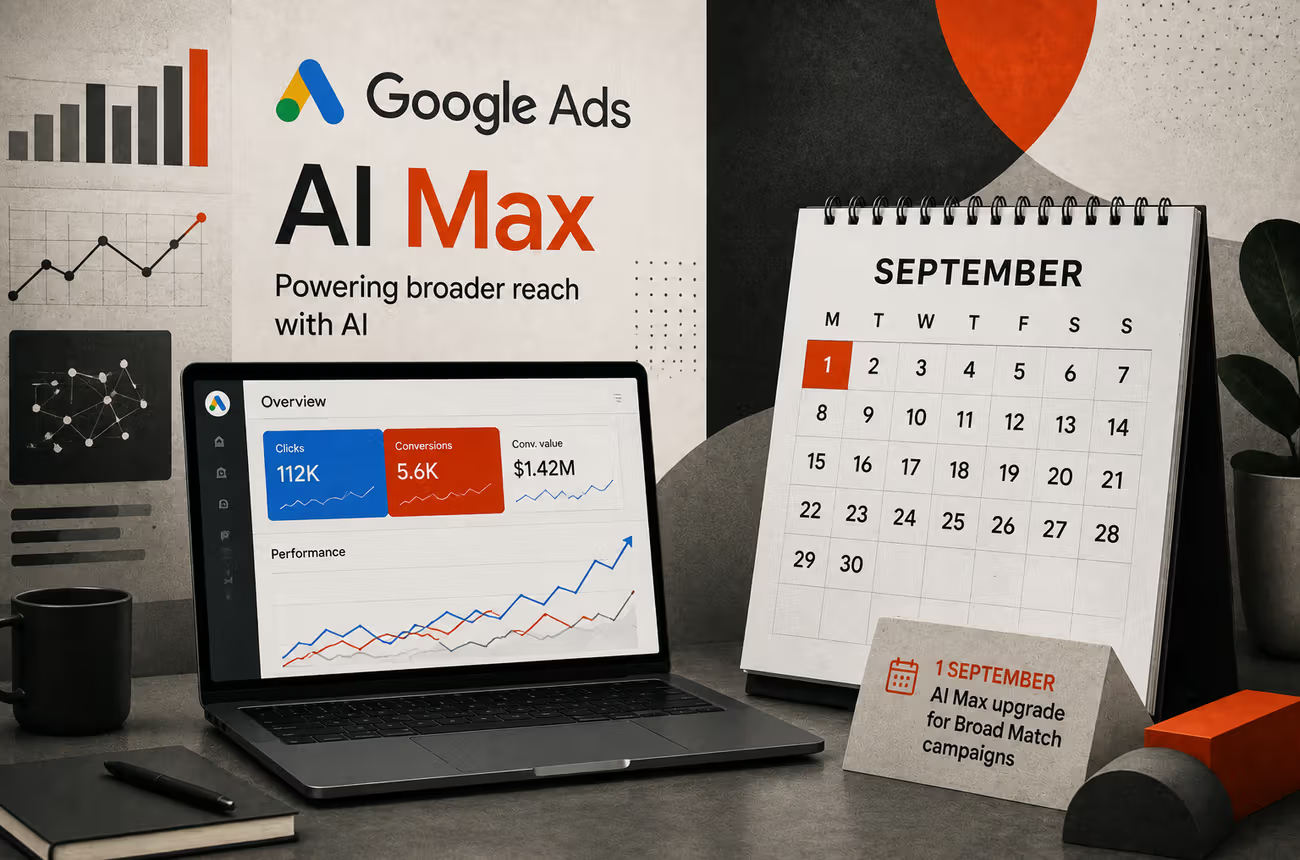
Google Ads put a calendar date on a migration most advertisers thought had been postponed. An email sent on 5 August 2026 told account holders that Search campaigns running automatically created assets or the campaign-level broad match setting will be converted to AI Max for Search campaigns from 1 September. It was signed by the Google Ads Team, not a named executive, and no blog post accompanied it.
The confusion is Google’s own doing. On 11 June the company delayed the Dynamic Search Ads migration by five months, to February 2027, and the trade press reported it as a reprieve. The extension covered Dynamic Search Ads alone. A single line in the same update kept automatically created assets and the campaign-level broad match setting on the original September schedule, and the help centre pages for both were never revised. Accounts that read June as a general postponement have just over three weeks to choose their own configuration before Google chooses it for them.
Which campaigns does the 1 September upgrade cover?
Google Ads is converting two legacy settings, and each cohort lands on a different default. Campaigns using automatically created assets will be upgraded to AI Max with search term matching and text customisation switched on. Campaigns using the campaign-level broad match setting receive search term matching alone. Accounts that never enabled either setting are unaffected.
The split has practical weight, because AI Max’s third feature, final URL expansion, requires text customisation to be active. The broad match cohort therefore gets neither generated ad copy nor landing page rerouting by default, and responsive search ads keep their pinned assets after the upgrade. That last point decides whether compliance wording stays where a regulated advertiser put it.
Google has said AI Max will be configured to mirror the legacy setup once the upgrades are complete, and that it expects all eligible upgrades to conclude by the end of September. No opt-out preserves either feature. Two levers remain. Switch the legacy settings off entirely, or enable AI Max manually through the pop-up banner in the Google Ads interface and pick the defaults instead of inheriting them.
Why is the automated assets cohort facing the bigger change?
Automatically created assets governed creative generation only. Search term matching governs which queries an advertisement becomes eligible for, which makes the September default a targeting change, not a relabelling. Campaigns that opted into automated headlines and descriptions will, from 1 September, also carry automated query expansion unless the setting is turned off at ad group level.
Two operational caveats sit in Google’s own documentation and apply to campaigns arriving through the automatic route. The first is budget. Google states that AI Max will not be effective on a budget-limited campaign, and surfaces an alert in the interface when one has AI Max enabled. Search term matching widens the pool of eligible queries without widening the budget funding it, which is the mechanism most likely to spread a fixed lead-generation budget across looser matches.
The second is tracking. Final URL expansion substitutes advertiser-supplied URLs with dynamic landing pages, and tracking templates built around fixed destinations can break. Google’s documentation identifies four supported lpurl tag patterns and warns that static tracking URLs without an lpurl tag can send users to the tracking destination instead of a landing page. This applies to the automated assets cohort only if final URL expansion is switched on later, since the September upgrade does not enable it.
Reporting changes arrive regardless of configuration. The search terms report gains AI Max as a match type, alongside a column separating broad match expansion from keywordless matching. The keywords report adds AI Max summary rows and the landing pages report adds a selected-by column.
What does the evidence say about AI Max performance?
Google puts the full AI Max feature suite at an average of 7% more conversions or conversion value at a similar CPA or ROAS, measured against search term matching alone. The footnote attached to the claim identifies it as Google internal data from 2026, excluding retail advertisers. It is a vendor figure, and it is lower than the 14% more conversions at similar cost the company claimed when AI Max entered open beta on 6 May 2025.
Independent measurement has not matched either number. Ezra Sackett, director of paid search at Monks, reported in August 2025 that 99% of AI Max impressions across roughly 30,000 search terms in client accounts produced no conversions. An analysis of more than 250 retail campaigns in November 2025 found AI Max delivering conversions at roughly 35% lower ROAS than traditional match types. Analysts separately flagged AI Max expansion onto Search Partner Network placements, where research from Intelligency Group put return on ad spend 37% below Google Search proper. All three findings were reported by the trade outlet PPC Land, and none has been replicated at scale by an independent auditor. That is a limit worth holding alongside Google’s own figure, not in place of it.
The gap between vendor-reported and independently measured performance is not confined to search. An analysis published on 28 July by the Trustworthy Accountability Group, the Association of National Advertisers and the data firm Fiducia found AI-generated inventory outscoring clean supply on the invalid traffic and viewability checks programmatic buyers rely on. It cleared at roughly 15% more per verified impression.
Google has answered the criticism by adding controls, not by retreating. Branded search controls arrived inside AI Max in May 2026, and AI Brief, a natural-language instruction layer, launched on 30 April alongside text disclaimers that force compliance wording into ads using final URL expansion. The commercial pressure runs the other way. At Google Marketing Live on 20 May, Vidhya Srinivasan, vice-president and general manager of Google Ads and Commerce, confirmed that the newest AI search ad formats are reachable only through AI Max for Search or Performance Max with text customisation. Conversational Discovery ads and Highlighted Answers are the two formats affected. Legacy Search configurations do not qualify, the same pattern visible wherever advertising is being rebuilt around AI assistants.
The same week supplied a reminder of how much of the search advertising relationship now runs on defaults. On 5 August, the day the upgrade email went out, the Competition Appeal Tribunal granted a collective proceedings order against six Google companies, certifying an advertiser damages claim on an opt-out basis. Every UK-domiciled business that paid for Google search advertising between 1 January 2011 and 15 April 2025 is inside the class unless it removes itself. The claimant side puts that group at roughly 880,000 businesses and the claim at up to £5bn. Certification settles how the case proceeds and nothing about whether Google did anything wrong. The company has said it will contest it.
Google expects all eligible upgrades to conclude by the end of September, and the Dynamic Search Ads migration follows in February 2027. The help centre pages for the two settings upgrading next month still carry the original date, unchanged since April.