Google puts Gemini Spark inside Chrome, where agents can fill B2B forms
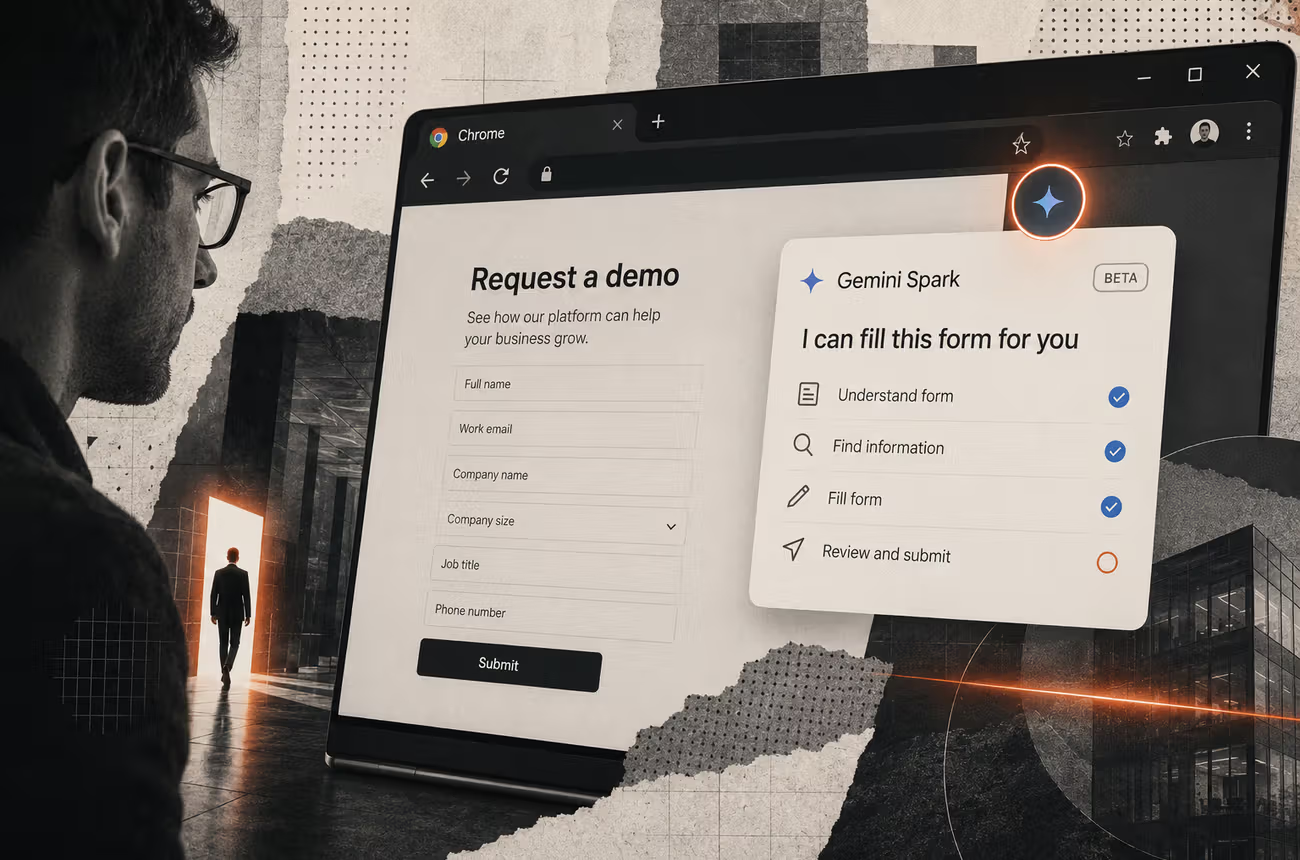
Google’s background agent stopped browsing at arm’s length on 30 July. Gemini Spark, the agent Google introduced at its I/O conference in May, can now drive a user’s own desktop Chrome, using the accounts that person is already signed into and the passwords saved in the browser, to work through multi-step web errands and hand the task back before payment.
The change reaches B2B marketing teams at the point where a website visit becomes a lead. Spark can now complete a form inside a genuine logged-in session, which makes whether a site can be operated by machine a question about conversion rather than about crawling. Google has already shipped the measuring stick: Lighthouse, its own auditing tool, added an Agentic Browsing category in May that scores how well a site holds up to machine interaction.
What can Gemini Spark do inside Chrome?
Gemini Spark can use Chrome auto browse to complete tasks on sites where the user is already signed in, according to the announcement published on 30 July by Adam Coimbra, director of product management for the Gemini app, and Charmaine Dsilva, senior director of product management. Google’s worked examples are consumer ones: scheduling viewings for saved apartment listings, or researching flight options and starting the booking process. Sensitive actions, payments among them, are handed back to the user. Google says the feature carries protection against prompt injection, where instructions hidden in a page attempt to redirect an agent, though it has not published the technical detail behind that claim.
Access is narrower than the announcement suggests. The Chrome capability is rolling out in the United States first, for subscribers to the paid Google AI Pro and AI Ultra tiers, with other regions promised later. AI Pro costs £18.99 a month in the UK and $19.99 in the US. Spark itself travelled further on the same day, reaching AI Pro subscribers in more than 160 additional countries, so the agent is now widely available while the browser capability is not. Google’s support documentation states that only Spark in desktop Chrome can use auto browse, and that Spark may still fall back to a separate remote browser Google runs itself.
The Chrome route is a narrower target than the general computer-use capability The Helm covered in July, and a more commercial one. An agent that can operate any screen is a productivity story. An agent that operates the browser, with the user’s logins, is sitting in the middle of the buying journey.
Why do agent visits no longer look like bot traffic?
Chrome auto browse runs inside the visitor’s own browser, so the request that reaches a website carries that person’s session, cookies and saved credentials rather than a declared crawler such as GPTBot or ClaudeBot. Blocking rules and analytics filters built around named crawler user agents do not catch it. Google’s announcement describes an indicator in the Chrome toolbar so the user can see Spark working, and says nothing about a signal that reaches the site being visited.
The volume question is settled at the level of the whole web, if not for any single B2B site. Cloudflare chief executive Matthew Prince said on 3 June that automated requests had passed human ones on Cloudflare Radar for the first time, at 57.5% of HTML traffic against 42.5%, roughly 18 months earlier than he had predicted at SXSW in March. The mix is shifting as well as the total. HUMAN Security’s 2026 State of AI Traffic and Cyberthreat Benchmark Report, cited by Fortune in July, put year-on-year growth in agent traffic that takes action, clicking links and completing forms, at 7,851%, against 597% for scrapers. No published dataset isolates that figure for B2B SaaS sites.
For marketing teams the near-term effect is on interpretation rather than volume. A demo request completed by an agent counts as a conversion, arrives with real contact details, and carries none of the scrolling or cursor movement that behavioural tools read as intent. Sessions that look abnormally fast and direct are worth treating as work being done rather than as bounces. The reverse failure is already documented: The Helm reported in July that agents comparing B2B vendors fall back to competitors when pricing cannot be parsed, which is the same problem one step earlier, where the agent never reaches the form at all.
How can marketers test whether agents can use their site?
Lighthouse, the auditing tool built into Chrome, added an Agentic Browsing category in version 13.3 on 7 May 2026, and it checks four things. The accessibility tree has to be sound, with a programmatic name on every interactive element and valid roles and parent-child relationships, because the tree is what an agent reads in place of the visual layout. Cumulative Layout Shift has to be low, because an element that moves between the moment an agent identifies it and the moment it acts produces the wrong action. A machine-readable llms.txt file has to sit at the domain root. And any WebMCP tools the site registers, declared in HTML or through JavaScript, have to validate.
Google has deliberately withheld a score out of 100. The report returns a pass ratio instead, on the stated grounds that standards for the agentic web are still emerging and the aim for now is to gather data and give actionable signals rather than a ranking. The category is marked experimental, needs Chrome 150 or later, and its WebMCP audits require registering for the WebMCP origin trial. The other three checks need no registration, which puts the pricing page, the demo request and the free-trial sign-up within reach of an afternoon’s testing rather than a project.
Two of those four checks are work most teams already owe someone. Naming and labelling form fields correctly is accessibility practice with an established legal case behind it in the UK, and layout stability has been a Core Web Vitals metric since 2020. The third, llms.txt, remains contested inside Google itself: search advocate John Mueller compared the file to the long-dead keywords meta tag in April 2025, on the grounds that no AI service was requesting it and server logs showed as much. Lighthouse now checks for it.
Google says the Chrome integration is rolling out in the United States first and will reach further regions in the future. It has not given a date.