Google builds computer use into Gemini, letting agents operate any screen
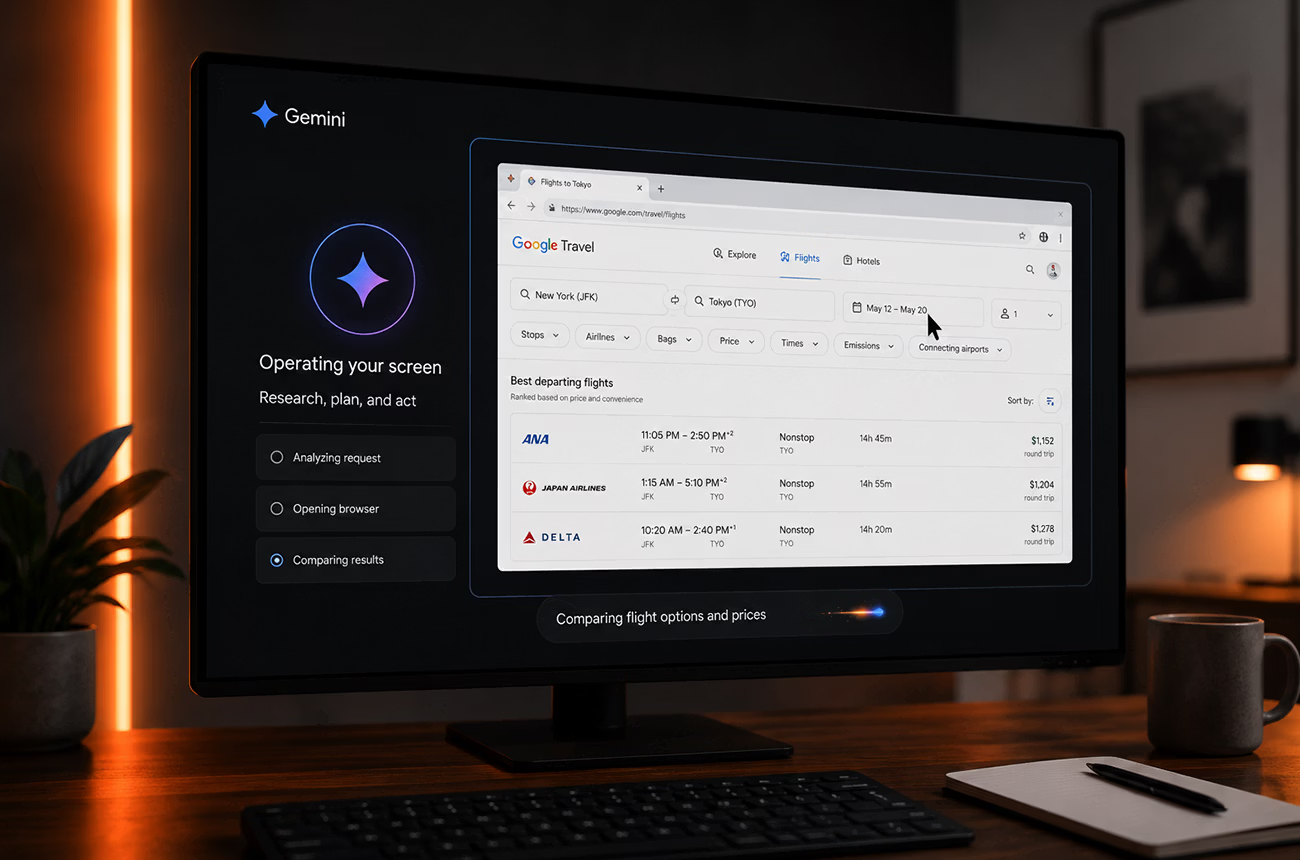
Google has handed its mainstream AI model the keys to the screen. On 24 June it made “computer use” a built-in tool in Gemini 3.5 Flash, so a single model can see a display and then click, type and scroll through a browser, a phone app or a desktop program much as a person would.
The change folds a capability Google previously sold as a separate model into the everyday developer model, and it arrives as the industry pivots from AI that answers questions to AI that does the work. The quieter implication runs past the demo: if agents increasingly research, compare and complete tasks across software, the next visitor moving through a company’s website or product may be a machine acting for a buyer rather than the buyer in person.
What Google built into Gemini 3.5 Flash
Gemini 3.5 Flash now carries computer use as one of its built-in tools, sitting alongside Search grounding and function calling. A developer can switch it on with a single parameter, the same way they would enable web search, and the model can then operate browser, mobile and desktop interfaces in one session. Until now the capability lived in a standalone Gemini 2.5 model, released in October 2025 and confined mainly to the browser; merging it into Flash lets one agent see a screen, look something up and act on it without passing requests between models.
The feature runs as an observe-think-act loop. The developer’s software sends Gemini a screenshot and a goal; the model reads the pixels, identifies the buttons, fields and menus, and returns a precise instruction such as a click at set coordinates, a keystroke, a scroll or a form entry; the application carries out the action, sends a fresh screenshot, and the cycle repeats until the task is finished. Google points the tool at long-horizon work such as continuous software testing, research across many websites, repetitive form filling and data entry into legacy systems, and offers it through the Gemini API and the Gemini Enterprise Agent Platform, its renamed Vertex AI. It is a preview aimed at developers and enterprises rather than a consumer feature, and was announced by Google DeepMind product manager Mateo Quiros.
Google reports a score of 78.4% on the OSWorld-Verified benchmark for the new model, up from 65.1% for the previous Flash generation, though that figure is self-reported, as such vendor benchmarks tend to be. The pitch leans partly on cost: Flash is one of Google’s cheaper models, which makes running many agents in parallel less expensive than on a heavier model. Whether the saving holds depends on how many steps a task takes and how often the safety guardrails pause to ask a human for confirmation.
How far the move from chat to agents has gone
The capability matters because delegating work to agents has stopped being hypothetical. The day after Google’s announcement, OpenAI reported that its rival Codex agent had passed five million weekly users, with non-developers — among them analysts, marketers, finance and legal staff — now around a fifth of the total and growing faster than the developer base; it put organisational adoption of the tool at roughly 17% and individual adoption under 1%. Those are OpenAI’s own, unaudited figures, and read better as direction than as gospel, but the corroboration is concrete: Samsung handed Codex to its entire South Korean workforce, marketing teams included.
Across Google, OpenAI and Anthropic, which pioneered computer use in Claude, the direction is the same. The unit of AI work is shifting from a short chat to a delegated, multi-step task an agent carries out on its own, and a growing share of that work is screen-based: navigating tools, pulling figures from dashboards, moving data between systems that were built for people. The agents doing it operate the very software and websites that marketing teams build and rely on.
What it changes for a marketing team
The practical question for marketers is whether an agent can actually complete a task on their site. If a buyer (or the buyer’s agent) asks software to compare vendors, find a price or start a trial, success depends on whether a machine can read the page, locate the right control and finish the journey. The work that makes a site legible to an agent is the work that already makes it legible to a person and to a search crawler: clear structure, labelled and stable interface elements, content that states things plainly, and flows that can be completed without guesswork. It is a low-regret investment, useful for humans, accessibility, search and AI citation well before any agent arrives.
There is a second, nearer-term edge. The cross-tool grunt work that drains a thin marketing team, such as testing a new landing page across browsers, filling the same fields into three systems or pulling weekly numbers from a dashboard, is exactly the kind of long-horizon, screen-based task computer use is built for. For a team told to do more with AI without more headcount, the value is less in a clever campaign than in handing off the repetitive navigation that no one wants to do by hand.
None of this is settled, and the calm reading is warranted. Computer use ships as a preview, its safety controls — confirmation before sensitive actions, and an automatic stop when prompt injection is suspected — are opt-in, and agents still stumble on CAPTCHAs, pop-ups, dynamically loaded content and layouts they have not seen. It is a capability for developers and enterprises today, not a wave of consumer agents browsing the web.
For now the unresolved question for marketers is not whether computer use works, but whether the sites and tools they run can be navigated by something that reads pixels rather than meaning — and that is a question worth answering before the answer is forced.