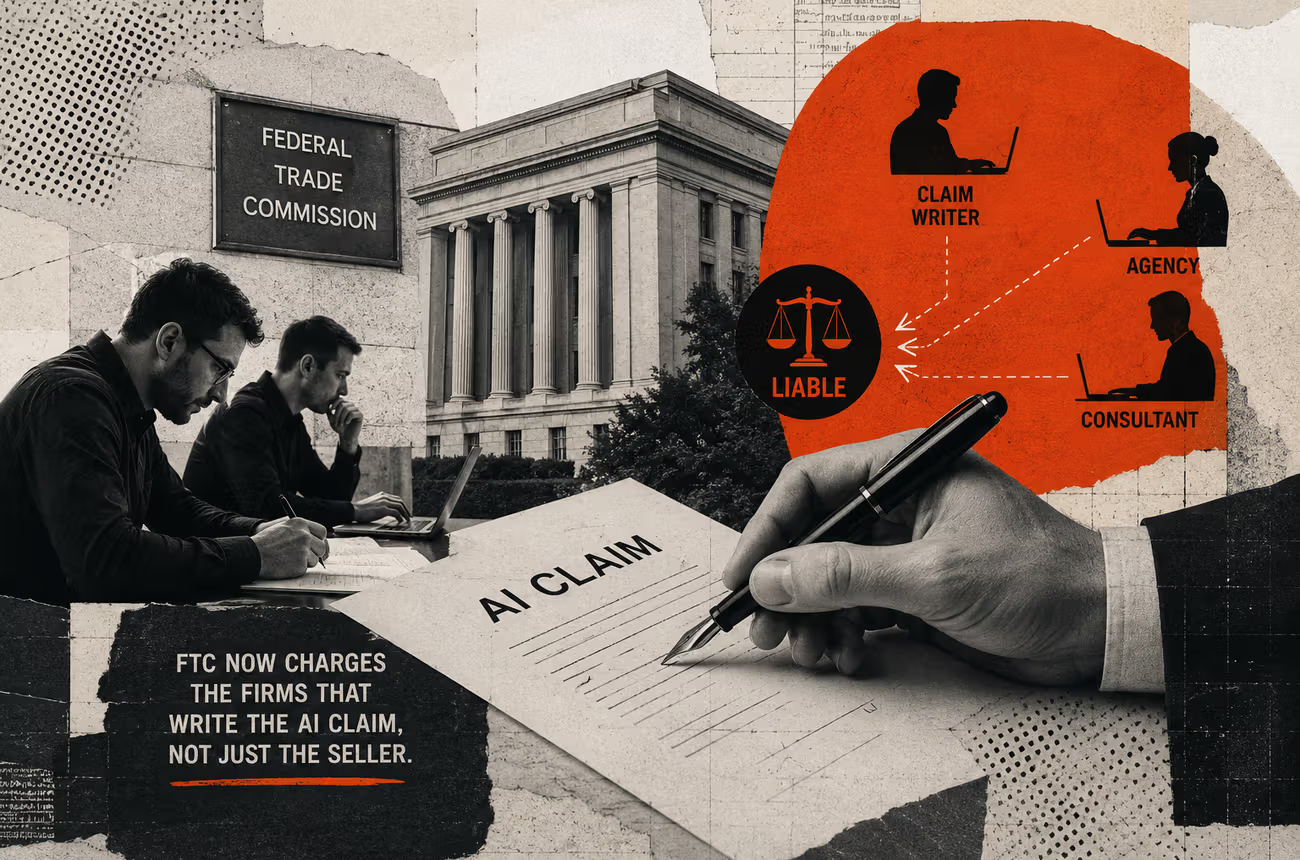
FTC now charges the firms that write the AI claim, not just the seller
The small businesses that bought Cox Media Group’s Active Listening service were told an algorithm was picking up consumers’ conversations through phones, televisions and smart speakers, then serving those people local ads. According to the Federal Trade Commission, what they actually received was an email list bought from data brokers and resold to them at a markup.
CMG Media Corporation, which trades as Cox Media Group, agreed on 21 May to pay $880,000 (about £645,000) to settle the regulator’s deception charges. Two marketing firms that worked with it, MindSift LLC of New Hampshire and 1010 Digital Works LLC of Wisconsin, agreed to pay $25,000 each. The combined $930,000 (about £680,000) is earmarked as redress for CMG’s customers, and those customers were businesses. Two things follow from that. The FTC’s artificial intelligence enforcement has stopped being only a consumer-protection exercise, and the firms that write the marketing materials are now being charged alongside the firms that sell the product.
What did the FTC say the Active Listening service actually did?
Active Listening did not listen. The FTC’s three complaints allege the service collected no voice data at all, obtained no consumer consent, and did not place ads accurately in the areas customers were paying to reach. What the companies supplied instead, according to the complaints, was resold data-broker email lists.
The consent claim drew separate attention. All three companies told prospective customers that consumers had opted in to voice collection by accepting app terms of service. The Commission rejected that reading directly, stating that clicking through mandatory terms does not constitute opt-in consent for collecting voice data inside people’s homes. It went further in the press release: had the service worked as advertised, collecting that data on that basis would itself have breached Section 5 of the FTC Act. The distinction sits close to the one the Commission has drawn elsewhere on consent, and to the labelling questions raised when the EU AI Act’s transparency rules took effect on 2 August.
Under the proposed orders, all three companies are barred from misrepresenting the qualities or features of their advertising services, the collection and use of voice data, whether consumers consented, and their geographic targeting capabilities. The Commission voted 2-0 to issue the complaints and accept the consent agreements. None of the three has publicly contested the allegations, and no statement from any of them was available at the time of writing.
Why is the FTC pursuing AI claims made to businesses?
The FTC’s deception authority covers businesses when they buy as customers, and it is now using it that way routinely. DLA Piper, which tracks the agency’s AI docket, counted the Active Listening action as the thirteenth AI-washing case the FTC has filed since 2024, and noted that seven of the last eight involved marketing claims made to other businesses rather than to end consumers. That is a marked shift from the sweep the agency launched in September 2024 under the Operation AI Comply banner, which was framed around consumer harm.
Holland & Knight named the same pattern in a two-year review of Operation AI Comply published on 18 August, listing scrutiny of business-to-business marketing claims as one of two defining enforcement trends. Its point for marketing teams is specific: the same substantiation requirements and deception standards apply whether the audience is a consumer or a sophisticated business buyer. FTC chairman Andrew Ferguson framed the programme to the Senate Commerce Committee in April as pro-innovation, describing the agency’s aim as encouraging growth in the AI market by targeting bad actors who undermine innovation through deception.
The substantiation bar is where most of the exposure sits. The FTC has not written a bespoke rule for AI claims; it applies the ordinary requirement that objective claims be supported by evidence at the moment they are made. The BBB National Programs’ National Advertising Division, which reviews advertising on a self-regulatory basis and creates a public record regulators can cite, has flagged three recurring problems in AI advertising: marketing features as available before they ship, demonstrations implying performance the product cannot consistently deliver, and productivity claims resting on user perception rather than measurable data. The advertising industry has been drawing its own line on the same territory, as the IAB’s Version 2 disclosure framework shows.
Who is liable when an AI claim travels through a channel?
MindSift and 1010 Digital Works faced a second count that CMG did not. The FTC charged both with supplying CMG the “means and instrumentalities” to deceive its customers, through marketing materials, sales pitches and prepared answers to customer questions that misrepresented what Active Listening could do. Neither firm sold the service to the small businesses; both wrote the words that did.
DLA Piper reads this as the first FTC action to carry such a count since the Commission reopened a settled AI matter involving Rytr LLC in December 2025 and vacated the earlier order, criticising the breadth of its means-and-instrumentalities theory and restating the doctrine’s proper scope. One traditional application the Commission identified then was precisely this: supplying deceptive marketing material to a seller who uses it on customers. The line the FTC appears to be drawing separates a tool that could be misused from content that is misleading on delivery.
For marketing teams the practical distinction is between originating a claim and repeating one. A vendor’s capability claim carried unchanged into a partner deck, a case study or a landing page is a claim the repeater is making too, and it is the repeater’s name on the page. Unsupported capability figures remain common in the category: Ahrefs led the launch of its Letaido agent workspace with a customer’s claim that a 40-hour week of research now takes an hour, published with no supporting data. The workable safeguard is documentary rather than editorial: asking a vendor for the testing, validation or performance data behind an AI capability claim, in writing, at the point the claim enters the copy.
The proposed orders are not yet final. All three FTC case dockets still listed the matters as pending on 25 August, three months after the announcement, with the consent agreements subject to public comment before the Commission decides whether to finalise them. Once an order is made final, each violation of it carries a civil penalty of up to $53,088.