IAB tells advertisers not to label every AI ad as new laws take effect
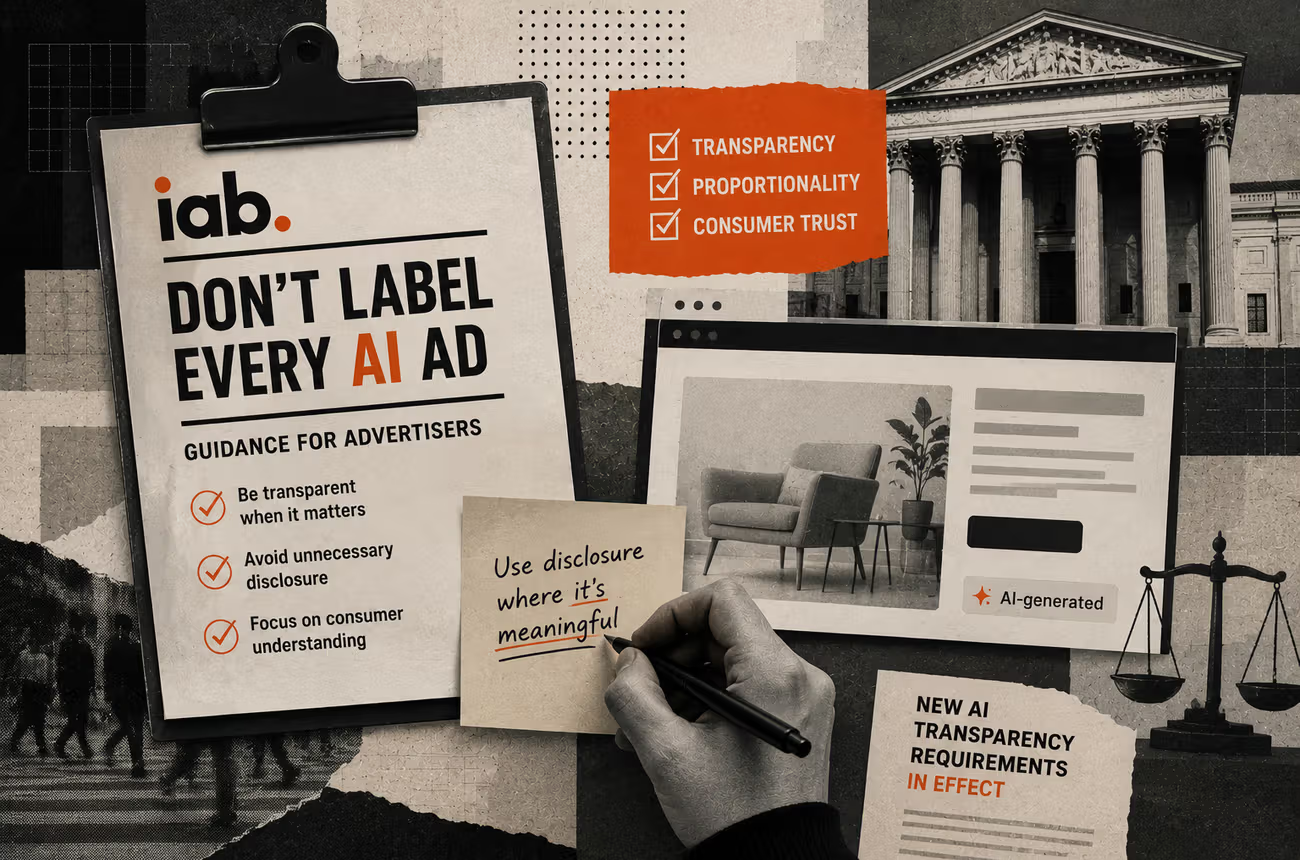
The advertising industry has drawn its own line around when AI use in a campaign must be disclosed, and it runs against the instinct to label everything. On 18 August the Interactive Advertising Bureau (IAB) published Version 2 of its AI Transparency and Disclosure Framework, a voluntary standard that calls for a consumer-facing label only when AI materially affects authenticity, identity or representation in ways that could mislead people.
The framework arrives after a fortnight in which real disclosure law took effect on both sides of the Atlantic. The EU AI Act’s Article 50 and California’s SB 942 both became enforceable on 2 August, adding to a New York synthetic-performer law and a revised South Korean AI Basic Act already in force. With generative tools now routine in campaign production, marketing teams face a growing gap between how much AI they use and how much of it they are expected to declare, and until this update there was no shared industry view on where the line sits.
That gap is what the IAB is trying to close for its members, which number more than 700 media owners, brands, agencies and technology firms. The document is an industry position rather than a legal one. It states that regulation takes precedence over self-regulation, and it is built to give advertisers a single baseline to work from instead of a separate reading of every jurisdiction’s rules.
When does the IAB say AI use needs a label?
The IAB frames disclosure as a question of consequence, not of how much AI was involved. A label is called for when AI could mislead a reasonable person about what is authentic, who is real, or what actually happened, which the framework calls its materiality test. It is not called for when AI has simply helped make the work.
The higher-risk list is specific. It covers images and video generated from prompts, some synthetic voices, synthetic avatars, digital twins of deceased individuals, digital twins of living people placed in fabricated situations outside a standard brand endorsement, and AI chatbots or assistants that a consumer could mistake for a human representative. For a B2B SaaS team, that reaches into now-common tactics: an AI-generated spokesperson fronting a product demo, a fabricated customer scenario, or a website assistant that answers as though it were a person.
The other side of the list is just as useful, because it names what does not trigger a label. Routine post-production, internal workflows, clearly fantastical imagery, generic synthetic voices, background music, standard audio enhancement, obvious cartoon or stylised avatars, and the category most marketers were unsure about, text and copy, are all treated as not automatically requiring disclosure. AI used to draft, edit, resize or translate an asset sits outside the threshold on its own.
What is the case against labelling everything?
The IAB’s central argument is that over-disclosure carries its own cost. “Not every use of AI needs a label,” said Caroline Giegerich, the bureau’s vice-president for AI. “Labeling everything teaches consumers to ignore labels and could negatively impact advertisers.” The working group’s task, she said, was to avoid two failures at once: under-disclosure that leaves people misled, and over-disclosure that drains the label of meaning.
The position rests on research the IAB published with Sonata Insights alongside the first framework in January. That study found consumer views on AI in creative were split, read by some as legitimate and by others as inauthentic, but that more than half of consumers wanted brands to disclose when an ad was fully AI-generated or used AI imagery or video. For anyone weighing the commercial risk of a label, one finding stands out: 73% of the Gen Z and Millennial respondents said clear disclosure would either raise their likelihood to buy or make no difference to it.
For marketing teams, that reframes disclosure as a trust decision rather than a purely defensive one, and gives them evidence to bring to a cautious legal or brand review. A targeted, honest label on the content that genuinely needs it is not the conversion risk it is often assumed to be. A label on everything is the greater threat to the signal.
Does the framework override the new disclosure laws?
The framework overrides nothing, and the IAB is clear that it sits beneath the law. Where a jurisdiction sets a binding rule, that rule governs; the framework’s job is to give advertisers, agencies, publishers and platforms a common reference so they are not reading each market from scratch. In the United States it offers two ways to satisfy a disclosure, a standardised “sparkle” icon or a plain text label, either of which the IAB treats as sufficient.
Agencies sit in the middle of this, translating the framework into the work that actually runs, and much B2B SaaS creative is produced exactly that way. Simon Poulton of the agency Tinuiti, one of the working-group contributors, said consistent guidance on disclosure means less guesswork and less risk for the brands an agency represents. That matters because deployer duties under the new laws can rest with the brand even when an agency made the asset, a point The Marketing Helm examined in its coverage of the EU rules.
Europe is the sharper reminder that the industry standard and the statute are different things. The Marketing Helm reported on 7 August that the EU AI Act’s Article 50 became enforceable on 2 August, with the European Commission’s guidance confining the duty to label AI-written text to public-interest publishing and leaving most commercial copy outside it, while still catching deepfakes, synthetic endorsements and certain health or sustainability claims. A UK or EU marketing team selling into Europe answers to that regime first. The IAB framework is a way to hold one consistent internal policy across it and the patchwork of US state laws, not a substitute for either.
In the United States the framework lets an advertiser meet a disclosure with either the sparkle icon or a text label. In the European Union, where Article 50 has been enforceable since 2 August, the common icon the Commission has floated for the same job is not yet finalised.