Being named in ChatGPT’s own query beats being crawled, analysis finds
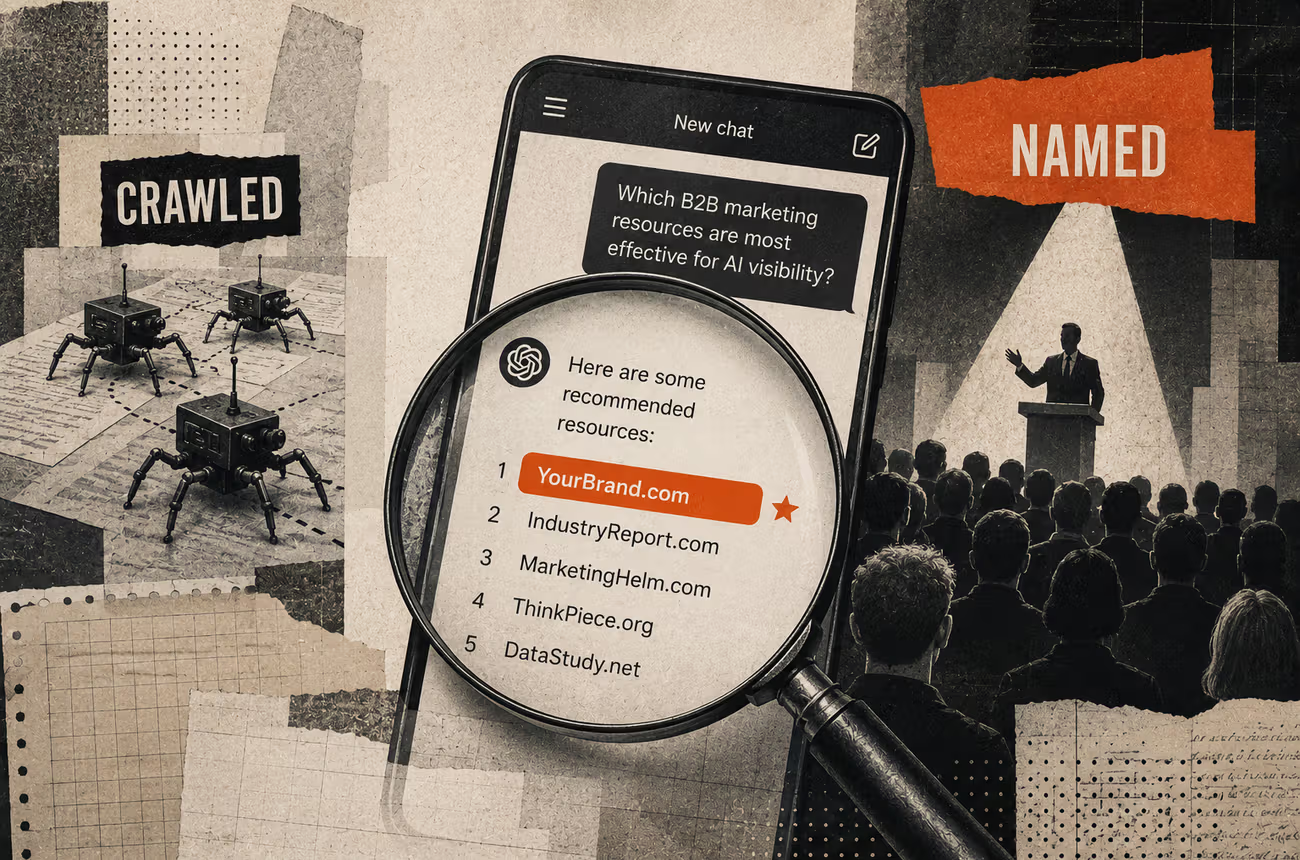
Before ChatGPT fetches a single web page, it has often already written the names of the brands it might recommend into its own search query. That is the finding at the centre of a network-traffic analysis published on 10 August 2026 by Suganthan Mohanadasan, a Norwegian search consultant based in Dubai, who read the raw traffic behind 60 ChatGPT conversations to work out where the assistant’s brand recommendations actually come from.
The distinction cuts against most of what marketers are sold as generative engine optimisation, or GEO, which aims at retrieval: making a site crawlable, parseable and worth fetching. Mohanadasan’s reading of the traffic points the prize earlier, to whether the model already knows a brand well enough to name it unprompted. If that holds, a share of AI visibility is set by brand familiarity accumulated over months, not by a page-level fix shipped this quarter.
He is candid about the limits. Every percentage in the analysis comes from one ChatGPT Plus account across roughly 60 conversations captured over two days, which he describes as solid on mechanism but only directional on scale.
What did the analysis find?
Mohanadasan captured raw HTTP traffic from a logged-in ChatGPT Plus account in Dubai on 24 and 25 July 2026, then read the JSON field that carries the queries the model writes for itself. When a user asks for a recommendation, ChatGPT does not pass the prompt straight to a search engine. It expands the request into several of its own queries, a process known as query fan-out, and those queries frequently arrive already populated with brand names the user never mentioned. Across the sample, brands that appeared in ChatGPT’s first self-generated query reached the final answer 68.9% of the time. Brands retrieved during the session but never named in any query reached it 2.1% of the time, a gap of roughly 33 times.
In 21 of 27 opening queries the model had already inserted brand names the user never typed, across 11 of 13 product categories. A request for the best AI note-taking app, for instance, produced a first query that already listed Granola, Notion AI, Otter, Fireflies, Fathom, Mem and Limitless, names drawn from the model’s training rather than the live web. Selection then tightened downstream: of 3,554 pages the model retrieved across 57 conversations, only 110, about 3.1%, reached an answer at all, and in 86 cases a brand was recommended without its site being fetched during the conversation. Mohanadasan also documented a routing pattern within the fan-out, with factual queries steered towards official pages and opinion-led ones towards review sites and Reddit.
How much weight should the numbers carry?
Mohanadasan states plainly that the figures are directional, not measured, and he revised the piece a week after publishing it. The version posted on 10 August carried a headline implying the recommendation was settled before any search ran. Further testing, he wrote in a 17 August update, showed that brands never named in the model’s own queries still reached the final answer, including as the recommendation itself, and that the search genuinely changes the result. He recast the claim: a brand is ‘in the running’ before the search, a strong predictor of inclusion rather than a guarantee of it. That correction is the opposite of the certainty the raw 33-times figure invites, and it matters for any marketer deciding how hard to act on it.
The finding drew quick amplification. Rand Fishkin, co-founder of SparkToro, shared it on LinkedIn and, as reported by PPC Land, characterised much conventional AI-visibility work as sitting somewhere between potentially misleading and useless. That is his reading rather than a measured result, and the underlying data remains a single-account sample awaiting independent replication.
What does it change for how marketers approach AI visibility?
For a B2B marketing manager, the analysis reframes the question from whether a site is optimised for AI to whether the model already knows the brand. Crawlability still counts, because the search can change the outcome, but it is no longer the whole contest: a brand the model has never internalised may never be looked at, however well built its pages. That squares with earlier reporting The Helm has covered, including a finding that B2B brands rank for thousands of keywords yet appear in only a small share of AI answers, and a survey concluding that no single GEO technique reliably lifts visibility across engines.
The common thread is that model-level familiarity, built through consistent presence in the sources models learn from, is slower to move and harder to buy than a technical checklist. Marketers need not take the percentages on trust to test the mechanism. It is reproducible: opening a browser’s network tab during a ChatGPT search, or using the free FanoutFox extension Mohanadasan has released, exposes the model’s own first query and whether a given brand is named in it, category by category.
No independent, multi-account replication of the citation figures has been published, and the JSON field the analysis depends on was renamed once already in early August, from search_model_queries to search_queries. The mechanism is visible to anyone who looks; the size of its effect is not yet settled.