Social media is the world’s top news source — and marketing has to follow
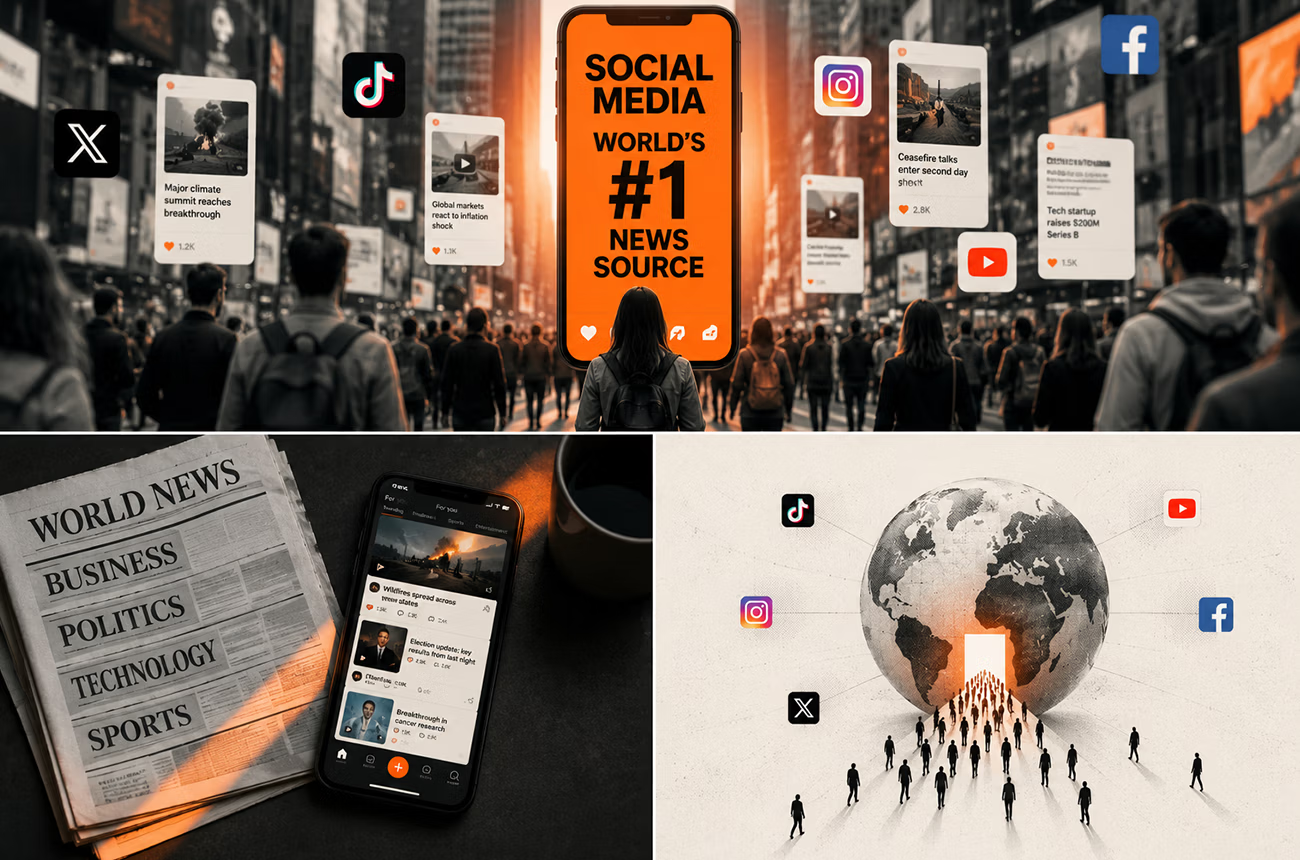
The way the world finds its news crossed a line in 2026, and there is a marketing budget on the other side of it. For the first time at a global level, social media and video networks have overtaken news organisations’ own websites, apps and television as the most widely used way of accessing news, according to the Reuters Institute’s Digital News Report 2026, the most comprehensive annual study of how people consume news. Social and video are now used by 54% of people across 48 markets, just ahead of news organisations’ own channels at 51%.
The report is about news habits, not buying decisions, so the read-across to marketing is an inference rather than a finding. But it is a reasonable one. The same shift the report documents — audiences moving off owned channels and search, and onto platforms, creators and AI answers — is the shift already reshaping how B2B buyers encounter brands. When attention and trust migrate to surfaces a company does not own, the discipline that earns presence and credibility on those surfaces, rather than buying or owning it, is the one that gains ground.
What did the Reuters Digital News Report find?
The Reuters Institute’s Digital News Report 2026, based on a survey of nearly 100,000 people across 48 markets, describes an intensifying “platformisation” of news. Social media and video networks now lead both television and publishers’ own sites as a weekly source of news for the first time globally. Online video has spread with them: 77% of the global sample watch online news video each week, and a majority now do so in every market the report covers — but the growth is happening on third-party platforms such as YouTube, TikTok and Instagram, not on news organisations’ own pages.
Creators have moved from the edge of the picture to the middle of it. The report found 27% of people now get news from news-focused creators and influencers, and 46% from creators of any type, with the most common reason being that creators are easier to understand than traditional outlets. AI chatbots are a smaller but growing route: 10% of people now use them for news each week, up from 7% a year earlier, rising to 16% of the under-35s.
Trust is the part that reads as a warning and turns out to be more useful than that. Trust in news overall has fallen to 37%, the lowest the report has recorded since it began measuring in 2015 and down from 40%, with declines in 29 of the 48 markets and a figure of 25% in the United States. Yet the report is explicit that trust in the most widely used individual news brands is holding up far better than trust in “news” as a category. Much of the headline decline reflects the consumption mix shifting towards social media and AI, which are trusted less — 22% and 20% respectively — than the legacy sources audiences are leaving.
Why does a news-consumption report land on marketing budgets?
Marketing teams should read the report because the channels it shows eroding are the same ones much of B2B marketing was quietly built on. Organic Google search traffic to more than 2,500 news sites fell by a third globally between November 2024 and November 2025, and by 38% in the United States, according to Chartbeat data cited in the report. Publishers expect search referrals to fall by a further 43% over the next three years, in a Reuters Institute survey of 280 media leaders, with around one in five bracing for losses above 75%. The cause is the rollout of Google’s AI Overviews and AI Mode, which answer more queries without a click.
That is a publisher problem on the surface and a marketing problem underneath it. For fifteen years a large share of content marketing followed the same logic as newsroom audience strategy: write for keywords, win the featured snippet, justify the work by pageviews. As the search pipe narrows and AI answers absorb the clicks that used to flow to web pages, the playbook that depended on ranking is losing its return — for brands as much as for publishers.
What does not narrow is the value of being talked about somewhere a buyer already is. If audiences increasingly meet information through social feeds, creators and AI assistants rather than by navigating to a site, then a brand’s visibility depends on being referenced across those surfaces — covered by trusted outlets, discussed by credible creators, and cited when an AI assistant answers a question in its category. That is the core work of digital PR, and it is why the report points, indirectly but clearly, at a budget reallocation rather than a panic.
What does the shift actually reward?
The report rewards earned authority over rented reach, which is the more durable asset for a B2B brand in any case. The single most reassuring finding for marketers is that trust did not evaporate when consumption moved to platforms — it moved with the brands that had earned it, while trust in unattributed “news” fell. A recognised, distinctive brand that people seek out on purpose held its ground; reach for its own sake did not.
The AI picture carries the same lesson. Among people who use chatbots for news, 42% say they always or often click through to the original source, and chatbot users tend to be heavier, more engaged news consumers rather than people abandoning brands. Being the source an AI assistant cites is therefore worth more than being one more page it summarises and discards — which makes the emerging work of generative engine optimisation, earning citations in AI answers, a close cousin of digital PR rather than a separate technical chore.
For a B2B SaaS marketing team, the practical reading is steadying rather than alarming. The case for digital PR in 2026 is not that owned content and search no longer matter; it is that they can no longer carry the load alone, and that earned coverage, credible third-party mentions, creator relationships and AI citation are where attention and trust now concentrate. The marketers who built genuine brand authority, rather than optimising for crawlers, are the ones the data says are best placed.
The report’s United States data shows the crossover plainly: social media rising past both television and news websites by 2026, with AI chatbots still near the foot of the chart but climbing. The global lines differ market by market, but the direction does not. The report’s own framing is that this is a phase of disruption and openness rather than collapse — and for marketing teams, the choice it forces is where to be found, not whether to be found at all.