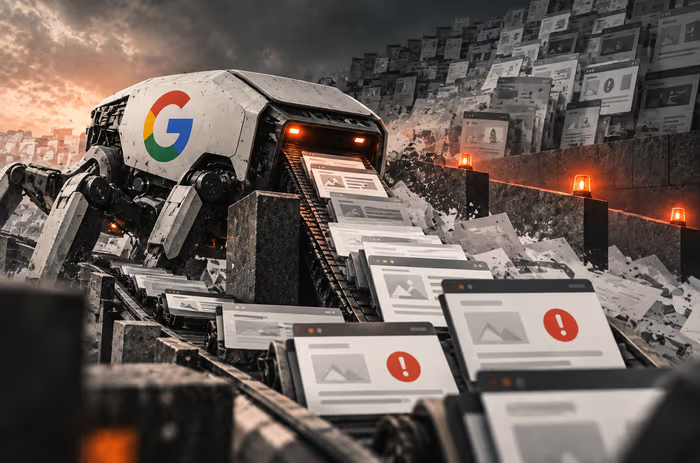
Amazon, Uber and Walmart cap staff AI use as token bills outrun budgets
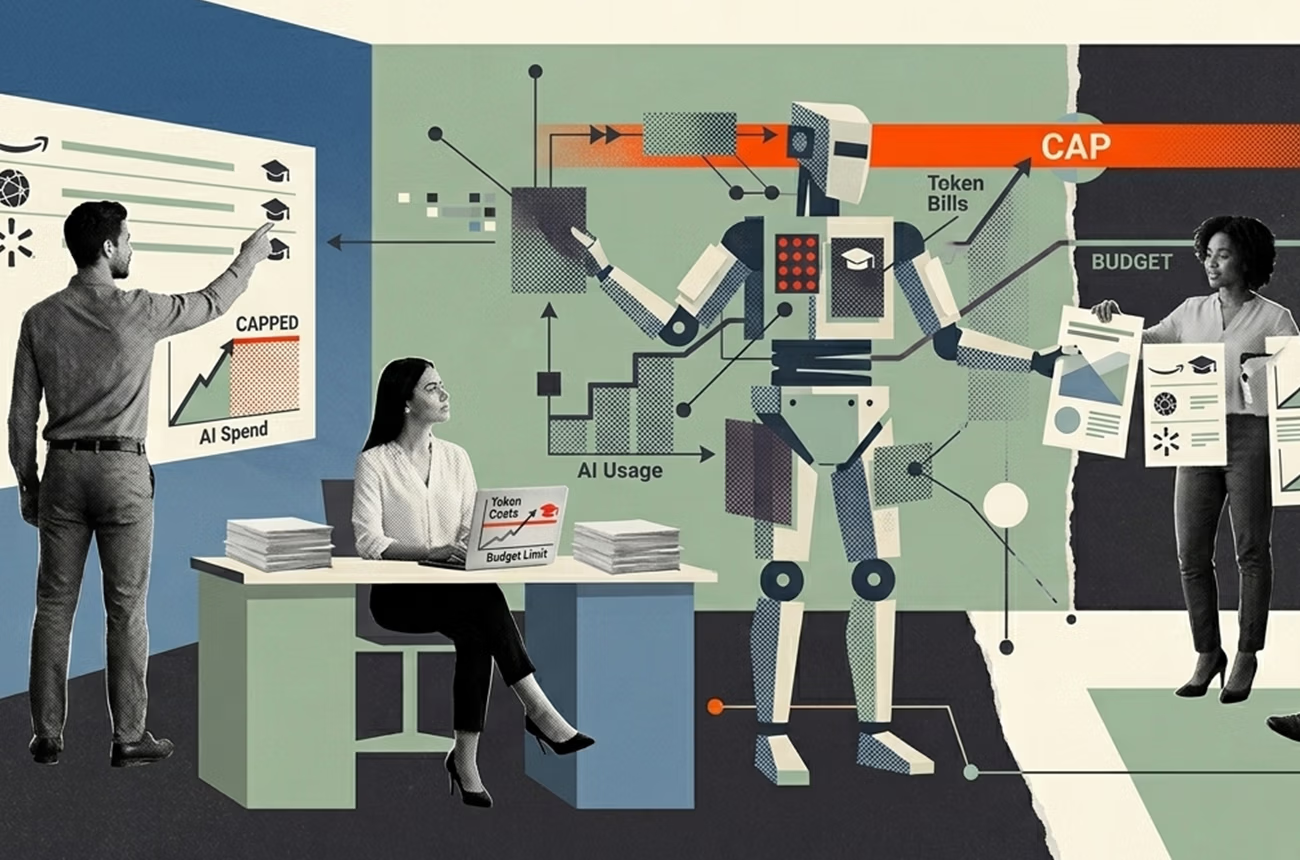
Uber spent the early part of 2026 encouraging its engineers to use artificial intelligence as freely as possible, even ranking internal usage on leaderboards. It burned through its entire annual budget for AI coding tools in four months. By June the company had reversed course, capping each employee at roughly £1,150 ($1,500) a month for each tool. It is not alone.
The about-turn, reported by Bloomberg, is one of several. Amazon, Walmart, Cisco and Meta have all moved to cap, ration or discourage staff AI use in recent weeks, according to the Financial Times, as a shift from flat subscriptions to usage-based billing exposes how expensive the technology becomes once whole workforces lean on it. For marketing teams that have spent a year being told to “do something with AI”, the development marks the point where the free-feeling phase ends and the budgeting begins.
Why has AI suddenly become so expensive to run?
Token-based pricing is the proximate cause. Where vendors once charged a flat monthly fee per user, groups including Anthropic and OpenAI have moved some services to billing by the token — the small units of text a model reads and generates — so the bill now climbs with every query rather than sitting still. The shift rewards heavy use with heavy invoices, and agents make the arithmetic punishing.
“The amount of infrastructure needed for an agent is meaningfully higher than for a chatbot,” Dylan Patel, founder of the research firm SemiAnalysis, told the FT. “For every human you might have 10, 100 or on the aggressive side 1,000 agents . . . they just keep working.” Because agents run multi-step tasks without waiting for a person, they generate tokens continuously rather than in the short bursts of a chat. Goldman Sachs analysts have predicted that the spread of agents will drive a 24-fold increase in token consumption by 2030.
Software firm Workato saw the effect first-hand. When Anthropic moved it to token-based pricing in May, its spending rose sevenfold on the first day. “We created a monster,” its chief information officer, Carter Busse, told the FT, adding that flat per-user pricing had sheltered customers from the true cost of what they were using.
Which companies are capping AI use, and how?
Uber has gone furthest in public. The ride-hailing company limits staff to roughly £1,150 ($1,500) a month for each agentic coding tool, such as Anthropic’s Claude Code or Cursor, after individual engineers ran up bills of $500 to $2,000 a month, Bloomberg reported. Employees monitor their spend on an internal dashboard and can request to exceed the cap; the limit applies only to coding tools, not to AI use across the company. Praveen Neppalli Naga, Uber’s chief technology officer, told The Information in April that the company had already exhausted its full-year AI coding budget.
The other measures vary in severity. Walmart has capped how much staff can use its in-house AI agent, according to people familiar with the matter cited by Bloomberg. Amazon stopped short of a hard limit, warning employees last month against using “AI just for the sake of using AI” after engineers began deploying agents to climb internal leaderboards, the FT reported. Some companies have gone a different route entirely, telling workers to run open-source models locally on their own servers or devices to cut the bill owed to AI labs and cloud providers.
The common thread is governance arriving after the experiment, not before it. Costi Perricos, who leads generative AI work at Deloitte, told the FT that compute costs were now entering the minds of chief financial officers and boards, and that consumers and businesses had been taught AI was cheap or free when it was neither.
What does the squeeze mean for marketing teams?
Marketing is already among the rising consumers of these tools, so the discipline now reaching engineering will not stop there. Dara Khosrowshahi, Uber’s chief executive, told The Information that legal and marketing teams had increased their AI usage alongside engineers as agents moved beyond coding. The lesson emerging across these companies is not that adopting AI was a mistake, but that the same task rarely needs the most expensive model to do it.
That is a distinction marketers can act on directly. Routine work — summarising a report, drafting a first pass, reformatting copy, classifying inbound leads — runs perfectly well on cheaper or open-weight models, leaving frontier models for the genuinely hard reasoning where they earn their price. Matching the model to the task, rather than reaching for the most capable one by reflex, is fast becoming the difference between a defensible AI budget and a runaway one. The marketing manager who understands token economics is better placed, not more exposed, as the caps come in.
Relief may also come from cheaper supply. Chinese AI models have overtaken their US counterparts in token consumption since the start of the year, according to data from the aggregator OpenRouter cited by the FT, helped by cheaper energy and more efficient models that let Chinese labs undercut US prices. For buyers, more competition at the lower end of the market is one of the few forces pushing in the opposite direction to the bills.
What none of the companies has yet shown is that the spending bought a proportionate return. Andrew Macdonald, Uber’s chief operating officer, said on a recent podcast that it was very hard to draw a line between rising token consumption and new features customers actually use. Until that line can be drawn, the caps are likely to stay.