Accenture says HR must manage AI agents — marketing is accountable first
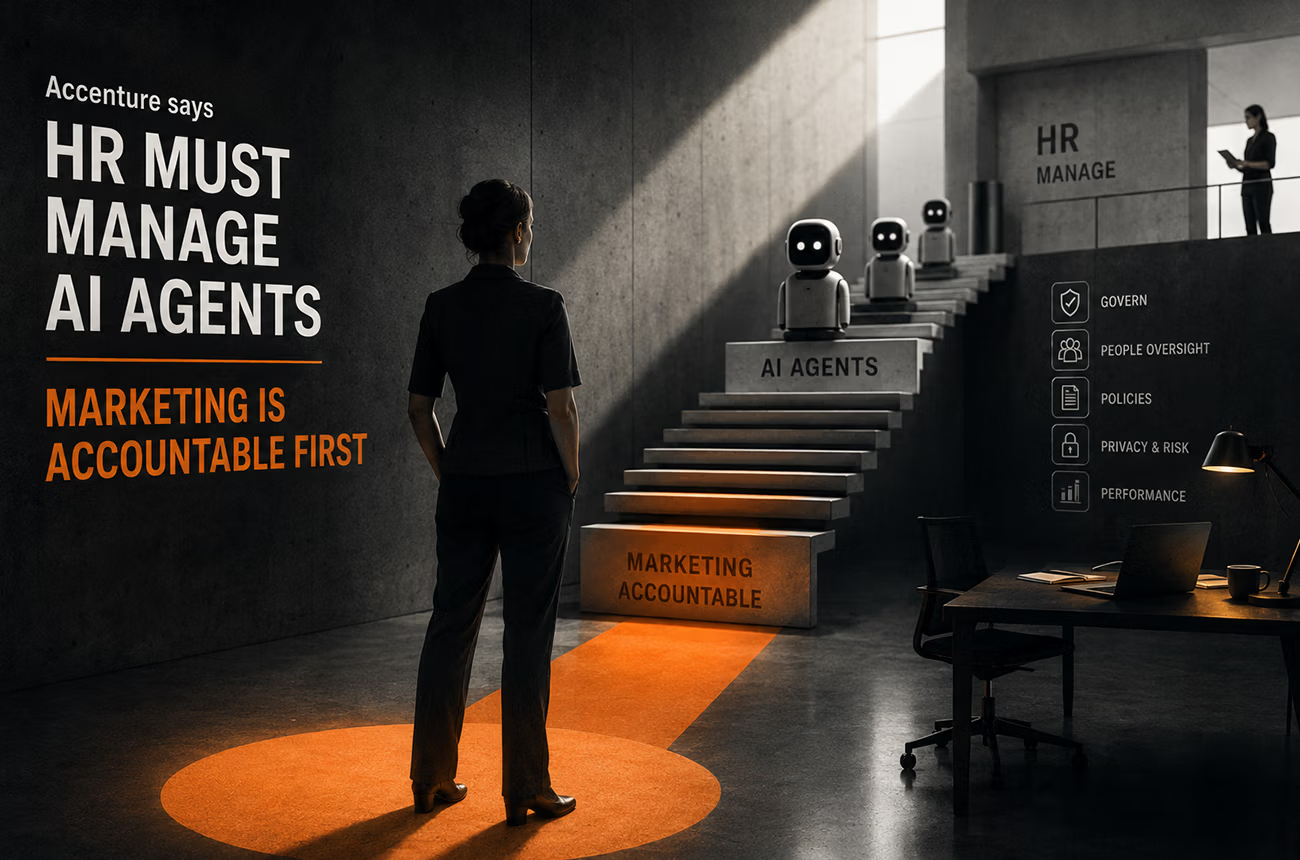
The work of managing AI has started to resemble the work of managing people, and according to the UK and Ireland chief of Accenture, human-resources teams will be expected to do both. Matt Prebble told the Financial Times that as companies deploy autonomous AI agents, leadership structures will have to be redrawn to account for a workforce that is part human and part software.
The shift lands now because marketing is already running more autonomous agents than almost any other function. Tools that draft campaign copy, build and schedule email sequences, segment audiences and adjust ad bids without a person in the loop have moved from pilot to production inside the past year. That puts the question Prebble raised — who is accountable when a machine, not a person, made the call — on marketing leaders before most of the org chart has registered it.
What did Accenture’s UK chief tell the FT?
Matt Prebble said HR directors will have to take responsibility for managing AI agents alongside human staff, and that boards are only at the very start of rethinking what leadership should look like as a result. In the FT interview, headlined “HR must manage AI bots as well as humans”, he argued that running an organisation will soon mean managing people, agents and the technology underneath them at once, rather than treating AI as a tool bolted onto existing teams.
Two roles shift in his account. The first is the operational leader, who becomes accountable for outcomes a machine generated rather than a person — owning the result when no human produced it. The second is the one Prebble was reportedly reluctant to name: a “chief trust officer”, a senior owner for the trust that comes under strain once decisions are made by systems people cannot fully inspect. He stopped short of saying every company would create the role, but the instinct behind it — that accountability has to land somewhere specific, and nobody has yet decided where — is the through-line of his argument.
It is a question Accenture is living itself. The consultancy, which employs more than 750,000 people worldwide, booked $923m in business-optimisation costs in its most recent quarter, including severance tied to headcount cuts made on a compressed timeline, according to its filings. The firm advising clients on how to restructure for autonomous AI is restructuring around the same pressures.
Why does the accountability question reach marketing first?
Marketing has adopted autonomous tooling faster than finance, legal or most of operations, which is exactly why the accountability question arrives at its door first. An agent that writes and sends a campaign is making decisions that used to carry a named owner: the claim that goes out, the segment that gets the email, the bid that spends the budget. When one of those misfires — an off-brand line, a mistargeted send, a price stated wrongly — the output still belongs to the marketing leader, even though no marketer typed it.
That is the practical version of Prebble’s point. The accountability does not disappear because the work was automated; it concentrates. A team that has wired agents into live campaign workflows has, often without deciding to, handed a machine the authority to act in the brand’s name. Deciding where that authority stops, and who answers for it, is now a marketing-leadership task rather than a future one.
Backing the profession here means resisting the easy framing that this is something happening to marketers. It is closer to the opposite: marketing is the function with the most hands-on experience of what autonomous systems get right and wrong at scale, which makes marketing leaders among the best-placed people in the building to define how agent work should be governed — not the least.
Who owns trust when an agent made the call?
Trust is the resource Prebble singled out as the hardest to place, and it is the one marketing has always been paid to protect. A “chief trust officer” may or may not appear on org charts, but the underlying job — keeping a brand credible when audiences cannot see how a decision was reached — is recognisably the work marketing already does, now sharpened by automation. Once an agent can speak in the brand’s voice, every output it produces is a deposit or a withdrawal from that account.
The human side of the shift points the same way. Uzair Qadeer, chief people officer at the BBC, told the HR World Summit in Porto that “if HR doesn’t play a role, AI transformation will not succeed”, and argued that automation raises the value of what he called “caveman skills” — perception, emotional intelligence, coaching, conflict resolution. His sharper line was a warning about leadership itself: “AI is not going to make bad leaders good, but it will absolutely expose who and where they are.” The BBC, he said, retrained 3,500 team leaders within a year on values and managing people through continuous change, rather than on the tools.
For marketing, the read-across is steadying rather than alarming. The parts of the job least exposed to automation — judgement about what a brand should and should not say, the instinct for when a campaign is technically correct but wrong in the room — are the parts that decide whether an audience keeps trusting it. Those are skills marketing managers already hold, and they become more valuable, not less, as more of the execution is handed to agents.
Prebble said boards are only beginning this work, and offered no template for where accountability and trust should finally sit. What he did make plain is that the decision will be made deliberately or by accident, before the tools force an answer — and in marketing, the tools are already in production.