AI agents burn five times more tokens than humans, but 85% of it is cached
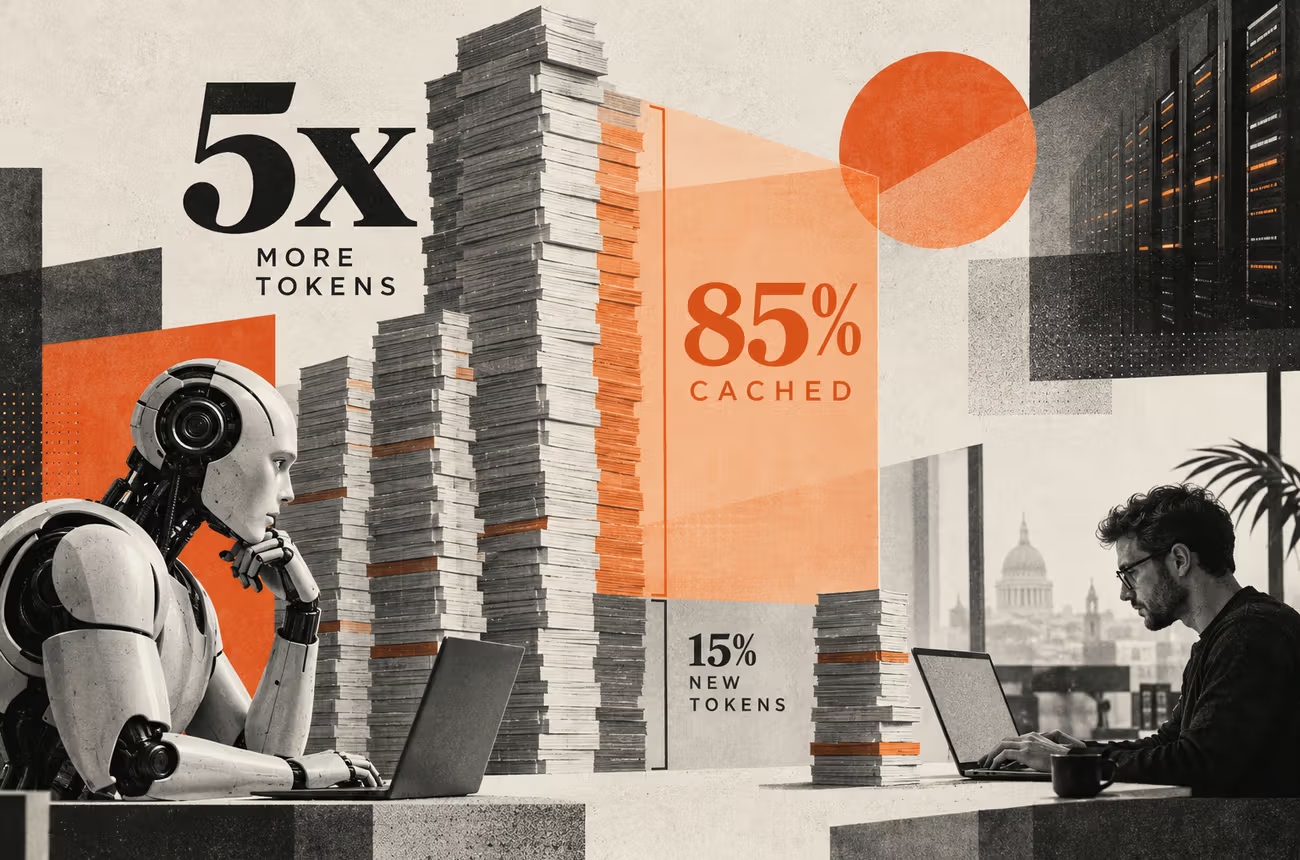
Andreessen Horowitz published a chart on 21 August showing that AI agents now consume nearly five times as many tokens as people do. The figure spread through marketing and technology feeds within days as a warning about runaway costs. The chart printed directly beneath it explains why the bill does not scale the same way.
That distinction matters now because marketing teams are moving agents into content production, research and campaign operations at the same time as finance teams have started auditing AI spend line by line. A five-times figure describes volume. It says nothing about what that volume costs.
What does the OpenRouter data actually measure?
OpenRouter’s figures describe traffic across its own routing layer rather than the AI market as a whole. The platform sits in front of most major commercial models and lets developers switch between them, which makes it a useful early indicator and an imperfect sample. The finding comes from data compiled by chartmaker Peter Walker and published by Moses Sternstein in the a16z newsletter Charts of the Week on 21 August 2026. Agents are using nearly five times as many tokens as humans, it reports, with agent usage up around 14 times since February.
Secondary reporting of the same chart puts agentic consumption at roughly 7.3 trillion tokens on a seven-day rolling average by mid-August, against reported human consumption of between 1.4 and 1.5 trillion. Walker has identified 6 February 2026 as the last day on which humans on the platform consumed more tokens than agents did. Human usage grew over the same period, by about 2.8 times, which is the figure most of the coverage dropped.
One caveat sits underneath all of it. OpenRouter does not receive a flag marking each request as human or agentic. It classifies traffic using a weighted combination of signals including tool calls, conversation turns and timing patterns. That is a sensible way to identify automated workflows at scale, and it is a classification rather than a count. Neither OpenRouter nor a16z has published the weighting in enough detail for an outside party to reproduce the result.
Why is five times the tokens not five times the bill?
More than 85% of agentic token burn comes from the cached prompt, according to the same OpenRouter data, and cached tokens are billed at a fraction of the standard input rate. The newsletter is explicit that cached tokens account for nearly all of the relative growth in agent token usage since February. The volume that produced the five-times figure is largely the cheap kind.
The mechanics explain the gap. A person sends a short prompt and reads a reply. An agent loads a stable block of context at the start of a task, covering its instructions, tool definitions and working memory, then re-reads that block on every turn as it iterates towards a result. Providers cache the repeated prefix rather than reprocessing it. Anthropic’s published pricing bills cache reads at 0.1 times the base input rate on most of its models, with a write premium of 1.25 times for its five-minute cache and 2 times for the one-hour version. Claude Fable 5.1 and Claude Mythos 5.1 are the exception: Anthropic cut their cache reads to 0.025 times base input, or $0.25 per million tokens, on 1 September. OpenAI lists cached input at a tenth of standard input across its current GPT-5.4 and GPT-5.5 models.
The discount is conditional, and that is where the budget is actually decided. A cache hit requires the prompt prefix to match what was written exactly, and to fall inside the cache window. An agent whose prompt changes on every run, or one that waits on a human approval step for longer than the cache lives, pays the full input rate on context it has already sent. Cache hit rate is the number worth instrumenting, alongside cost per completed task.
Neither of those is a token count, and the difference is not academic. A workflow that burns ten times the tokens and replaces four hours of manual research is not the same purchase as one that burns ten times the tokens and produces a draft nobody publishes.
What does the decline at Zapier, n8n and Make mean for marketing stacks?
Zapier, n8n and Make are each recording double-digit declines in site traffic on a trailing 12-week basis, according to Similarweb data published in the same newsletter. All three predate large language models and dominate the automation category by site visits. Gumloop, launched in 2023 as an AI-native agent builder, is the only platform in the set gaining traction.
Site visits are a demand proxy rather than a revenue figure, and all three incumbents have their own AI products. Sternstein’s reading is that it is far too early to write them off. What the data supports is narrower and still useful to anyone maintaining a marketing stack: traffic that used to go to connector-based workflow tools is going somewhere else, and agents are the obvious candidate.
The same newsletter puts that shift in proportion. Only a small share of AI adopters are running fully deployed agents, and the gap between typical and heavy users is widening rather than closing. Drawing on OpenAI data, it records an eight-fold gap in token output between the typical enterprise and the top decile. The gap approaches twelve-fold in the technology sector, where the heaviest users are producing 32.5 times the tokens they were in April 2025.
Neither a16z nor OpenRouter has published the underlying dataset or the weights used to separate agent traffic from human traffic.
Correction, 7 September 2026: this article originally stated that Anthropic bills cache reads at 0.1 times the base input rate. That multiplier holds for most Claude models but not for Claude Fable 5.1 and Claude Mythos 5.1, released on 1 September, which are billed at 0.025 times. The passage has been updated.