Granola sued over bot-free notetaking and default AI training on meetings
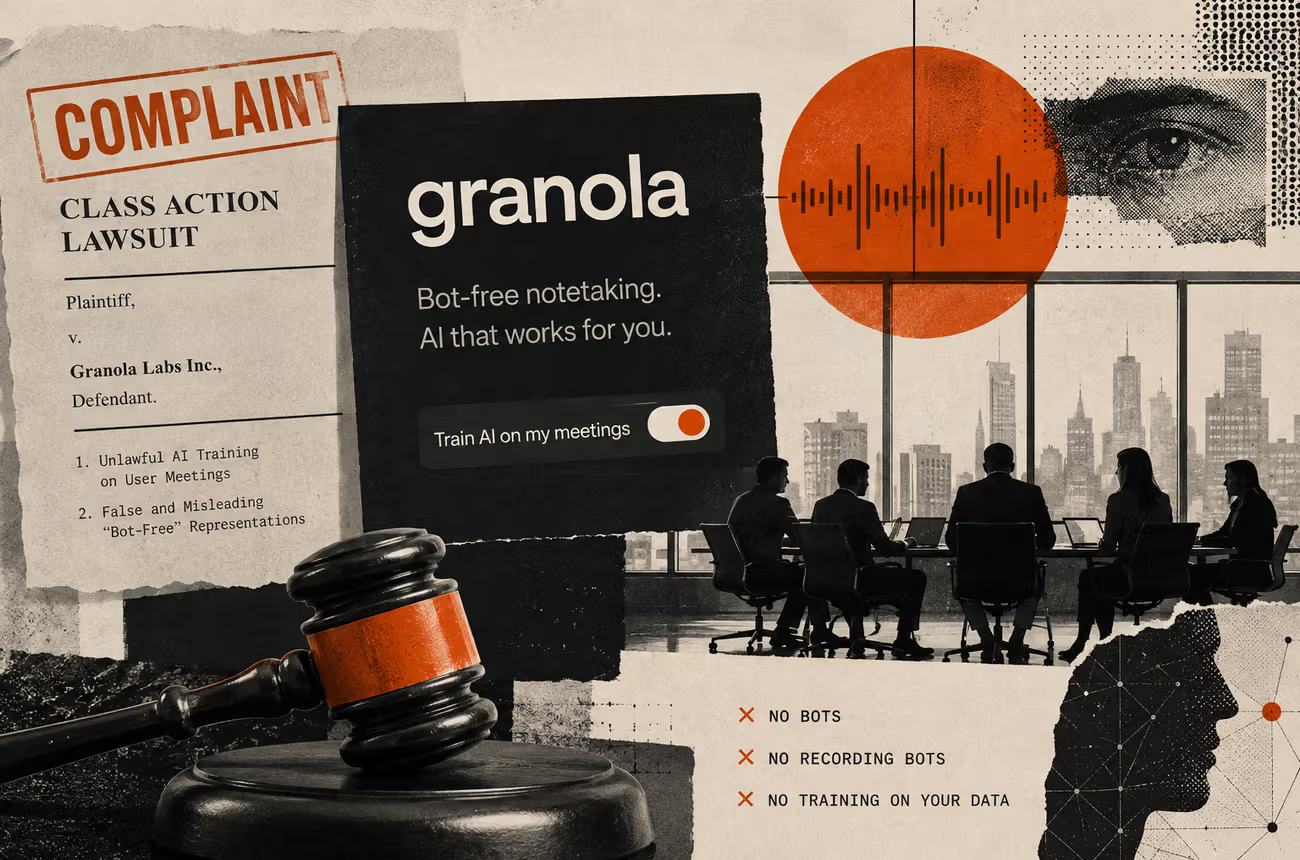
Granola built its product on a promise that other people in the meeting will not know its notetaker is running. That promise is now the lead exhibit against it. A proposed class action filed on 30 July in the US District Court for the Northern District of California alleges the AI notetaker intercepts and records meeting participants who were never told it was there, then uses what it captures to train its own models by default.
The case, Chamberlain v. Granola, Inc. and Granola Labs Ltd., puts a marketing argument on trial. Granola’s own website, quoted throughout the complaint, tells prospective customers that visible bots change how people behave on a call, particularly in client conversations, interviews and early-stage discussions, and that a meeting assistant works better unannounced. The complaint treats that as evidence the missing disclosure is a deliberate business decision rather than an engineering gap. It was brought by Tarra Chamberlain, a Florida resident, on behalf of a proposed nationwide class and a California subclass, and estimates the class runs to millions of people.
The seven claims run from intrusion upon seclusion at common law through the federal Electronic Communications Privacy Act, two sections of California’s Invasion of Privacy Act covering wire interception and the recording of confidential communications, the state’s Comprehensive Computer Data Access and Fraud Act, its Unfair Competition Law, and unjust enrichment. Chamberlain is represented by Schubert Jonckheer & Kolbe in San Francisco and Lowey Dannenberg in White Plains, New York.
What does the complaint say Granola’s software does?
Granola captures audio from two places on a user’s computer, according to the filing: the microphone, which picks up the user, and the system audio output, which picks up everyone else. Because it draws on whatever the machine plays, the complaint states it can transcribe calls made through practically any internet calling application, not only Zoom, Google Meet and Microsoft Teams, and can record in-person conversations as well. That audio passes to a transcription vendor acting as Granola’s agent, producing a live transcript while the meeting is still running.
Notice is optional. Two mechanisms exist, the complaint states: a message posted in the meeting chat once transcription begins, and a marker overlaid on the user’s video feed. Both have to be switched on separately, which the filing argues means Granola can operate with neither active in the ordinary course of business. It also states that Granola does not configure Zoom or Teams recording settings on a customer’s behalf, leaving any platform-level notice to the account holder.
Granola’s own help centre puts responsibility in the same place. It advises users that it is best practice to make sure participants know when AI notetaking tools are in use, points them to a third-party guide on state recording laws, and describes its in-meeting watermark and automated chat message as visible to everyone in the meeting when enabled. The documentation also says the desktop applications transcribe in real time and do not store meeting audio, and that the iPhone app caches audio temporarily before keeping only the transcript.
Why is the model-training default a separate problem?
Model training is switched on by default for users on Granola’s Free and Business plans, according to the complaint, through a setting each person has to find and disable. On Business plans, the filing states, every user must opt out individually rather than an administrator doing it once for a workspace. The opt-out applies only from that point forward, and the complaint cites Granola’s own materials acknowledging the company cannot confirm whether a user’s data was excluded from training that had already happened.
The gap the complaint presses is who holds the switch. People whose voices are captured on a call are frequently not Granola account holders, so they have no setting to change and no forward-looking opt-out to exercise. Granola’s privacy policy, dated 24 July 2026 and cited in the filing, describes removing data folded into its models as a matter of rebuilding the underlying model or database rather than deleting a record.
Granola’s published documentation frames the same practice differently. It says the company may use anonymised data to improve its services, that the data is never sent to third parties, that any user on any plan can opt out in settings, and that Enterprise customers are opted out by default with admin-level enforcement across an organisation. Anonymised is Granola’s characterisation of the data. The complaint does not accept it.
Where does this leave the rest of the notetaker category?
Otter.ai has been defending a closely related consent question in the same district since August 2025. Four class actions filed between August and September that year were consolidated on 22 October 2025 as In re Otter.AI Privacy Litigation, No. 5:25-cv-06911, before Judge Eumi K. Lee. Otter has moved to dismiss, denying that any interception occurred and arguing the plaintiffs have not plausibly pleaded the core elements of their claims. No ruling had been issued as of early August 2026, and no court has found Otter’s recording practices either lawful or unlawful. Fireflies.ai faces a separate biometric privacy claim in Illinois, Cruz v. Fireflies.AI Corp., filed on 18 December 2025.
The Otter cases test whether a bot sitting visibly in the participant list amounts to notice. The Granola complaint tests something narrower and, for the category, more awkward: whether a tool that never appears at all can rely on the account holder to disclose it. Both routes arrive at the same place. The person who has to tell the room is the one running the software, not the vendor that sold it.
Granola announced a $125m Series C on 25 March 2026 at a valuation of roughly $1.5bn, according to the complaint, which also names Vanta, Gusto, Thumbtack, Asana, Cursor and Mistral AI among its customers. It puts the amount in controversy above $5m, the threshold for federal class actions under the Class Action Fairness Act, and seeks statutory damages under California’s Invasion of Privacy Act of $5,000 per violation or three times actual damages, whichever is greater.
Neither Granola, Inc. nor Granola Labs Ltd. had publicly responded to the complaint as of 2 August 2026.