Meta's free Muse Glimmer runs AI agents offline on a 24GB graphics card
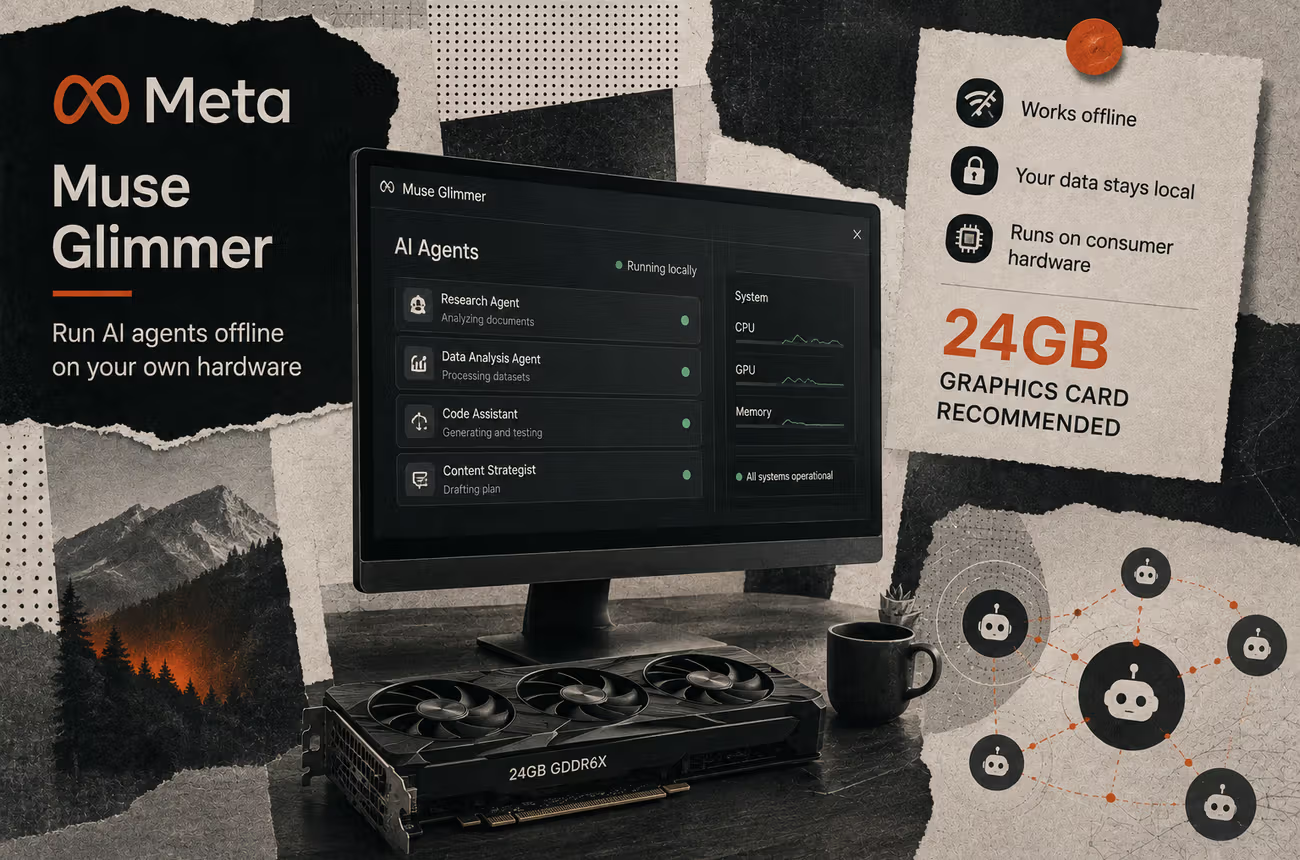
Meta’s return to open weights arrived on 10 August in a package small enough to sit on one desktop. Muse Glimmer, built by Meta Superintelligence Labs, is a 30-billion-parameter dense model distilled from the company’s closed Muse Spark and published on Hugging Face under an Apache 2.0 licence, which permits commercial use, modification and redistribution without asking Meta first.
Mark Zuckerberg attached a larger promise to the release. Writing on X, he said weights for Muse Spark 1.2, Meta’s current flagship, would follow. No date has been set, no licence named and no repository published, so that half of the announcement remains an intention rather than a shipped product. Meta’s chief AI officer, Alexandr Wang, had said in an interview released on 13 May that Muse Spark was “not suitable for open sourcing”. Meta has not explained what changed in the three months since.
The development matters to marketing teams because of where it moves the constraint. Most B2B marketing functions have spent two years being told to automate with AI while legal decides which data may leave the building and finance queries the per-seat and per-token bills. An agent that runs offline, on hardware bought once, answers both of those objections at the same time. It replaces them with a more practical one about who owns the machine and who configures it.
What can Muse Glimmer actually do?
Muse Glimmer is built for multi-step task execution rather than conversation. Meta’s technical description covers tool calling with precise schemas, planning sustained across long workflows, and failure recovery, where a model that hits a failed tool call is trained to diagnose the error and retry instead of halting. A dedicated perception encoder lets it read interleaved text and images, and it was trained on data from more than 100 languages.
For a marketing team, that combination describes fairly unglamorous work: reading a competitor’s pricing page from a screenshot, pulling figures out of a PDF report, sorting and renaming a folder of campaign assets, or running a research task across several tools without a person driving each step. Meta says the model works with OpenClaw and other agentic orchestration patterns, so it can slot into scaffolds a technical team already runs rather than demanding its own. A controllable effort setting trades reasoning depth against speed.
The performance claims deserve one caution. Meta’s published comparison puts Glimmer against Google’s Gemma4-31B and Alibaba’s Qwen3.6-27B, reporting leads on several agentic tests, including 75.5 on MCP Atlas, 74.6 on DeepSearch QA and 51.2 on SWE-Bench Pro against 36.9 for Gemma and 50.2 for Qwen. Those are Meta’s own evaluations of Meta’s own model, and independent benchmarking has not yet caught up. The same table shows Qwen ahead on OSWorld-Verified, at 75.6 against Glimmer’s 65.9, and on TerminalBench 2.1.
What does running Muse Glimmer locally cost?
Muse Glimmer needs a machine with a 24GB or 32GB memory envelope, which is not standard marketing-team kit. At full precision a 30-billion-parameter model requires more than 55GB, so Meta compresses the weights to roughly 4-bit precision, bringing the language model under 20GB and leaving headroom for working memory, the image encoder and a speculative decoding drafter. The company says the compression costs little to no accuracy on agentic tasks.
Speed comes from that drafter, a small companion model based on DFlash that proposes blocks of tokens for the main model to verify in parallel. Meta measured decoding 3.1 times faster on an Nvidia RTX 5090, 1.8 times on an M5 Max Mac and 1.5 times on an M4 Max.
None of those machines is cheap, and the UK market has been moving against buyers. The RTX 5090 carried a £1,889 recommended price at launch; one UK price tracker recorded a lowest available new listing of £3,600 on 10 August, against a twelve-month median of £2,995. A Mac configured with enough unified memory sits in comparable territory. Muse Glimmer costs nothing per token, but the hardware it needs is a capital purchase, and it will usually sit with IT rather than in the marketing function.
Distribution, at least, is straightforward. Meta named Ollama, LM Studio and Unsloth as local runtime partners, llama.cpp, ExecuTorch and MLX for edge deployment, vLLM and SGLang for serving at scale, and Together AI, Fireworks AI and OpenRouter for teams that want the model without the machine. It is working with AMD, Arm, Dell, Intel and Nvidia on device optimisation.
Why has Meta reopened its models?
Meta’s open-weight turn reverses the direction the Muse family has travelled since the spring. Muse Spark arrived in April as a proprietary model, followed by Muse Spark 1.1 on 9 July and Muse Spark 1.2 on 5 August, a coding-focused release with a one-million-token context window sold through the Meta Model API from about £0.93 ($1.25) per million input tokens. Glimmer is the first Muse model with published weights.
Zuckerberg set out the reasoning in a 6,500-word essay on 10 August, arguing that the United States and its allies should lead the open-source AI ecosystem rather than concede it, and that American labs face regulatory friction their foreign competitors do not. The backdrop is a run of capable open-weight releases from Chinese labs while US firms kept their strongest systems closed.
The commercial logic is simpler than the politics. Meta does not sell model access as a primary revenue line; Anthropic and OpenAI do. Muse Spark 1.2 scores 54 on the independent Artificial Analysis Intelligence Index, level with Grok 4.5 and behind Claude Opus 5 on 61 and GPT-5.6 Sol on 59. Published as promised, it would become the strongest American open-weight model available to download, which is a harder proposition for rivals whose margins depend on the API.
Meta has not named a date, a licence or a parameter count for the Muse Spark 1.2 weights, and no repository has yet appeared.