McKinsey: marketers embrace AI but under 10% of firms capture the value
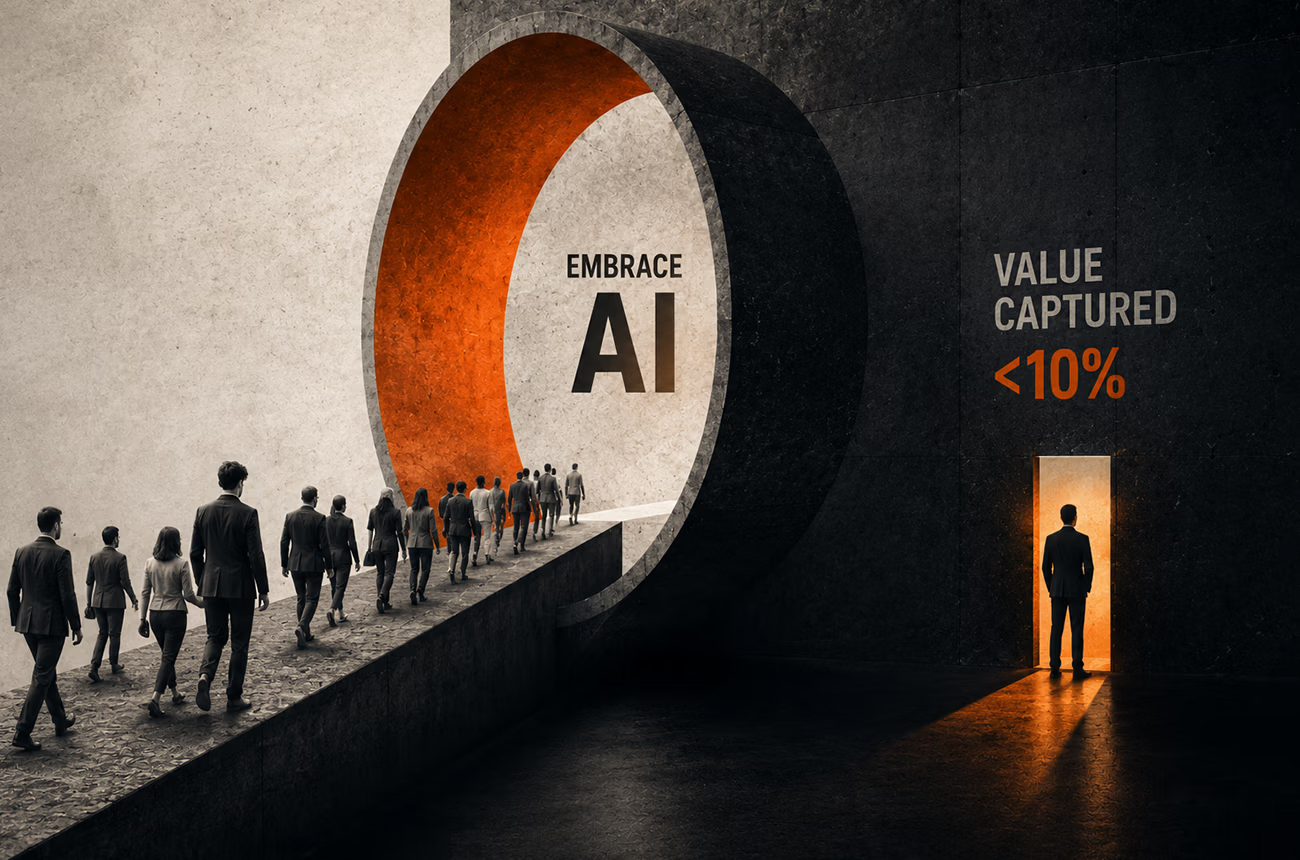
Marketers have rarely agreed on anything as readily as they agree on AI: 86% told McKinsey they are excited to use it, and close to 60% reach for it several times a week. Yet according to research the firm launched at Cannes Lions in June, fewer than one in ten of their organisations has turned that enthusiasm into value across its workflows, a shortfall McKinsey estimates at up to $90bn in improved marketing returns in the United States alone.
The finding sits at the centre of two linked studies McKinsey published at the festival. One, produced with Google, surveyed more than 500 marketers and named what it called an “AI marketing cognitive dissonance” between how much marketers use AI and how little their organisations get from it. The other set out the capabilities the firm expects to define marketing next, and put a number on the prize being left unclaimed. The throughline is that the bottleneck is organisational, not technical: the tools are in wide use, but the work around them has not been redesigned.
What the research found
The enthusiasm is close to universal, and so, beneath it, is the anxiety. McKinsey’s survey found 86% of marketers excited about using AI in their work, while 57% were anxious about what it means. Among CMOs the split is sharper still: 96% excited, 71% anxious, and 80% worried about their own roles. The anxiety was not confined to the functions one might expect; it ran across the marketing organisation, from copywriters to media analysts to the chief marketing officer. Against that backdrop, the value gap is stark. As McKinsey senior partner Kelsey Robinson put it, “AI adoption is happening faster than value creation”.
The value figures explain why the gap matters commercially. McKinsey estimates that organisations which redesign marketing so that insight, creation, personalisation and optimisation run in real time are seeing two-to-three times productivity gains, savings of 10% to 30%, and revenue and conversion growth of 4% to 7%. Those are the firm’s figures for the fastest movers, not guaranteed outcomes, and the studies were produced by a consultancy and a platform vendor with a shared interest in AI transformation. But the direction is consistent with a wider pattern: usage is everywhere, captured value is rare.
Why enthusiasm isn’t turning into value
The barrier McKinsey identifies is not access to AI but the shape of the organisation around it. Most marketing teams have layered AI tools onto legacy systems, the firm argues, producing a patchwork of disconnected pilots that increase activity, more draft images, more generated copy, without changing the workflow or the result. Capturing value, on its account, requires rewiring how marketing works rather than buying another tool. Julien Boudet, a McKinsey senior partner, framed the cost of delay bluntly: “standing still is the riskiest strategy of all”.
A second obstacle is who controls the budget. More than half of marketers, 53%, said they see AI primarily as a driver of growth rather than efficiency, while sensing that senior leaders weigh it the other way. McKinsey notes that the chief financial officer often treats marketing as a cost centre, which narrows the business case for transformation to savings and starves the broader rewiring of investment. The result is a standoff in which the spending needed to close the value gap is justified on the terms least likely to close it.
What it means for marketing teams
For a marketer reading the anxiety figures, the more useful reading is what the research says is actually at risk. The threat the data describes is not the technology replacing the role; it is the organisation failing to redesign around it, and the people who adapt fastest pulling ahead of those who do not. The report’s own framing is that the gap is a leadership and operating-model problem, not a deficit in marketers’ skill or appetite, which is borne out by the near-universal weekly use.
What that points to in practice is staged change rather than a single leap. McKinsey highlights organisations that prove value in defined pockets, such as customer support or a contained form of personalisation, while they continue to rebuild data foundations and workflows, instead of waiting for perfect conditions before starting. The firm also sketches a set of new roles it expects to emerge, from marketers who manage how brands are represented in AI systems to ones who orchestrate always-on, one-to-one campaigns; those are projections of where the work moves, not established job titles. The common thread is that the value accrues to teams that redesign the work, not those that simply adopt the tool.
Whether organisations can rewire quickly enough to claim the returns on offer is the open question. McKinsey’s estimate of up to $90bn in uncaptured US marketing value is a measure of the distance between the AI marketers are already using and the value their employers have so far failed to organise around it.