LinkedIn says its classifiers, not the slop button, drove the 40% fall
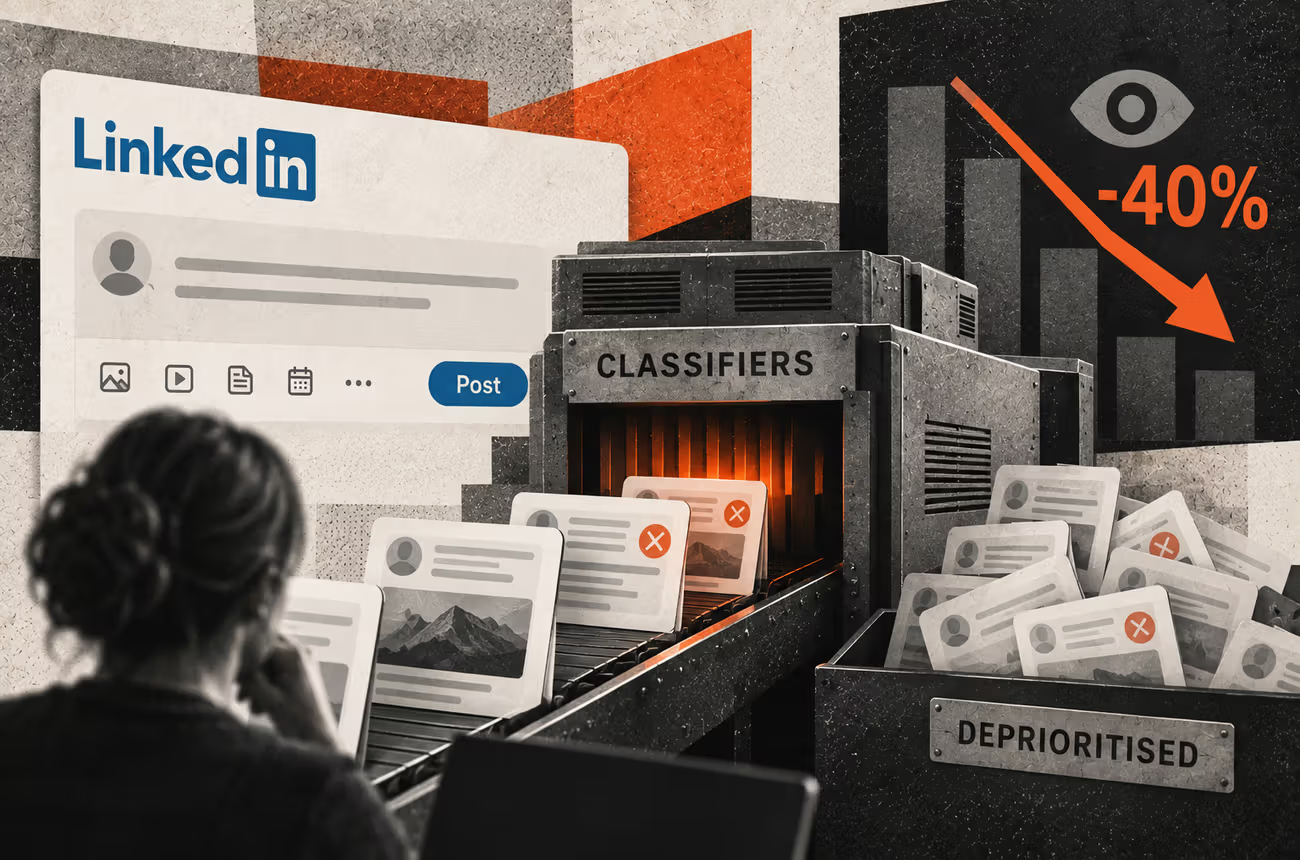
LinkedIn’s chief product officer put two numbers in the same post on 20 August, and the coverage welded them together. Hari Srinivasan reported that more than a million people had clicked the platform’s “Seems like AI slop” button, and that members were seeing roughly 40% fewer views on content LinkedIn classifies as slop. Asked how much of that decline came from member flags, LinkedIn’s Amanda Purvis told Moneywise the 40% is specific to the detection classifiers the company launched on the same day as the button.
The distinction decides what a marketing team does next. Read as cause and effect, the two figures say readers can now vote a company’s posts out of the feed, and a million of them have started. Read as LinkedIn describes them, the button is a personalisation control that mostly changes the feed of the person pressing it, while distribution is settled by classifiers trained to find posts with nothing in them. The first reading argues for rebuilding a publishing process around reader sentiment. The second argues for having a point.
What did Srinivasan actually report on 20 August?
Srinivasan reported one adoption figure and one distribution trend, three weeks after launch. Over a million people had clicked “seems like AI slop”, he wrote, thanking them for feedback that was helping LinkedIn understand how its community experiences low-quality content. LinkedIn’s corporate communications team later told Moneywise the figure counts unique members who used the feedback flow, not total clicks. Several outlets, PCWorld and TechSpot among them, reported instead that the button had been used more than a million times, converting a count of people into a count of events.
The timeframe came apart in the same way, and that error started at the source. Srinivasan wrote that the button had launched “two weeks ago”. LinkedIn switched it on on 30 July and he posted on 20 August, an interval of 21 days. Cybernews quoted him directly and printed two weeks. Fortune wrote “the first two weeks”. The Register did the arithmetic and headlined three weeks. Outlets that repeated the shorter window were being faithful to a post that was itself wrong.
The same post carried a real product change. Authors whose posts collect enough member feedback will now see a message in their post analytics reading “Some members told us this post seems like AI”, with a note that LinkedIn is passing it on as feedback to consider for future posts. Purvis said the message is rolling out to members over the coming weeks. When The Helm covered the button’s launch on 30 July, that private author warning was still in testing.
Does clicking “seems like AI slop” reduce a post’s reach?
Sam Corrao Clannon, LinkedIn’s creator product lead, has said the button is not a report at all. It is not “a reporting path for policy violations”, he said, and it does not connect to LinkedIn’s moderation system. He described it instead as a disinterest signal at the viewer level, designed to give members more control over their own feeds while showing LinkedIn what they regard as low-substance content. Pressing it removes the post from that member’s feed.
Srinivasan set the same limit on the distribution side. No single piece of feedback determines how content is distributed, he wrote, because LinkedIn weighs many signals together, and the company has built safeguards to stop feedback being used to target members unfairly. A post’s performance changes only when a large number of members raise the same concern. That threshold doubles as a defence against coordinated flagging by competitors or disgruntled contacts, a risk agencies raised as soon as the button appeared. The reach penalties that do exist came earlier, in the May policy under which LinkedIn began holding generic AI-written posts inside an author’s own network rather than recommending them onward.
The definition matters as much as the mechanism. Corrao Clannon defined AI slop internally as content that is sophisticated or polished in its presentation but lacks substance: no particular experience, perspective or insight, posted to take up space and attract attention without effort behind it. Using AI to refine language sits outside the target, and he was explicit about it. The operative question for a B2B team is therefore not whether a model touched the draft, but whether anything in the finished post could only have come from the people who published it.
What is the 40% figure actually measuring?
The 40% measures views of posts LinkedIn has already classified as slop, against a baseline Srinivasan described only as a few weeks earlier. Purvis attributed the fall to the classifiers announced alongside the button on 30 July, and Srinivasan did not break out how much of it came from reader flags. LinkedIn has published no absolute view counts on either side of the comparison, so the figure gives a direction rather than a quantity.
The figure does not measure what many readers took it to mean. LinkedIn has not said what separates a slop post from an ordinary one inside its systems, or how much feedback it takes before the analytics message reaches an author. Srinivasan conceded at launch that slop is hard to define and that the definition keeps changing, which is the same admission read forward: a 40% fall in views of slop is a fall in views of whatever the classifier currently counts as slop.
The prevalence figures in circulation come from outside the company and predate the button. Pangram Labs, which runs a browser extension that scans posts as members scroll past them, reported on 9 July that more than 40% of LinkedIn posts over 250 words came back as fully AI-generated, across 1,002,627 posts collected since 24 April. Originality.ai put the share at 81.2% of 5,000 public posts it examined from July. The two are not measuring the same thing: Originality.ai counts posts of 100 words or more and calls one likely AI at 50% model confidence, which accounts for most of the gap. Pangram’s sample carries a self-selection problem, since the posts came from people who had gone and installed a slop-detecting extension. Neither says anything about the feed as it stands now.
Moneywise asked LinkedIn whether the volume of AI-generated posting on the platform is falling, rather than the views that posting attracts. Purvis said the company has no data to share at this point.