Cloudflare launches AI visibility scoring built on crawl and referral data
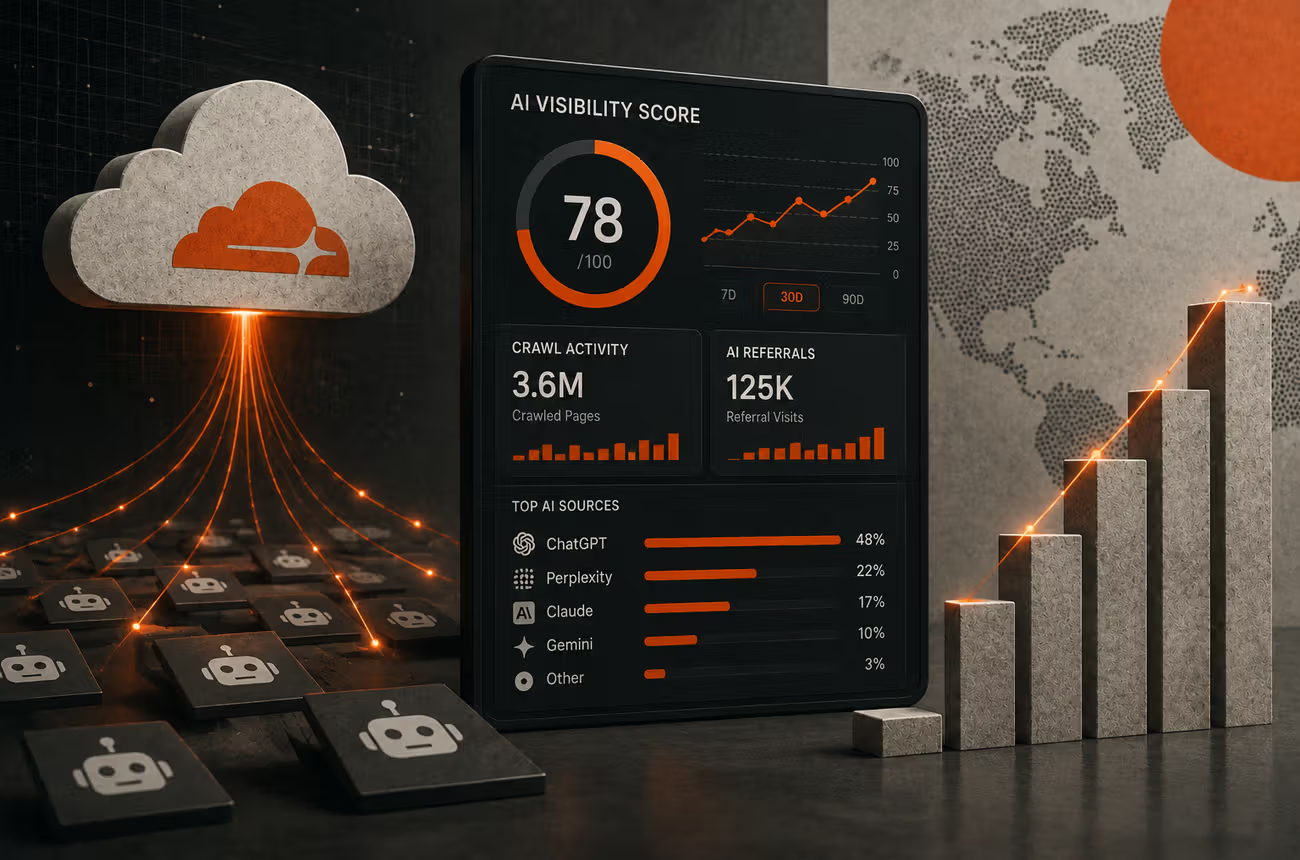
Cloudflare has spent the past year telling website owners which AI crawlers were taking their content. On 6 August it started telling them whether any of it came back. Released in early access, the AEO Visibility Dashboard reports four numbers. They describe how often AI assistants cite a site, name the brand, give it room in an answer, and pick it over a competitor.
The launch lands in a measurement category that has attracted serious money and almost no standardisation. Profound, the best-funded specialist, raised a $96m Series C at a $1bn valuation in February, taking its total funding to $155m. Semrush, Ahrefs and Conductor have added AI-visibility modules to existing SEO suites. None of them counts a citation the same way. Marketing teams are left comparing numbers that measure different things, then defending budget on the strength of them.
What does the AEO Visibility Dashboard actually measure?
Cloudflare’s dashboard reports four metrics, each aimed at a different diagnostic question. Citation Rate is the share of answers in a site’s category that cite the site as a source. Mention Rate counts how often assistants name the brand whether or not they link to it. Prominence tracks how much of an answer is attributed to the site and how early that attribution lands. Share of Voice sets a brand’s citations against its competitors’ across the questions its customers actually ask.
The pairing of the first two is the one worth understanding. Cloudflare’s framing is that a brand named far more often than it is cited has an authority problem, not an awareness problem. The two call for different work. That distinction is more useful than a single blended visibility score, which is what several rival tools lead with.
Two further readouts sit alongside the four. An Industry Fit score measures whether assistants place a site among its actual competitors, derived from which brands keep appearing together in the same answers. An AI Operator Activity view shows real crawl and referral traffic broken down by operator, including the errors those crawlers hit. Cloudflare points at one pattern in particular: the operator that crawls thousands of pages and refers nobody back.
Where do the numbers come from?
Cloudflare probes the assistants directly, which is worth stating plainly because the company’s own announcement is ambiguous on the point. The press release criticises tools that fill the gap “by only sending test prompts to AI chatbots and sampling the responses”, calling the method limited in scale and inconsistent. The engineering post published the same day, by Matthew Conroy and Jack Galilee, confirms Cloudflare does exactly that. Cloudflare infers a site’s industry and category, then queries the leading assistants with likely customer prompts. Today that means Anthropic’s Claude and OpenAI’s GPT. What differs is the machinery around the sampling, not its absence.
Three details in that post matter more to a marketing manager than the metric definitions. Cloudflare runs each category panel once and reuses that baseline across every account in the category, rather than re-querying models when a site owner scans. A Citation Rate is therefore read from a pre-computed snapshot, not a live query about that brand. Each assistant is prompted repeatedly across different models through Cloudflare AI Gateway, to absorb the variance that comes from models rarely answering the same question twice. Scoring runs on Workers AI alongside exact text analysis, which Cloudflare says avoids a model grading its own output.
Coverage is the sharpest limit. The dashboard measures Claude and GPT, and Cloudflare’s wording leaves room for more later. Google’s Gemini, Perplexity and Microsoft Copilot are absent at launch, which matters for any category where buyers start inside Google’s surfaces. Adweek’s coverage described the tool as measuring assistants including Gemini, which the engineering post does not support.
What should marketing teams do with the score?
Marketing teams evaluating the dashboard are being offered a different kind of evidence rather than a better version of the same thing. Cloudflare’s argument rests on sitting at the network layer, between AI platforms and the sites they read. That gives the crawl and referral half of the picture a foundation the specialists have to buy or infer. Stephanie Cohen, Cloudflare’s chief strategy officer, framed the gap as brands not knowing whether they are in the conversation at all.
The prompt half is on the same footing as everyone else’s, and carries the same caution. The Helm has reported before that no generative-engine technique has been shown to lift visibility reliably across engines, and that vendor-published visibility statistics often rest on surveys rather than measurement. A category-level baseline reused across accounts is a reasonable engineering trade for speed and cost. It is also a reason to treat a Citation Rate as a directional reading of a category rather than a live measurement of one brand, particularly in a board paper.
Cloudflare has published no pricing, no eligibility criteria and no indication of whether the dashboard will sit inside existing plans or be sold separately. For teams already running Cloudflare, the cost of finding out is a request, not a procurement cycle. That is its own argument against buying a specialist tool before establishing that the numbers change a decision.
Both halves of the suite are now in the same place. Agent Readiness, the existing tool, checks whether an agent can reach and parse a site at all, running checks on robots.txt, sitemaps, machine-readable content and callable interfaces. Cloudflare’s own count puts fewer than half of all HTML page requests as coming from a human.
Cloudflare has not given a general availability date for the AEO Visibility Dashboard. Access requests run through the Overview tab of the Cloudflare dashboard, where Agent Readiness also sits.