Claude now watermarks text worldwide, including copy it only proofread
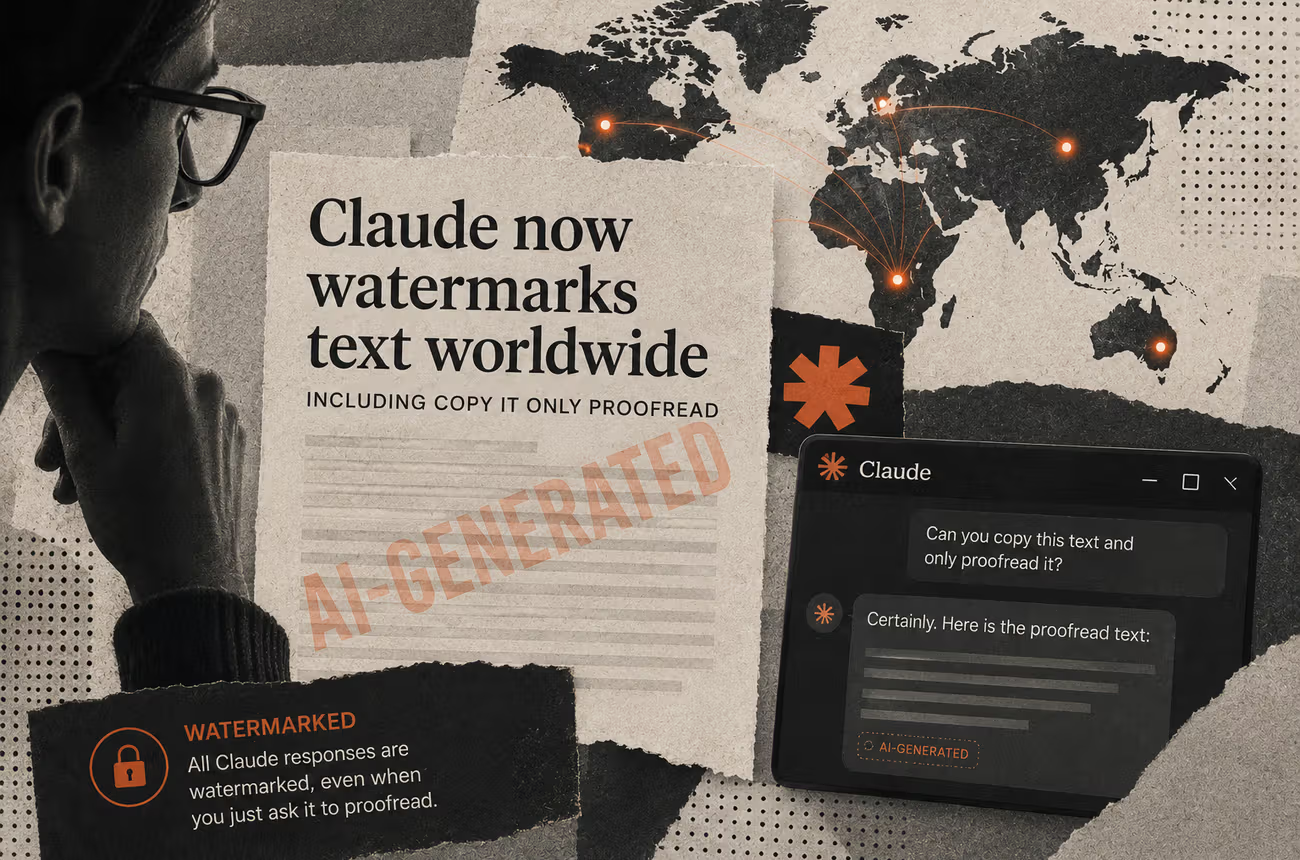
A Claude support page updated on 11 August settled a question marketing teams have been asking since the EU AI Act’s transparency rules took effect: text produced by Claude now carries an invisible mark, and so does human text that Claude has merely tidied up.
Anthropic has signed the EU AI Act’s Article 50(2) Code of Practice on Transparency of AI-Generated Content, as a provider of both generative AI models and generative AI systems. Under those commitments, Claude models launched on or after 2 August 2026 weave an imperceptible watermark into generated text and attach signed provenance metadata, following the C2PA open standard, to generated .svg, .png and .jpg files. Marking is applied at model level, so it covers the Claude apps, the Claude Platform API, Claude Code, Claude Cowork and Claude Tag, and it applies wherever Claude is offered rather than in the EU alone.
Marketing teams are affected on both sides of the rule. Article 50 makes providers such as Anthropic responsible for marking output so that it can be detected, and makes the organisations deploying generative systems responsible for labelling certain content they publish. The marks are arriving faster than any shared understanding of what a detected mark proves, which is where the exposure sits for teams whose agency contracts and editorial policies already carry AI clauses.
What does a detected Claude mark actually prove?
Anthropic’s documentation states that a detected mark shows content may have been processed by Claude, and is not fully conclusive on its own. The company gives the reason plainly: people use Claude to proofread, translate, summarise and convert files, so output can carry a mark even when the underlying ideas, text or data came from somewhere else.
That limitation inverts the assumption most content policies are built on. A marketing manager who writes a case study, then asks Claude to tighten it or translate it into German, publishes a document carrying the same signal as one Claude wrote from a blank page. Nothing in the mark separates the two.
The absence of a mark proves as little. Anthropic lists the conditions under which marked content loses its mark: generation by a model released before marking was supported, heavy editing, paraphrase, translation or mixing into other writing, passages too short to give a reliable signal, and file metadata stripped through format conversion, re-saving or screenshots. That last case is a routine event in a publishing stack. A pipeline that resizes a hero image or converts it to another format may remove the provenance data before the asset reaches the page.
Which teams have to disclose AI use under the AI Act?
The European Commission’s guidance places disclosure duties on deployers in three situations: emotion recognition and biometric categorisation, deepfakes, and text publications on matters of public interest issued without human review or editorial control. Ordinary marketing copy does not fall into that third category, and copy a named person has reviewed and taken responsibility for is exempt in any case.
The deepfake duty is the one most likely to reach a campaign. Synthetic image, audio or video resembling real people, places, objects or events must be labelled whatever its commercial purpose, and the Commission has published a set of EU icons that deployers may use to do it.
Signing the code is voluntary; the Article 50 obligations are not. The Commission and the AI Board have confirmed the code as an adequate voluntary tool for demonstrating compliance, and roughly 190 companies and organisations had signed by the end of July 2026, according to the Commission. Organisations that choose another route have to prove their measures are equivalent to national market surveillance authorities, which enforce the rules. Penalties under the Act run to €15m or 3% of total worldwide annual turnover, whichever is higher.
What happens between now and 2 December?
Anthropic has not published the technical detail of how its marks can be detected. The company says it will support users and third parties in detecting them, as the code requires, and will share the method in forthcoming documentation. Until that arrives the marking cannot be independently verified, and no agency, employer or platform can check a piece of copy against it.
The support page itself is written in the language of intention rather than completion. Anthropic describes it as an account of how the company is planning to put its commitments into practice, says newer models support marking at launch, and says work is under way on the models released before August. What is confirmed is the commitment and the mechanism. What is not yet available is the means for anyone outside Anthropic to test either.
The Act’s transition period gives providers until 2 December 2026 to bring models already on the market into compliance, as Axios reported, so the coming months will show how the rest of the field intends to mark text. OpenAI’s published compliance approach currently centres on images and audio rather than text. Google, Meta, Microsoft, OpenAI, Black Forest Labs and Synthesia are among the code’s signatories, according to TechCrunch.
Robustness remains contested. Jonas Geiping, who leads a machine learning safety group at the ELLIS Institute Tübingen and studies watermarking, has said that paraphrasing can remove a watermark, though not every paraphrase will, as reported by Search Engine Journal. Distribution platforms are meanwhile building their own detection: LinkedIn is testing a control that lets members report a post as AI slop, Substack has embedded Pangram’s detection tools, and Snap has stopped promoting AI-generated video in its main feed, according to Axios.
Anthropic has not said when its detection documentation will be published.