AI now writes marketing's first drafts — research counts the cognitive cost
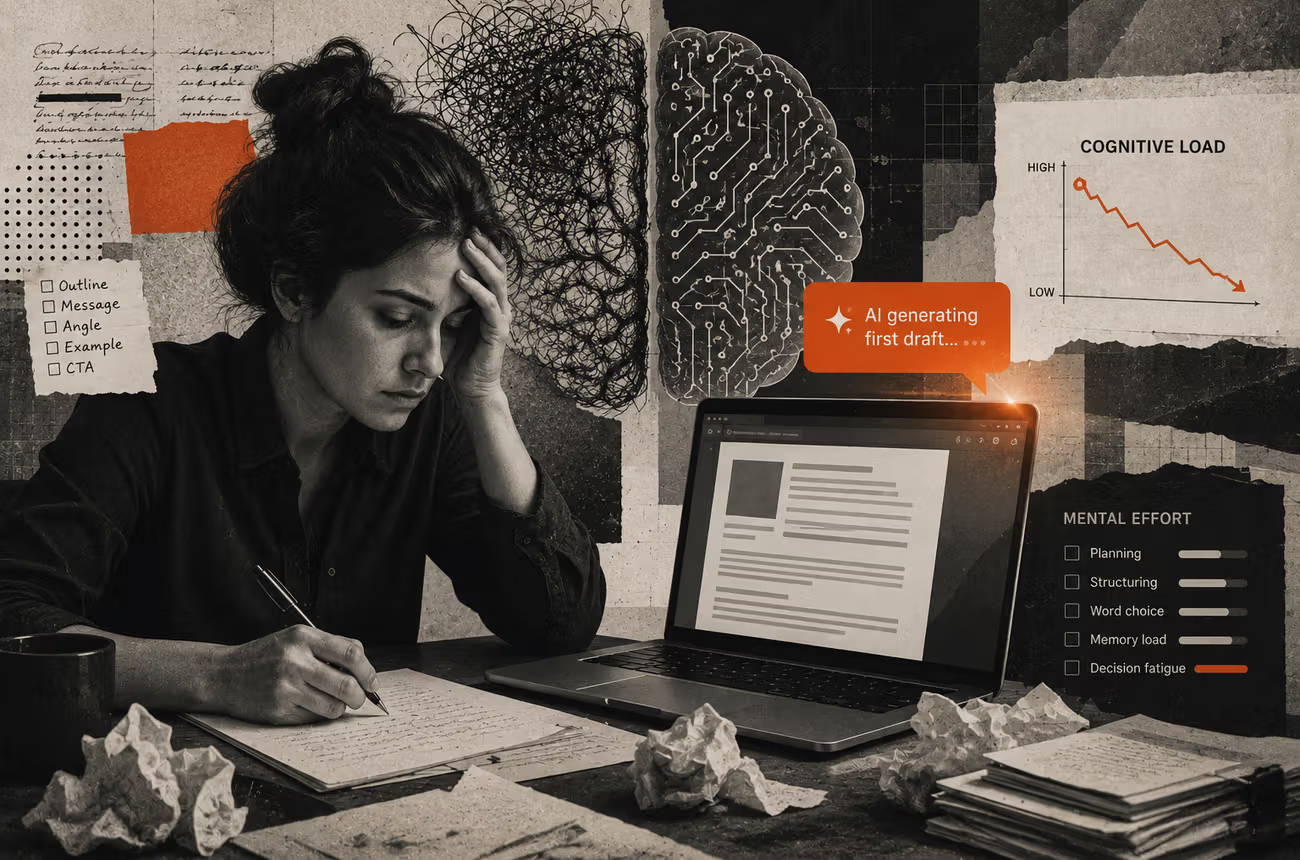
The argument that writing is thinking, not merely a record of it, returned to wide circulation on 17 August, when the New York Times published a feature by Dana Goldstein asking what students lose when they stop writing. Its answer, drawn from decades of cognitive research, is that the difficulty of composition is not a fault to engineer away but the source of much of its value. Read from a marketing desk rather than a classroom, it is less a lesson about schools than a warning to the profession that has handed its writing to a machine faster than most.
Marketing sits near the front of that queue. Writing is already the leading use of generative AI at work, and marketing runs on written output: campaign copy, briefs, positioning documents, the pitch deck, the email nobody wanted to draft. The skill most exposed to automation is therefore also the one the research associates with the judgment marketers are paid for. That turns the evidence on what writing does to the brain into an operational question for marketing leaders rather than a sentimental one, and the steadier reading of it favours deliberate use over either blanket adoption or blanket refusal.
What does the research actually show about writing and thinking?
Cognitive psychologist Ronald T. Kellogg spent years establishing that drafting even a straightforward persuasive essay ranks among the more mentally demanding things a person does routinely, closer in working-memory terms to hard physical labour than to reading. Writing forces a person to hold a subject in mind, sift what they already know, plan a structure and test each sentence against the last. Kellogg’s summary, quoted widely, is that “writing is a technology for thinking”. The benefit is not the finished document. It is what the effort of producing it leaves behind in the person who produced it: retention, planning, and the capacity to weigh a counter-argument and revise towards it.
The sharpest recent evidence that outsourcing that effort carries a cost comes from MIT’s Media Lab. In a preprint titled “Your Brain on ChatGPT”, published in June 2025, Nataliya Kosmyna and colleagues used EEG to track 54 people writing essays across four sessions, each assigned to one of three conditions: with ChatGPT, with a search engine, or with no tools at all. The chatbot group showed the weakest brain connectivity, the poorest recall of what they had just written, with most unable to quote their own essays accurately, and the lowest reported sense of ownership over the result. The authors named the pattern “cognitive debt”.
Those findings carry caveats, and holding them is the point rather than a hedge. The MIT work is a preprint, not yet peer-reviewed, run on 54 adults; a critique in The Conversation noted that its most-cited claim rests on a single switched-condition session rather than a sustained test. Estimates of how many students now write with AI run from two-thirds to 90%, a spread wide enough to show the measurement is rough. The defensible reading is not that AI writing “rots the brain”, a framing the study’s own authors have pushed back on, but that a growing and mostly early body of work points one way: the less cognitive effort a writer supplies, the less the writing returns to them.
Why does this land on marketing first?
Marketing meets this before most fields because its work is overwhelmingly written and its tools arrived early. The vendors have not been subtle about the direction. Grammarly, the writing assistant embedded across marketing teams, renamed its parent company Superhuman in October 2025 and now sells a suite of agents built to draft in a user’s own voice. Its general manager for education told the New York Times that educators withholding AI writing tools are effectively telling students their coursework is irrelevant to the job market, and framed the present as a moment to tear the old model down. That is a vendor’s account of the shift, and it reads best as one.
The counter-move is already visible on the platform where most B2B marketing is published. LinkedIn spent two years building AI into its compose box, then reversed course: it is retiring its post-writing assistant in favour of a proofreader and letting members flag posts that read as machine-made, as the Helm reported in July. Its chief executive’s stated reasoning, that there is no shortcut to working out something worth saying, is the cognition argument in commercial dress. The line the research draws, between AI as an editing aid and AI as a substitute for having a thought, is the same one LinkedIn is now drawing through its own product.
None of this makes the marketer who uses AI the problem. The profession did not create the tools or the pressure to adopt them, and treating writers as the weak link misreads both the evidence and the work. The sharper question is which parts of the writing are worth keeping effortful, because the effort is where the thinking happens.
What does a deliberate division of labour look like?
The researchers behind the coverage did not reject AI, and neither does the steadier reading of their work. The MIT team’s own conclusion favoured delaying AI until a writer has done enough unaided work to have something of their own, a sequence rather than a ban. The University of Sydney has built that principle into policy with a “two-lane” model: some assessment is kept secure and unassisted to verify capability, while the majority is opened to AI for drafting, feedback and analysis, with its use disclosed. The New York Times reported a similar recommendation from a group of writing experts convened at the University of California, Irvine, to keep writing central and human-first while using AI for prompts and early feedback.
Translated to a marketing team, that maps onto a division of labour many are already reaching by feel. The first-draft thinking, the positioning, the argument, the angle a campaign turns on, is the part the evidence says to keep human, because that is where the judgment forms. Editing, proofreading, pressure-testing a draft against its counter-arguments, generating variants of a line that already exists: these are the stages AI sharpens without hollowing out. The Helm has reported the same split emerging from practice, where teams hand execution to AI and defend human time for the strategic calls machines still get wrong. The research supplies the mechanism behind the instinct.
The evidence on professionals, as opposed to students, remains thin: no long-run study has yet tracked what sustained AI-assisted writing does to a working marketer’s judgment over years. The MIT team’s recommendation, until one does, is to earn the thinking before reaching for the tool.