OpenAI and Anthropic cut flagship AI prices by up to 50% in a week
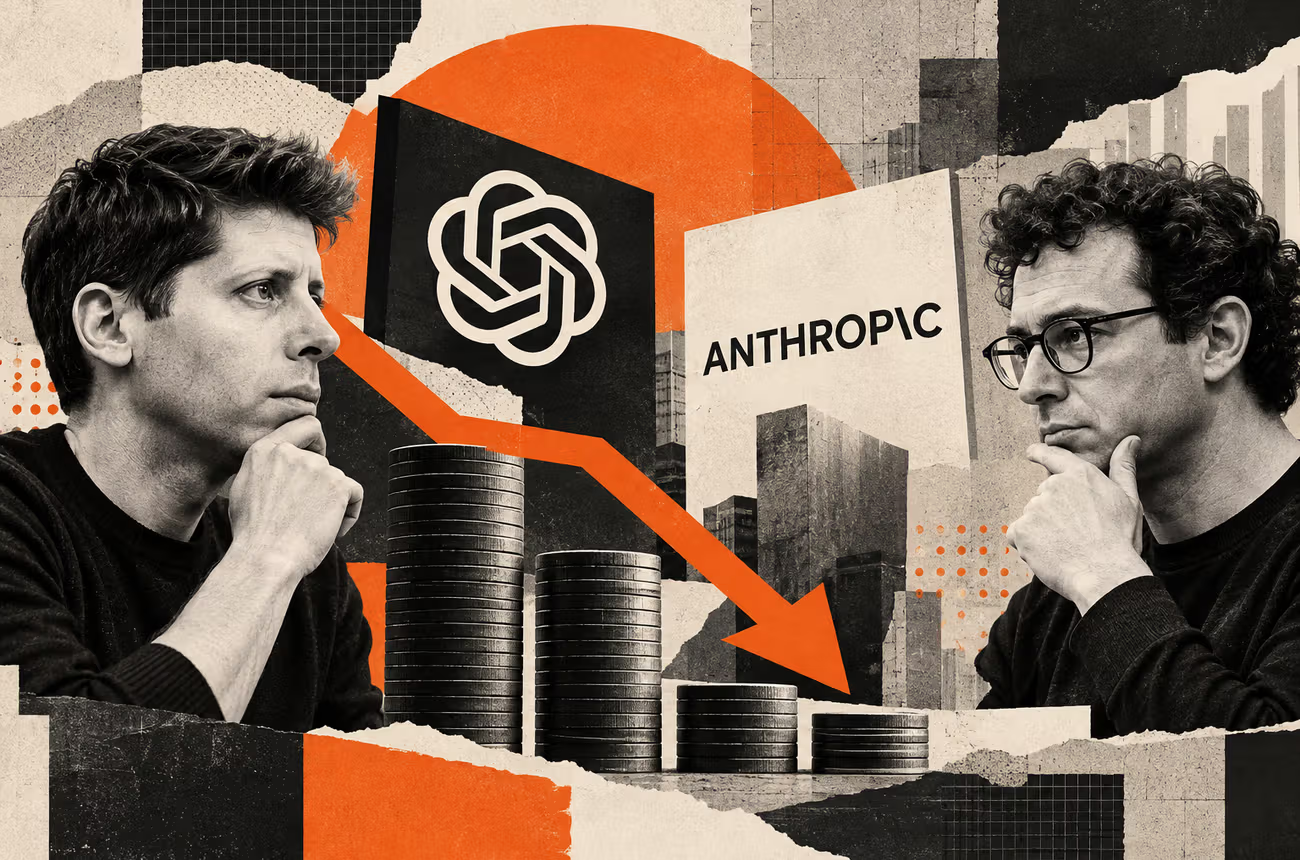
OpenAI cut API prices for GPT-6 Sol and Luna by 50% against GPT-5.6’s promotional pricing when it launched the models on 22 September, taking GPT-6 Luna to $0.10 per million input tokens and $0.50 per million output tokens, and GPT-6 Sol to $2 and $10. Anthropic, which released Opus 5.5 the same day, says the model costs around 40% less to run than Opus 5 while matching Claude Fable 5.1 on most work. Axios first reported the moves, alongside a Citadel Securities client note arguing that falling per-token costs are increasing overall AI spending rather than simply compressing providers’ revenue.
The price cuts matter to B2B SaaS marketing teams because inference cost has been the main brake on scaling AI-driven content production, personalisation and agentic campaign workflows. As per-token prices fall and Chinese open-weight developers add further pressure, procurement decisions are shifting from brand loyalty toward measured price-performance — changing both how marketing teams choose AI tools and how AI-enabled SaaS vendors pitch their own products.
What did OpenAI and Anthropic actually cut?
OpenAI’s cuts are the more precisely documented of the two. Its launch announcement for GPT-6 Sol and Luna states the company “reduced API prices for Sol and Luna by 50% compared with their GPT-5.6 promotional pricing” — a specific baseline, not an unconditional cut against all prior list pricing. GPT-6 Luna now costs $0.10 per million input tokens and $0.50 per million output tokens, down from $0.20 and $1.20. GPT-6 Sol costs $2 input and $10 output per million tokens, down from $4 and $20. OpenAI also raised its prompt-caching discount to 90% on cached input-token reads, which lowers costs further for applications that reuse context.
Anthropic’s claim is looser. Its newsroom page states that Opus 5.5 “performs at the level of Claude Fable 5.1 on most work and costs 40% less to run than Opus 5” — wording that describes the cost of completing typical work, not a confirmed cut to the model’s per-token API rates. Anthropic has not published a comparable before-and-after pricing table for Opus 5.5, so the saving should be read as a claim about task-level efficiency rather than a like-for-like price cut. Secondary reports put Opus 5.5’s list price at $4 per million input tokens and $20 per million output tokens, with the 40% saving attributed to the model using fewer tokens to complete a typical task.
Why is Citadel Securities linking cheaper tokens to higher spending?
Citadel Securities told clients that falling per-token costs are stimulating enough extra usage to increase total AI spending, rather than simply shrinking providers’ revenue per query. Axios frames the finding through Jevons paradox — the economic pattern in which efficiency gains increase total consumption of a resource rather than reducing it, because falling costs unlock new uses that were previously too expensive to justify. Morgan Stanley separately told Axios that growing competition from Chinese AI labs was likely to expand overall demand for computing rather than simply squeeze the margins of incumbent providers.
The clearest evidence for rising usage under falling prices sits outside the direct pricing announcements. Chinese developer DeepSeek released V4.1 Flash the same week, claiming benchmark improvements over its previous flagship; Axios reported the model reached number one on OpenRouter’s leaderboard with usage up 172% in a single week. Gartner’s own newsroom, in a forecast published 16 September, projects worldwide AI spending will grow 49.5% in 2026 to $2.7 trillion, with a further 36.2% rise forecast for 2027 — a broad spending forecast rather than direct proof that price cuts caused the growth, but consistent with the direction Citadel describes.
How should marketing teams evaluate AI models now that prices are falling?
Marketing teams weighing a model switch should judge cost per completed task rather than list price per million tokens, factoring in retries, caching and the human review time each option demands. Public benchmark leaderboards, including the one DeepSeek V4.1 Flash currently tops, measure general capability rather than performance on a company’s own brand voice, customer data or campaign workflows — so a favourable ranking is a starting point for evaluation, not a substitute for it. A useful operational sequence is to separate AI use cases by risk (unsupervised customer-facing work against internal drafting and enrichment), build a task-level test set from real work, benchmark the total cost of an approved output rather than a raw token price, and route lower-risk tasks to cheaper models while reserving stronger ones for higher-stakes work. Falling costs make that kind of routing more affordable to run, but they do not remove the need to re-test it as pricing and model quality keep moving.
Neither OpenAI nor Anthropic has said whether the current round of cuts will hold once competitive pressure from Chinese open-weight labs eases, and Citadel Securities has not published the underlying data behind its usage-and-spending finding.